
The Season of Celebs: How to Make the Most of Star Talent in the Super Bowl
While many Super Bowl LX commercials are still being kept under wraps, one thing is certain: celebrities will once again take to the Big Game advertising stage (just like they did in 2025).
- Raisin Bran is enlisting William Shatner for its Big Game debut
- Bud Light is bringing back the trio of singer Post Malone, comedian Shane Gillis and NFL great Peyton Manning for the second year in a row.
- Pringles is leveraging singer Sabrina Carpenter.
- Skittles and Elijah Wood are bringing absurdity and the rainbow to viewers.
- Michelob ULTRA has enlisted Olympians Chloe Kim, T. J. Oshie and a mystery ski jumper.
- Kinder Bueno’s ad will feature Giggly Squad host and former ‘Bravolebrity’ Paige DeSorbo, as well as a mystery celebrity guest.
- Ben Stiller and Benson Boone are teaming up with Instacart
- KPop Demon Hunters star Ejae is singing Liquid I.V.’s praises
And there’s many more to come!
Celebrities will always be a fixture of Super Bowl advertising, even as creators break into the Big Game. Star-studded casts command expensive contracts and marketers must also consider the costs to ideate, produce and support a Super Bowl campaign through media spend. Thus, brands and agencies both need to be confident in strategically selling in celebrity-backed work.
Does Star Power Actually Power your Brand?
With six years of Super Bowl ad insights at our fingertips, we can get a clearer picture of how different approaches impact effectiveness, including the use of celebrities. According to System1’s testing, Super Bowl ads featuring celebrities achieve a 2.8 Star Rating (long-term market share potential). This is only slightly better than the 2.5 Star Rating for ads without celebrities.
Thankfully, there’s good news. Committing to consistency and the repeated use of a celebrity can help brands score better on Star Rating year after year. See #5 below for more on this strategy.
Additionally, celebrities perform stronger on driving short-term sales potential. They earn stronger Spike Ratings in System1’s testing compared to non-celebrity counterparts, as they elicit intense emotions that factor into Spike.
So, famous faces can support immediate sales following a large Super Bowl investment (music to the CFO’s ears!) and, if used well, they can also support long-term brand building.
Let’s explore how brands can maximize a celebrity investment.
Making the Most of a Celebrity-Backed Ad
There are several considerations when working with celebrity talent.
- Does the celebrity spark positive emotion?
In the recently published book, The Creative Dividend, System1 and Effie highlight the key role that emotion plays in advertising effectiveness, specifically positive emotion.
System1’s Star Rating measures the overall emotional response to advertising to predict consumer behavior in the long term. It reflects what people feel across the emotional spectrum, weighing surprise and different types of happiness positively, and neutrality or negative emotions negatively. Positive emotion can include humor, pride, excitement, awe-inspired, schadenfreude, ecstatic, and more.
Consider the emotional response that your celebrity elicits in people. While negative emotions can certainly reduce brand-building potential, so too can neutrality. When people feel nothing, they do nothing, and the most common response to advertising is neutrality. Ideally, your celebrity spokesperson will elicit high levels of positive emotion.
This is where pre-testing comes in. Testing rooted in emotional response can showcase the different types of emotion that people feel throughout the ad, including the parts that feature the celebrity, as well as the reasons why they feel this way. This insight helps marketers better understand the predicted commercial impact of the creative and how the celebrity either supports or detracts from this goal.
- Is the celebrity widely recognizable?
For a stage as big as the Super Bowl, with millions of people watching, a celebrity with mass appeal is a sound choice. They could be an actor, comedian, athlete, musician or other popular figure. Consider someone who is well-known across generations and has experience entertaining, but ideally someone who isn’t over-exposed or at risk of representing numerous brands.
Emerging stars can work in the right setting. However, they may not appeal to a broad audience, but rather just Gen Z and/or Gen Alpha. In years past, System1 has seen strong representation for celebrities aged 55 and over, including Martha Stewart, Christopher Walken and Arnold Schwarzenegger. Often, they’re recognized and liked by older viewers and still popular and relevant enough to be familiar to younger generations too.
Widely recognizable celebrities do come with risks though. See points 3 and 6 to learn more!
- Does your spokesperson support or overshadow your brand?
Celebrities can keep people from changing the channel, scrolling on their phone or reverting to a second or third screen when the game goes to the ad break. They grab attention and as previously discussed, they can also spark positive emotion that supports long-term branding building. These are all benefits.
The watchout is whether the star outshines your brand. With 30-second Big Game spots costing upwards of $8 million, brands can’t afford to be forgotten or even referred to in conversations as ‘that one ad with Jimmy Fallon.’ Your brand must come easily to mind to fully realize the commercial impact of your creative.
In 2025, the average Fluency Rating for Super Bowl ads was a modest 78, meaning, on average, 22% of viewers couldn’t correctly name the brand after watching the ad. Of the top 10 Big Game ads for Fluency, three leveraged well-known stars and one featured a group of influencers. Meanwhile, six of the top 10 ads did not use celebrities.
If you’re set on including a celebrity, consider pre-testing to determine where brand recognition spikes and whether the majority of viewers can recall the brand. If the celebrity is stealing the spotlight, consider ways to integrate your distinctive assets quickly or even have the celebrity say the brand name repeatedly or showcase the product throughout.
- Is the celebrity irreplaceable?
There’s actually advantages to either approach. On the one hand, you may have a creative idea that can continue year after year, even if the celebrity spokesperson changes. For example, Uber Eats enlisted Matthew McConaughey for a season-long ‘Football is for Food’ campaign throughout 2024, culminating with a Super Bowl ad in 2025.
Then, for the 2025 season, Uber Eats cast Bradley Cooper, continuing with the same ‘Football is for Food’ theme. This allows the campaign to remain feeling fresh and gives Uber Eats the flexibility to introduce new cast members without interrupting the creative concept.
On the other hand, it can be argued that you want to choose a celebrity that’s irreplaceable. Someone who is such a natural fit for the ad, so deeply embedded into its story, so skilled at eliciting the right emotion, that they can not be easily replaced with someone else. For example, Bill Murray starred in Jeep’s 2020 Super Bowl ad, returning to once again play his Groundhog Day character, reliving the same day over and over. If Jeep had tried to put someone else in that role, it wouldn’t have had the same impact.
So, when casting a celebrity, think about whether they truly make sense for the role—are they irreplaceable? If you plan to replace them, is the next celebrity capable of carrying on the momentum and the creative theme that you’ve committed to, like McConaughey and Cooper do for Uber Eats.
- Will your spokesperson be used consistently over the long term?
Often, celebrity appearances in Super Bowl campaigns are a one off. But you can argue that they shouldn’t be.
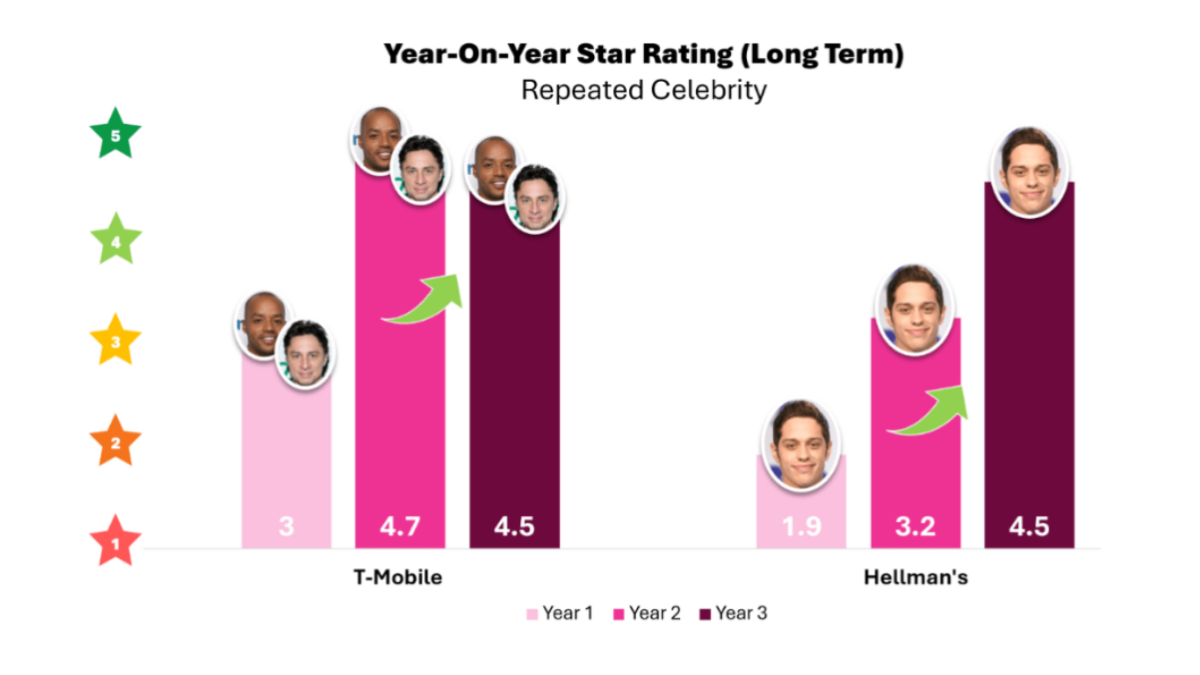
In The Creative Dividend, System1 and Effie explore the many benefits of consistency in advertising. This includes consistent positioning, agency tenure, cross channel consistency, fluent device and celebrity tenure and more. We’ve seen this play out on the Super Bowl as well, like Budweiser using the Clydesdales year after year, Red Bull bringing its recognizable animation style to game night and T. Mobile Home Internet featuring Zach Braff and Donald Faison singing and dancing through the neighborhood streets alongside other celebrity guests.
Just like recurring characters, celebrity spokespersons need time to wear in. And when they’re given that time, they improve in effectiveness, driving long-term market share growth. They become closely associated with your brand and you reap the benefits of eliciting intense, positive emotions with each new adventure you take them on.
- Is there reputational risk associated with the celebrity?
Your celebrity spokesperson is a reflection of your brand. Their actions and public statements can spiral into scandal and newsworthy headlines that distract from your message or worse, turn consumers against it due to your brand’s association with the public figure. When was the last time your talent was in the news, and was the sentiment positive or negative?
For this reason, brand-owned characters are the safer investment compared to celebrities. Your marketing team is fully in control of where fluent devices show up, what they look like, what they say and do, etc. But celebrities will always be an attractive option for advertisers, especially for major moments like the Super Bowl.
When working with celebrity partners, whether romantic or business, another consideration is whether their relationship will stand the test of time. Ben Affleck and Jennifer Lopez’s very public (and second) split meant that Dunkin’ needed to make a choice after featuring the couple in several ads. Affleck, a long-time fan and feature for the brand, returned for a Super Bowl ad the year following his breakup with Lopez. We can only hope that Zach Braff and Donald Faison remain friends forever so that T. Mobile Home Internet doesn’t need to kick one out of the neighborhood.
The strategies outlined above give your brand a better understanding of how to best leverage celebrity talent and watchouts to consider. While the players are undoubtedly the stars of the game, celebrities hope to be the effectiveness stars of the ad break.
Pre-testing can help brands predict and improve the commercial impact of their Super Bowl ads as well as dig deeper into whether a celebrity is driving positive emotion, supporting brand recognition and maximizing commercial impact.
Create with Confidence®
Each year, System1 tests every Super Bowl ad with our Test Your Ad Competitive Edge platform. Subscribe to see all the latest additions to our Super Bowl LX topical category, where you can filter the rankings by Star (predicted long-term impact), Spike (predicted short-term impact), Fluency Rating (strength of branding) and more.
Featuring more than 100,000 ads, it’s the world’s largest database of emotional norms, enabling brands to compare, benchmark and be inspired by best-in-class creative.
Powered by System1’s AI search, you can find star-studded Super Bowl ads with ease and see which were most effective at driving brand recognition, short-term sales potential and long-term brand-building potential.
Who will be the stars of Super Bowl LX? Join System1’s post-game webinar on Monday, February 9 to see which ads were the top performers and why, plus a look at seven years of Super Bowl advertising effectiveness to inspire your next campaign.