• About
    • About Us
    • Leadership Team
  • Products
    • Test Your Ad
    • Test Your Ad Screen
    • Test Your Ad Competitive Edge
    • Test Your Innovation
    • Test Your Brand
    • Case Studies
    • Methodology
  • Insights
    • Latest & Upcoming
    • Christmas Ads
    • The Creator Effectiveness Playbook
    • The Creative Dividend – Effie
    • The Startling Power of Surprise
    • Super Bowl 2027 Ads
    • Orlando Wood
    • Brands On Top
    • Advertising Principles Explained
    • Lemon
    • Look Out
    • Achtung! How to attract and sustain attention
    • Advertising Effectiveness
    • Living Room Legends – ITV
    • Putting on a Show – Aardman
    • The Extraordinary Cost of Dull
    • The Cure for Dull
    • The Multiplier Playbook
    • Compound Creativity
    • Category Insights
    • How Creativity Boosts ROI
    • Ritson on Ad Effectiveness
    • Sports Sponsorship
    • Unlocking Profitable Growth
    • Cultural Moments
    • Super Bowl 2027 Ads
    • The 12 Gifts of Christmas
    • Olympics Advertising
    • Olimpíadas (Portuguese)
    • World Cup
    • Futebol (Portuguese)
    • Media Channels
    • Audio
    • Digital – TikTok
    • Digital – Pinterest
    • OOH – JCDecaux
    • TV
    • Representation
    • Seeing Gen Z
    • Feeling Seen USA
    • Feeling Seen UK
    • Wise Up!
    • Sustainability
    • The Greenprint USA
    • The Greenprint
    • The Greenprint Brazil
  • News & Events
    • News
    • Ad Of The Week
    • Innovation Of The Week
    • Blog
    • Uncensored CMO
    • In The Press
  • Investors
    • Investor Info
    • The Board
    • ESG
  • Work With Us
    • Careers
    • Culture
  • Contact Us
    • Get In Touch
    • Offices
Request a Demo
  • About
    • About Us
    • Leadership Team
  • Products
    • Test Your Ad
    • Test Your Ad Screen
    • Test Your Ad Competitive Edge
    • Test Your Innovation
    • Test Your Brand
    • Case Studies
    • Methodology
  • Insights
    • Latest & Upcoming
    • Christmas Ads
    • The Creator Effectiveness Playbook
    • The Creative Dividend – Effie
    • The Startling Power of Surprise
    • Super Bowl 2027 Ads
    • Orlando Wood
    • Brands On Top
    • Advertising Principles Explained
    • Lemon
    • Look Out
    • Achtung! How to attract and sustain attention
    • Advertising Effectiveness
    • Living Room Legends – ITV
    • Putting on a Show – Aardman
    • The Extraordinary Cost of Dull
    • The Cure for Dull
    • The Multiplier Playbook
    • Compound Creativity
    • Category Insights
    • How Creativity Boosts ROI
    • Ritson on Ad Effectiveness
    • Sports Sponsorship
    • Unlocking Profitable Growth
    • Cultural Moments
    • Super Bowl 2027 Ads
    • The 12 Gifts of Christmas
    • Olympics Advertising
    • Olimpíadas (Portuguese)
    • World Cup
    • Futebol (Portuguese)
    • Media Channels
    • Audio
    • Digital – TikTok
    • Digital – Pinterest
    • OOH – JCDecaux
    • TV
    • Representation
    • Seeing Gen Z
    • Feeling Seen USA
    • Feeling Seen UK
    • Wise Up!
    • Sustainability
    • The Greenprint USA
    • The Greenprint
    • The Greenprint Brazil
  • News & Events
    • News
    • Ad Of The Week
    • Innovation Of The Week
    • Blog
    • Uncensored CMO
    • In The Press
  • Investors
    • Investor Info
    • The Board
    • ESG
  • Work With Us
    • Careers
    • Culture
  • Contact Us
    • Get In Touch
    • Offices
  • World Cup
    World Cup

What's the formula for a winning World Cup ad?

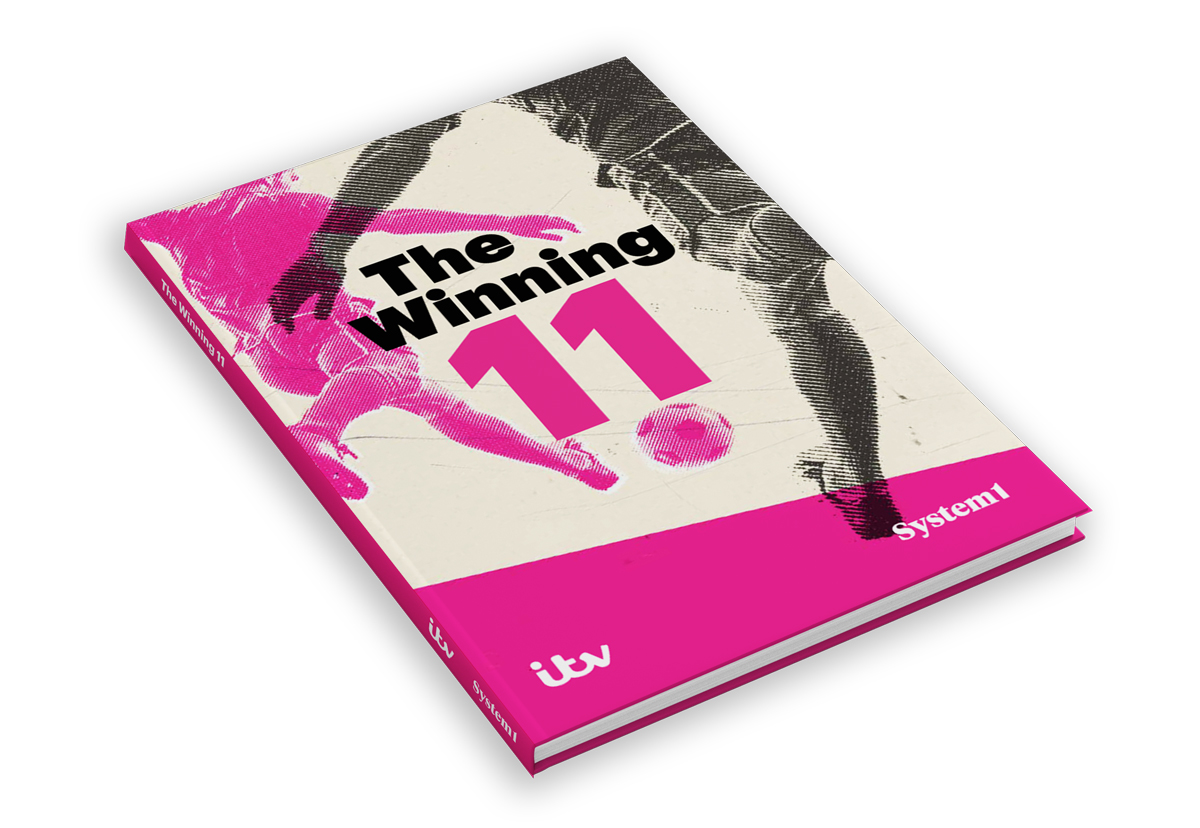
We’ve compiled our strongest Winning 11, a study that gives you 11 guiding principles for developing winning advertisements, inspired by our passion of football and informed by our ad effectiveness measuring knowledge. These players (OK, strictly speaking, principles) can assist you in delivering a championship-winning performance in your upcoming campaigns.

"Inspired by our love of football and informed by our predictive measures for short- and long-term impact, we have pulled together our strongest Starting 11. As well as looking at great ads from recent sports events we’ve gone back to some of the brilliant World Cup work of the past to see which commercials still hit the spot and which approaches wouldn’t work so well today."

Rebecca Hatherall​
Jon Evans Chief Customer Officer, System1

Download The Winning 11 Report

These insights within this guide will provide you with the tools you need to attract as many eyes on your campaigns this Winter as possible.

In Partnership With ITV

How to Win at the World Cup

The World Cup always provides a large commercial opportunity for brands, so there’s no better time to launch a 5-Star campaign that both new and old customers can enjoy and engage with. Our panel discussion with ITV and Zenith goes into detail on how to create an ad worthy of a World Cup.

Blog Posts

Ad Of The Week
15 December 2022

Brazil’s Vivo Goes For Goal With 2022’s Top World Cup Ad

...

...

Tom Ewing
Tom Ewing
Editor in chief
Read more

Other Campaigns

World Cup

Super Bowl LIX

Analyzing the big game’s brand-building ads

Find Out More
The Gift of Great Christmas Creative

Christmas

How to Ace your Christmas Advertising

Find Out More
Feeling Seen UK

Feeling Seen UK

Diversity in Advertising a guide to getting it right

Find Out More
FAQs

What is The Winning 11?

The Winning 11 is a System1 report, created in partnership with ITV, that sets out 11 principles for making effective advertising around major sporting events. Each principle is paired with an “Ad Spotlight”: a real example from a World Cup, Olympics, Rugby World Cup or other big event, or a great ad that holds the same lesson. All of the ads were tested using System1’s Test Your Ad platform. 

Who is The Winning 11 for?

It is for brands, marketers and agencies planning advertising around a major sporting event. The principles cover strategy (reach, emotion, branding and audience) and execution (characters, music, cultural references and endings), and the report closes with advice on testing before you launch. 

Why was The Winning 11 created for the 2022 World Cup?

The 2022 tournament was the first ever Winter World Cup, so it landed at the highest-spending time of the year. Match schedules overlapped with Christmas, which raised creative questions (combine Christmas and football, or keep them separate?) and media questions (how to stand out, respond to the mood of the tournament and use context to boost impact). ITV expected big audiences, more shared viewing, and a chance to reach younger and more affluent viewers, plus a new audience energised by the Lionesses’ Euro 2022 win. The report distils lessons from previous big events to help brands make the most of that opportunity. 

What are the 11 principles in The Winning 11?

The 11 principles are: 

  • 1. Build a Legacy: the most effective advertising is broad and long-term. Aim for fame and fortune follows. 
  • 2. Play the Beautiful Game: make emotional ads and entertain for commercial gain. 
  • 3. Choose Your Strongest Side: use your distinctive brand assets consistently so people recognise you quickly. 
  • 4. Big Games Need Big Characters: ads with recurring characters or scenarios (Fluent Devices) are more effective. 
  • 5. Play to the Crowd: keep your target audience as wide as possible. 
  • 6. Play with Passion: look for the human emotional story. 
  • 7. Great Teams Need Great Communication: use “betweenness”, the spoken and unspoken communication among characters. 
  • 8. Sing When You’re Winning: use music that is melodic and memorable. 
  • 9. Culture Is Your 12th Man: draw on cultural references for greater emotional response. 
  • 10. Be a Great Finisher: end your story well, with a happy ending and negative feeling resolved. 
  • 11. Be Ready to Win: do your homework and test your ads with the public before launch. 

Why does long-term reach matter for sports event advertising?

Advertising works over the long term and the short term, but its most important effects, improved pricing power and increased market share, accumulate over the long term. Brands achieve these effects with advertising that is consistent, emotionally engaging and broad in reach. Reach matters most because it touches people beyond those currently in the market, who may become future customers. The report notes that TV remains the keystone channel for broad reach, citing the 2018 Profit Ability study (Ebiquity and Gain Theory), which found TV to be the most effective and efficient advertising medium. Results are best when TV is used alongside online channels. 

Which ad is the example of building a legacy?

P&G’s “Thank You, Mom” (Olympics, 2012). It turned the “Proud Sponsor of Moms” tagline into a film about the hope, dedication and heartbreak of raising an athlete, gained huge reach online and on TV, and became a multi-year campaign. P&G later said it was the most effective ad in its 100+ year history, and when System1 tested a decade of Cannes Lions winners for emotional response in 2019 it still came out on top. 

Do emotional ads really work better than rational ones?

Yes. In The Long and the Short of It, Les Binet and Peter Field analysed decades of IPA Award-entered work and found that advertising using an emotional approach was twice as likely to achieve long-term profit growth as work that took a rational approach or mixed the two. Emotional ads are more likely to be noticed and lodge in long-term memory, which increases brand salience across a wide audience. The report’s guidance is simple: if people feel nothing, they do nothing, so leave your audience feeling happy and entertain for commercial gain. 

How can a sports event ad build strong branding without losing the entertainment?

The report says effective advertising is more than sponsorship: aim for strong, consistent branding without dampening interest in the entertainment you are providing. Your brand is recognised through a whole set of distinctive assets, such as shapes, names, colours, slogans, jingles and characters, and the stronger the association with your brand, the more effective they are. Identifying your assets and using them consistently is a foundation of effective advertising. Nike’s 1998 World Cup ad “Airport” is the example: it uses famous players as brand assets, shows them doing something unexpected that exaggerates their real-life images, and still scores 4 Stars 24 years on. 

What is a Fluent Device and why should it be in your sports ad?

Fluent Devices are recurring characters or scenarios, such as the GEICO Gecko, the Smash Martians or the Compare the Market meerkats, that make a brand quicker and easier to recognise. They have become less popular with advertisers but remain the most effective kind of brand asset: a campaign that uses a Fluent Device is over 30% more likely to drive profitable growth than one that does not. At sporting events, Fluent Devices often take a back seat to event-specific creative devices, which the report calls a mistake. Carlsberg’s 2014 “Kickabouts” is the example of staking a claim to a sports event while still building the brand’s usual identity, and it still scores as 4-Star entertainment. 

Should World Cup ads target young male football fans?

No. The report warns against concentrating on a stereotypical young, male audience, because the audience for big sports events is much wider than core fans. Over 27 million people tuned in to ITV’s coverage of the Euro 2020 semi-final between Denmark and England, and the Italy v England final recorded the highest viewing figures of the 21st century. Big events draw in casual fans, particularly when there is a strong narrative such as a national team doing well, so great advertising entertains across demographics. Pepsi’s “Dare For More” (2006 World Cup) is the example: it does not rely on knowing or caring about football, and still earns a strong 4-Star score today. 

What kind of story works best in a sports event ad?

A human emotional story. Individual players, acts of skill and the event’s location are common features of sports advertising, but the report says they are no substitute for an emotional story with broader appeal. At the 2019 Rugby World Cup, many ads leaned on the Japanese location, while the highest-scoring ad, from ball manufacturer Gilbert, ignored location and players to tell the story of a young fan saving up for their dream ball. It is the report’s example of a 5-Star ad that finds an emotional journey beyond sporting specifics. 

What is “betweenness” in advertising?

Betweenness is the communication, spoken and unspoken, among the characters in an ad. Drawing on Orlando Wood’s books Lemon and Look Out, the report explains that emotionally powerful advertising contains features that appeal to the right brain, which pays broad attention and focuses on relationships between people and things. Your ad should be “a window on a living world”, not just a shop window for your product. Nike’s “Dream Further” (Women’s World Cup, 2019), the highest-scoring ad of that tournament, opens and closes with looks and gestures between a young mascot and the player she walks out with. 

What kind of music works best in an ad?

Melodic and memorable music. The report says an ad’s soundtrack makes a big difference to how it is received, and that melodic or harmonic music wins the right brain’s attention. Highly rhythmic soundtracks tend to be less effective, particularly when they dictate the editing and pace and make the ad feel jerky and fragmented. A familiar track can be a real asset, and if the sport has a tradition of fans singing or chanting, drawing on it can work very well. Lucozade’s “Three Lionesses” (Women’s World Cup, 2019), a female makeover of “Three Lions”, is the example. 

How should brands use cultural references?

Sport does not exist in a vacuum, and international tournaments tap into the culture of the countries taking part. The right brain delights in spotting something familiar in an unexpected situation, so references can be irreverent, affectionate or given a modern twist, and parody and pastiche are a pleasure for audiences. Ads set in a distinctive time or place tend to be very emotionally engaging, while non-descript, generic settings tend to feel flat. Mars’ 2010 World Cup ad is the example: it recreated John Barnes’ rap from New Order’s “World In Motion” and the original video too, with Keith Allen bobbing up and down behind him. 

How should a sports ad end?

With a happy ending and any negative emotion resolved. The report cites Daniel Kahneman’s peak-end rule: the impression we take away from an experience combines its most intense moment and its end. A last-minute twist, an emotional climax or a final joke are all good ways to finish. The report also advises resolving any negative feeling you introduced for tension, and being careful with the closing shot, since lingering on a pack shot or logo for too long can deflate emotion. Nike’s “You Can’t Stop Sisters” (US Open, 2020), which overwrote the “You Can’t Stop Sport” slogan at its climax, is the example. 

Why should you test your ad before it airs?

Researching ads with the public to gauge emotional response is the best way to maximise effectiveness. The report argues that most traditional metrics do not predict long-term effectiveness and only lead to more conservative advertising, and that there is a big difference between populist ads that many people love and average work that satisfies enough people to tick a box. Guinness’ “Basketball” (2015) was researched with System1 from the animatic stage, and suggestions such as reducing the voiceover helped lift its emotional response. It went on to score 5 Stars and win an IPA award. 

How does System1 measure emotional response to ads?

System1 asks people directly how an ad made them feel, using a method derived from psychologist Paul Ekman’s facial coding research. Viewers choose one of seven basic emotions (happiness, fear, disgust, anger, surprise, contempt and sadness) or neutral from a pictorial scale designed for fast and frugal mental processing. This differs from automated facial coding, which uses an algorithm to estimate how audiences feel. Neutral is included because an ad can leave an audience unmoved. 

What is a System1 Star Rating?

The Star Rating translates an ad’s emotional profile into a score from 1 to 5. Positive weights are applied to happiness and surprise, and negative weights to neutrality and the other emotions. A 1-Star ad is weak, with no likely growth amplification, while a 5-Star ad produces a strongly positive emotional response with strong growth-amplification potential. Assuming Excess Share of Voice (ESOV) of 10% and average competitor ad quality, projected share gains are 0% for 1 Star, 0.5% for 2 Stars, 1% for 3 Stars, 2% for 4 Stars and 3% for 5 Stars. 

Does emotional response really predict market share growth?

In System1’s UK cereals example, Extra Share of Voice (a brand’s share of voice minus its share of market) alone showed a correlation of 0.25 with actual value market-share change 12 months later. When emotional response to the ads (Star Rating) was factored in alongside the quantity of advertising, the correlation rose to 0.83. In short, quantity and quality of advertising together predict share change with much greater confidence than quantity alone. The report points to Orlando Wood’s Lemon (IPA, 2019) for a fuller explanation of the model. 

Which classic ads from The Winning 11 still score well today?

Several spotlight ads still perform strongly when tested now: 

  • P&G “Thank You, Mom” (Olympics, 2012): came out on top when System1 tested a decade of Cannes Lions winners in 2019. 
  • Nike “Airport” (1998 World Cup): still scores 4 Stars. 
  • Carlsberg “Kickabouts” (2014 World Cup): still 4-Star entertainment. 
  • Pepsi “Dare For More” (2006 World Cup): still scores a strong 4 Stars. 
  • Gilbert “Rugby Memories” (Rugby World Cup, 2019): a 5-Star ad and the highest scorer of that tournament. 
  • Guinness “Basketball” (2015): a 5-Star ad that also won an IPA award. 

The report also notes that some past World Cup work has not aged well: Carlsberg’s macho 2010 “Team Talks” is a turn-off for modern audiences. 

What is System1’s Test Your Ad platform?

Test Your Ad is System1’s platform for predicting the short- and long-term effectiveness of advertising within 24 hours. It works at any stage of development, from creative concepts to finished films, and System1 can give creative guidance throughout the process and suggest improvements designed to lift an ad’s Star Rating. All of the ads featured in The Winning 11 were tested with it. 

Featured Products

Test Your Brand (old)
Test Your Ad

Empowering every marketer
to create great advertising

Test Your Ad is the testing platform for marketers who want to make brilliantly effective ads. Next day predictions, intuitive metrics, and diagnostics you can use.

Test Your Ad
Test Your Ad (old version)
Test Your Innovation

5-Star Innovation is
80% familiar, 20% new

Which idea deserves investment? From tweaked taglines to category-changing innovations, Test Your Innovation picks winners at every scale.

Test Your Innovation
Test Your Ad (old version)
Test Your Brand

Improve brand health.
Predict brand growth

Clear, predictive measures that let you understand brand health, predict future performance and improve and inform your brand strategy.

Test Your Brand
FANCY A CLOSER LOOK?

Request a demo
with one of our experts

Complete the form to book your demo.

  • Discuss your use cases and business needs
  • Our expert will give a hands-on demonstration of the platform
  • We’ll show how deep consumer insights can guide your marketing strategy

Get the Ad Of The Week in your inbox

By subscribing you agree to the use of your data in accordance with our privacy policy

Got a specific question? Get in touch

Services are conducted in accordance with ISO 20252 and MRS standards.

  • Instagram icon
  • Privacy & Cookies
  • Terms & Conditions
  • Corporate Social Responsibility
  • Contact
  • Modern Slavery Statement
  • Company Info
  • Financial Info
  • Share Details
  • Investor News
  • Shareholder Info
  • Corporate Governance
  • AIM Rules

Please note that www.system1group.com is the official and trusted source for information about our company and services. Exercise caution when accessing information from other sources.

© 2026 System1 Group PLC. All rights reserved.