• About
    • About Us
    • Leadership Team
  • Products
    • Test Your Ad
    • Test Your Ad Screen
    • Test Your Ad Competitive Edge
    • Test Your Innovation
    • Test Your Brand
    • Case Studies
    • Methodology
  • Insights
    • Latest & Upcoming
    • The Creator Effectiveness Playbook
    • The Creative Dividend – Effie
    • The Startling Power of Surprise
    • Super Bowl 2027 Ads
    • Orlando Wood
    • Advertising Principles Explained
    • Lemon
    • Look Out
    • Achtung! How to attract and sustain attention
    • Advertising Effectiveness
    • Living Room Legends – ITV
    • Putting on a Show – Aardman
    • The Extraordinary Cost of Dull
    • The Cure for Dull
    • The Multiplier Playbook
    • Compound Creativity
    • Category Insights
    • How Creativity Boosts ROI
    • Ritson on Ad Effectiveness
    • Sports Sponsorship
    • Unlocking Profitable Growth
    • Cultural Moments
    • Super Bowl 2027 Ads
    • The 12 Gifts of Christmas
    • Olympics Advertising
    • Olimpíadas (Portuguese)
    • World Cup
    • Futebol (Portuguese)
    • Media Channels
    • Audio
    • Digital – TikTok
    • Digital – Pinterest
    • OOH – JCDecaux
    • TV
    • Representation
    • Seeing Gen Z
    • Feeling Seen USA
    • Feeling Seen UK
    • Wise Up!
    • Sustainability
    • The Greenprint USA
    • The Greenprint
    • The Greenprint Brazil
  • News & Events
    • News
    • Ad Of The Week
    • Blog
    • Uncensored CMO
    • In The Press
    • Upcoming Events
    • TMRE 2026
    • ANA Masters of Marketing 2026
  • Investors
    • Investor Info
    • The Board
    • ESG
  • Work With Us
    • Careers
    • Culture
  • Contact Us
    • Get In Touch
    • Offices
Request a Demo
  • About
    • About Us
    • Leadership Team
  • Products
    • Test Your Ad
    • Test Your Ad Screen
    • Test Your Ad Competitive Edge
    • Test Your Innovation
    • Test Your Brand
    • Case Studies
    • Methodology
  • Insights
    • Latest & Upcoming
    • The Creator Effectiveness Playbook
    • The Creative Dividend – Effie
    • The Startling Power of Surprise
    • Super Bowl 2027 Ads
    • Orlando Wood
    • Advertising Principles Explained
    • Lemon
    • Look Out
    • Achtung! How to attract and sustain attention
    • Advertising Effectiveness
    • Living Room Legends – ITV
    • Putting on a Show – Aardman
    • The Extraordinary Cost of Dull
    • The Cure for Dull
    • The Multiplier Playbook
    • Compound Creativity
    • Category Insights
    • How Creativity Boosts ROI
    • Ritson on Ad Effectiveness
    • Sports Sponsorship
    • Unlocking Profitable Growth
    • Cultural Moments
    • Super Bowl 2027 Ads
    • The 12 Gifts of Christmas
    • Olympics Advertising
    • Olimpíadas (Portuguese)
    • World Cup
    • Futebol (Portuguese)
    • Media Channels
    • Audio
    • Digital – TikTok
    • Digital – Pinterest
    • OOH – JCDecaux
    • TV
    • Representation
    • Seeing Gen Z
    • Feeling Seen USA
    • Feeling Seen UK
    • Wise Up!
    • Sustainability
    • The Greenprint USA
    • The Greenprint
    • The Greenprint Brazil
  • News & Events
    • News
    • Ad Of The Week
    • Blog
    • Uncensored CMO
    • In The Press
    • Upcoming Events
    • TMRE 2026
    • ANA Masters of Marketing 2026
  • Investors
    • Investor Info
    • The Board
    • ESG
  • Work With Us
    • Careers
    • Culture
  • Contact Us
    • Get In Touch
    • Offices
  • The Long and the Short (form) of It
    The Long and the Short (form) of It
Download the Research

How can advertising stop the scroll and grow brands?

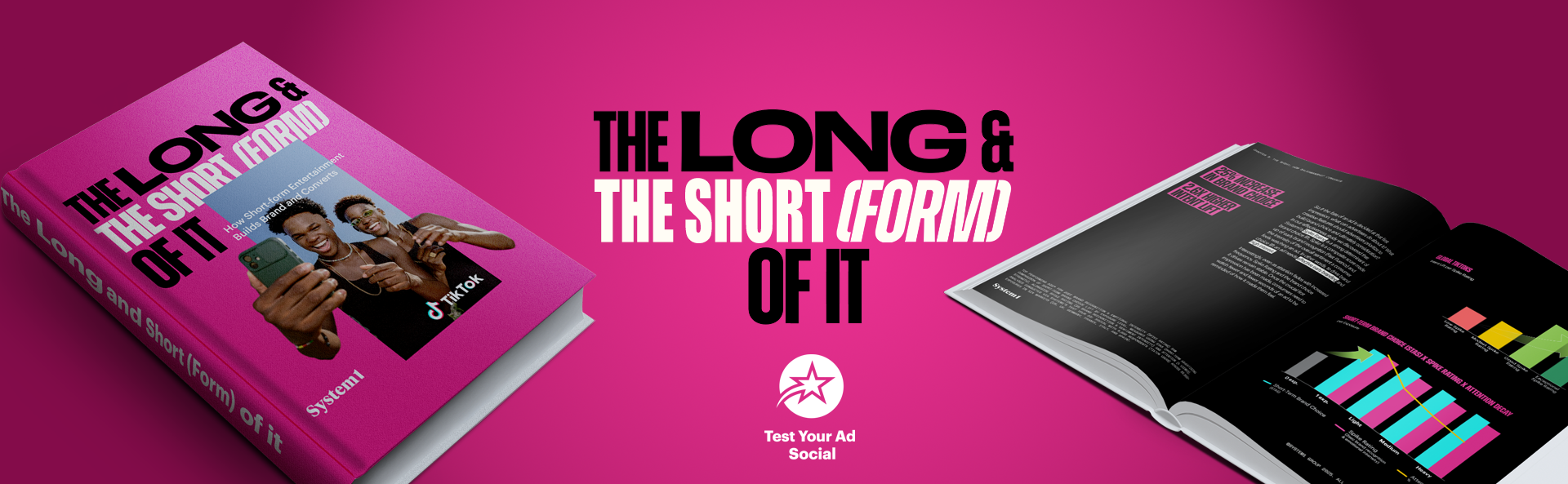
Unlock the keys to short-form video ad success with The Long and Short (form) of it, a new global whitepaper from System1 and TikTok that builds on Les Binet and Peter Field’s insights from The Long and Short of It. ​

Using System1’s Test Your Ad Social platform, we analyzed emotional responses to 887 global short-form video ads from over 92,000 TikTok users, and matched these responses to 350+ in-market result studies.

Key findings:

  • Creator ads win attention, early branding maximizes its impact​
  • Entertainment drives both the long and the short​
  • The enemy of conversion isn’t dislike, it’s indifference​
  • Branding done right isn’t a tax on attention, it’s a dividend​

Submit your details to download the full whitepaper launched at the Cannes Lions Festival. 

Watch the webinar

Join System1’s Josh Fruttiger and TikTok’s Esteban Ribero for a closer look at how entertainment, early and effective branding and frequency help ads win across the funnel.

We shared key findings from The Long and Short (form) of It, a new global whitepaper from System1 and TikTok that builds on Les Binet and Peter Field’s insights from The Long and Short of It. ​

Download the full whitepaper below.

Predict and understand your digital creative to help you better understand and improve the performance of all elements of your campaign. Test Your Ad either among the general population, or custom samples to gain insights from specific target audiences.

Learn more about Test Your Ad
FAQs

What is The Long and the Short (Form) of It?

The Long and the Short (Form) of It is a global research report from System1 and TikTok that builds on Les Binet and Peter Field’s seminal 2013 paper, The Long and the Short of It: Balancing Short- and Long-Term Marketing Strategies. Where Binet and Field established the what and why of balancing brand-building and sales activation, this report tackles the form: how short-form video ads on platforms like TikTok can be built to do both. It’s the first study to combine System1’s deep creative analysis with TikTok’s in-market brand and conversion data at this scale. 

Methodology

The report draws on two large-scale global studies conducted by System1 and TikTok. 

The first, Global Impactful Entertainment 2025, used System1’s Test Your Ad Social platform to test 887 short-form video ads across eight verticals (CPG, Retail, Tech, Telco, Travel, FinServe, Auto and QSR) in eight markets (US, UK, Germany, France, Italy, Spain, Brazil and Mexico). It involved 84,788 TikTok users and was matched to 239 Brand Lift Studies and 119 Conversion Lift studies, plus platform metrics like view-through rate. 

The second, Understanding Creative Fatigue 2025, deliberately induced creative fatigue in a controlled environment, exposing 8,000 TikTok users across six markets to 40 ads at varying frequencies (1st, light, medium and heavy exposure) to measure how short- and long-term effectiveness holds up under repetition. 

Test Your Ad Social measures how ~150 social platform users feel after viewing a short-form ad, how much attention it holds, and how quickly they can correctly identify the brand. Its three key metrics are: 

  • Star Rating: the type of emotional response felt, predicting an ad’s long-term brand-building impact. 
  • Spike Rating: whether an ad brands early enough and the intensity of the emotional response, predicting short-term impact. 
  • Fluency Rating: correct brand attribution after 2 seconds and after skipping. 

What's the difference between Showmanship and Salesmanship?

Showmanship and Salesmanship are two sets of creative features, defined by System1’s Chief Creative Officer Orlando Wood in his books Lemon (2019) and Look Out (2021), that pull advertising in different directions. 

Showmanship (entertaining) features put on a show for the viewer rather than assuming their interest. They include: characters acting, a story unfolding, entertaining language, spontaneous changes in facial expression, a recognizable place, a hummable tune, people interacting, a pause or soft/hushed voice, and something out of the ordinary. 

Salesmanship features assume the viewer is already interested and speak to people in “buying mode.” They include: many words on screen, someone talking directly to the viewer, lots of fast-cut scenes, a divided or split screen, facts/figures/comparisons, useful information, a focus on a product, and a call to action. 

The research finds that Showmanship builds brands, while Salesmanship converts, but the most effective short-form ads use both. 

Has advertising become less entertaining over time?

Yes. Analysis of over 1,000 UK TV ads from 2004–2023 shows Salesmanship (left-brain) features have steadily risen while Showmanship (right-brain) features have declined since the mid-2000s. Short-form video presents a chance to reverse this trend, since in a skippable environment, entertaining ads have to earn attention rather than assume it. 

Do more entertaining short-form ads build stronger brands?

Yes, significantly. Comparing the most entertaining ads (top 25% for Showmanship features) to the least entertaining (bottom 25%), the most entertaining ads deliver: 

  • +39% Memory Lift 
  • 2x Brand Awareness Lift 
  • 2.8x Brand Image Lift 

They also drive +40% Star Rating (positive sentiment) and +54% Attention, and ads in the top quartile for sentiment and attention see correspondingly larger brand lifts (up to 3x for Brand Image).

Does branding early hurt attention on short-form video?

No, contrary to popular belief, early branding does not come at the cost of attention. Ads with exceptional early branding (Fast Fluency in the first 2 seconds) versus weak early branding drive: 

  • +88% Memory Lift 
  • +92% Brand Awareness Lift 
  • +85% Brand Image Lift 

Viewers are savvy and expect ads to be ads, so branding early, as long as it feels natural rather than forced, reduces confusion and builds stronger, more distinct memories. 

Does entertaining creative help fight creative fatigue?

Yes. Ads with exceptional early branding see 48% less negative sentiment, 57% more happiness, and 19% less attention decay at heavy exposure compared to first exposure. Similarly, the most entertaining ads are 2x as effective at holding initial positive sentiment at heavy exposure versus the least entertaining ads. 

High frequency doesn’t fix weak creative, it compounds whatever is already there. Strong ads (4+ Star Rating on first exposure) keep building brand equity across repeat exposures, while weak ads (1 Star) generate little to no useful positive sentiment even at first exposure, and that gap widens with frequency. 

Refreshing the same creative idea with entertaining variety (rather than running one asset unchanged) also sustains brand-building potential better at higher frequencies than running the same execution repeatedly. 

What drives conversion on short-form video?

The first impression is make-or-break. Short-form ads deliver an 88% lift in Brand Choice (measured via STAS, Short-Term Advertising Strength) from the very first exposure, and this ceiling is set almost entirely by that first impression. Frequency can reinforce a strong start but can’t rescue a weak one. Ads in the top quartile for Brand Choice lift after one exposure go on to lift brand choice at roughly 4.5x the rate of the bottom quartile, even after further exposures. 

The strongest predictor of both brand choice and intent is System1’s Spike Rating, a composite of early brand recognition and emotional intensity. Ads with exceptional Spike Rating see a 25% increase in Brand Choice Lift and 2.6x higher intent lift versus ads with low Spike Rating. 

Interestingly, higher view-through doesn’t mean more conversions. There’s a negative relationship between view-through and conversion lift (-51% for highest vs. lowest view-through), because top-converting ads are often designed to make their point quickly and prompt action rather than hold attention for its own sake. 

Does Salesmanship actually convert better?

Yes, ads with the highest levels of Salesmanship features drive 88% higher conversion lift than ads with the lowest levels. But even ads built to sell aren’t immune to being ignored: dull, neutral-sentiment ads are 27% less effective at driving conversion. As the report puts it: the enemy of conversion isn’t dislike, it’s indifference. Whether the sentiment is positive or negative, ads need to make people feel something. 

Do marketers have to choose between entertaining and selling?

No. This is one of the report’s central findings. The most entertaining short-form ads (top quartile for Showmanship features) don’t just build brand, they also convert better: 

  • +39% Memory Lift 
  • 2x Brand Awareness Lift 
  • 2.8x Brand Image Lift 
  • +50% Conversion Lift 

By contrast, ads built around Salesmanship features convert only marginally better but come with a hidden cost to brand: -8% Memory Lift, -50% Brand Awareness Lift and -23% Brand Image Lift versus low-Salesmanship ads. Entertainment is the one creative approach shown to drive both brand-building and conversion at once. It’s a strategic imperative, not a trade-off. 

Does brand size change what creative strategy works?

Yes. Brand size shapes what creative needs to do: 

  • Category leaders benefit from a “tailwind” of existing brand equity. Salesmanship hurts their Brand Awareness less (-26% vs. -76% for challengers/contenders) and can even lift Brand Image (+45%). Their equity also means Salesmanship and strong early branding are especially effective at driving conversion for them. 
  • Challenger and contender brands don’t have that cushion. Salesmanship disproportionately hurts their brand-building (-76% Brand Awareness Lift), so they need to lean harder into entertainment and distinctive, early branding. When they get it right, “Distinct Entertainment” (top-quartile Showmanship plus early branding) delivers up to 4x Brand Image Lift and erases the brand-size gap in positive sentiment entirely — the most entertaining ads score equally well (2.8 Star Rating) regardless of brand size. 

For conversion, entertainment gives challenger/contender brands an outsized advantage (2.4x conversion lift from Showmanship) since they lack the latent equity that lets category leaders lean on Salesmanship (3.5x conversion lift) instead. 

What's the most effective way to brand an ad early without hurting attention?

Not all distinctive assets are equal. Logos are the most recognizable asset but carry one of the highest attention costs, likely because years of logo-first ads have trained viewers to swipe past them. The best-performing assets combine strong recognition and strong attention: logo in context, spoken brand name, sonic assets, brand music/jingles, and fluent characters. 

In terms of Brand Awareness Lift specifically, when present in the first two seconds: sonic assets (+191%), logo in context (+182%), fluent characters (+57%) and jingles (+40%) perform best, while a bare logo (-30%) and brand font alone (-33%) actually correlate with lower Brand Awareness Lift. 

There’s also a sweet spot for quantity: ads that use up to 4 distinctive assets in the first 2 seconds see roughly 2x the brand recognition of ads using just 1, with limited attention decline. Beyond 4 assets, attention starts to drop off significantly. 

How do creator-led ads compare to brand-made ads?

Creator-led ads earn 39% more attention than traditional brand ads (e.g., repurposed TVCs), but TikTok users can correctly identify the brand at roughly half the rate. Creators are an attention opportunity with a branding gap. 

The fix is well-branded creator content: creator-led ads with exceptional early branding deliver 2.3x more Brand Awareness Lift and 3x more Brand Image Lift than poorly-branded creator ads, bigger gains than the equivalent uplift for brand-traditional or brand-native content. When challenger and contender brands combine creator-led formats with strong early branding and positive sentiment, Brand Awareness Lift can reach 11x the weak baseline.

What are the report's key takeaways?

  1. Entertainment, and the attention and sentiment it drives, builds brands and combats creative fatigue. 
  2. Entertainment drives both the long and the short: selling doesn’t have to be transactional; it can put on a show, and when it does, brands and consumers both win. 
  3. The first impression is make or break: frequency can reinforce but can’t rescue a weak start. 
  4. The enemy of conversion isn’t dislike, it’s indifference: dull ads drive 27% fewer conversions. 
  5. Branding done right isn’t a tax on attention, it’s a dividend: distinctive, well-integrated early branding earns recognition fast without sacrificing attention. 
  6. Creator ads win attention; early branding maximizes its impact: pairing creator reach with distinctive branding is a powerful path to outperformance, especially for challenger and contender brands. 

In short: Entertainment = Effectiveness. 

Get in touch

Want to make 5-Star Marketing? Need to understand your customers better? Interested in knowing more about anything we do?

We’d love to hear from you.

Contact Us
FANCY A CLOSER LOOK?

Request a demo
with one of our experts

Complete the form to book your demo.

  • Discuss your use cases and business needs
  • Our expert will give a hands-on demonstration of the platform
  • We’ll show how deep consumer insights can guide your marketing strategy

Get the Ad Of The Week in your inbox

By subscribing you agree to the use of your data in accordance with our privacy policy

Got a specific question? Get in touch

Services are conducted in accordance with ISO 20252 and MRS standards.

  • Instagram icon
  • Privacy & Cookies
  • Terms & Conditions
  • Corporate Social Responsibility
  • Contact
  • Modern Slavery Statement
  • Company Info
  • Financial Info
  • Share Details
  • Investor News
  • Shareholder Info
  • Corporate Governance
  • AIM Rules

Please note that www.system1group.com is the official and trusted source for information about our company and services. Exercise caution when accessing information from other sources.

© 2026 System1 Group PLC. All rights reserved.