
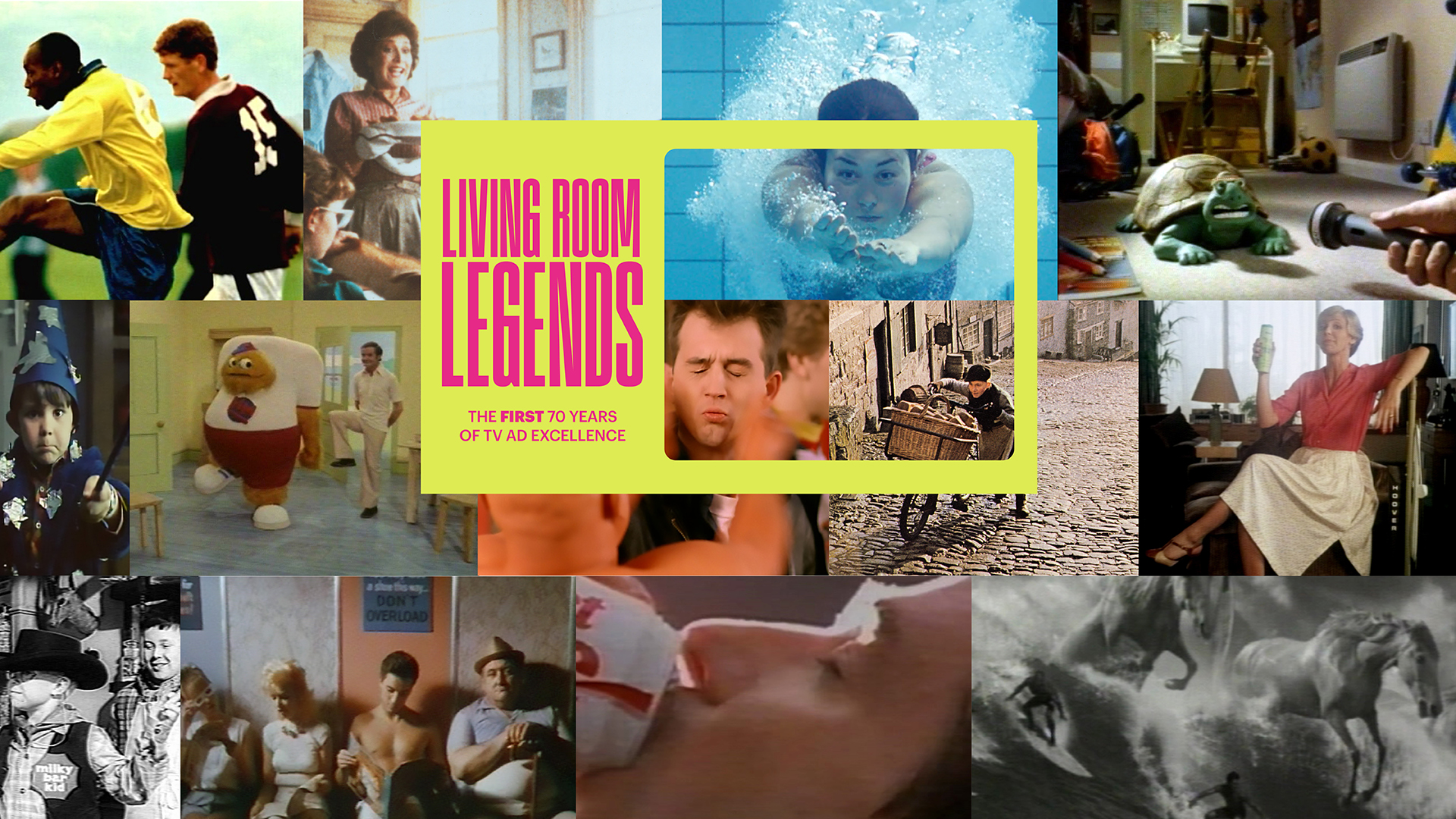
Living Room Legends: The First 70 Years of TV Ad Excellence is a research report from ITV, D&AD and System1, created to mark 70 years since TV advertising first aired in the UK. It celebrates 70 of the most iconic British TV ads and asks what makes advertising last, what makes it work, and what the next generation of creatives can learn from the people who got it right.
The report combines creative expertise, cultural insight and System1’s emotional data. It includes seven in-depth case studies, seven timeless creative themes and seven practical lessons for modern marketers.
It is written for brand leaders and marketers who want to make ads that move both people and markets, and for creative teams who want to understand how storytelling, craft and emotional impact have endured. Strategists, planners and students interested in how creativity, culture and commercial effectiveness intersect will also find it useful. In short, it is for anyone who wants their work to be remembered, repeated and rewarded.
The 70 ads span seven decades, from Gibbs SR Toothpaste (1955), the first TV ad shown in the UK, to McDonald’s “Raise Your Arches” (2023). Examples include:
The full list, with the reason each ad was chosen, is in the report appendix.
ITV, D&AD and System1 each brought a different lens: ITV as the broadcaster that aired the campaigns and understands their cultural reach, D&AD for world-class standards of craft, and System1 for evidence-based emotional measurement. An industry workshop with creatives, strategists, marketers and researchers helped refine the list.
Each ad was assessed on three factors: cultural impact (ads that became part of everyday life), creative excellence (recognition from peers and awards such as D&AD) and effectiveness (ads known to have driven results or changed behaviour, including public information campaigns such as the British Heart Foundation’s “Vinnie”). One ad represents each brand or campaign.
The list is not definitive, and not every ad could or should be made today. Some categories, such as tobacco, can no longer be advertised, food and drink face more restrictions, and some ads reflect social norms that are now clearly outdated.
All 70 ads were tested on System1’s Test Your Ad platform among 10,500 nationally representative UK respondents, and their results were compared with a database of 35,668 UK TV ads tested with 5 million respondents. System1’s methodology has been validated in experiments with the IPA and shown to predict long-term impact and market share change within categories.
The findings are supported by wider System1 and IPA research, including Compound Creativity and The Extraordinary Cost of Dull, Orlando Wood’s research on showmanship features, System1 and ITV’s Feeling Seen research, and the industry workshop.
System1’s testing measures emotional response, because its validated methodology shows that emotion leads to action. Four measures are used throughout the report:
The 70 ads averaged a System1 Star Rating of 4.1, compared with 2.7 for UK TV advertising. That is a gain of 1.4 Stars, and into the territory where long-term brand growth becomes more likely.
System1’s conclusion is that these are not a few lucky hits among a sea of mediocrity. The Legends consistently deliver high emotional performance, and with it a higher potential for long-term brand growth.
Yes. When System1 tested the ads with contemporary audiences, many made over a generation ago still earned top scores, showing that their ability to engage viewers is timeless. Ads from sixty years ago in the report score top marks on System1’s effectiveness scale alongside the best of TV advertising today.
Milkybar (1961) is still a 5-Star hit with viewers, LEGO “Kipper” (1981) earned Exceptional Star and Spike Ratings with a 2025 audience, and Smash “Martians” (1973) earned an Exceptional Spike Rating.
System1’s data shows that emotion is the best predictor of both short-term uplift and long-term brand growth. In the short term, the intensity of emotion drives immediate response, and it is not always positive: the 1987 AIDS “Don’t Die of Ignorance” campaign drove action through intense negative emotion. In the long term, it is the positive emotions of happiness and surprise that drive impact, which is why so many of the greatest ads tell funny, inspiring or heartwarming stories.
The Legends deliver on this. 45% of viewers reported feeling happiness, 12 points above the UK TV average of 33%. According to the affect heuristic, people who feel good judge more favourably, so a happy viewer is more likely to remember the brand, trust it and act on it.
Neutrality is the most common emotional response to advertising: almost half of responses to UK TV ads (47%) are neutral, and when people feel nothing, they do nothing. According to The Extraordinary Cost of Dull, a joint study by Peter Field, Adam Morgan and Jon Evans using System1 data and the IPA Effectiveness Databank, the dullest campaigns need up to £10 million more in media spend to match the impact of the least dull.
The Legends avoid this penalty. Just 31% of responses to them were neutral, 16 percentage points fewer than the UK average.
System1, ITV and D&AD identified seven qualities that recur across the 70 ads. Every ad excelled on at least one of three foundations:
Four building blocks are the techniques great ads share, and they are what make the ads commercially effective:
Together they fulfil the unspoken contract between brand and viewer: people pay brands attention, and brands give them something entertaining, memorable and worthwhile.
A convention is simply the way something is usually done, and many of the Legends play with, mock or break them. Pot Noodle’s “Slag of All Snacks” tore up food advertising conventions, Tango’s “Orange Man” ushered in the brasher, bolder ads of the 90s, and Cadbury’s “Gorilla” offered no message and no product, just surreal joy.
Defying convention creates standout and cut-through, builds mental salience and creates space to reposition a brand in a memorable way. It also generates surprise, one of the most effective emotions, which drives intensity of response and both short and longer-term effectiveness. The report adds a caveat: breaking rules only works when the idea is strong, the craft is high and the audience is taken seriously.
Imaginative repetition, first described by BBH co-founder John Bartle, means keeping a consistent brand message, creative idea or tone while adapting it to keep the campaign fresh. System1 and the IPA’s Compound Creativity study of 56 brands shows the payoff. The most consistent brands create ads that work twice as hard, report double the profit gains of the least consistent brands, and generate 27% more very large brand effects. Their ads also grow more effective every year they maintain that consistency.
Compare the Market’s Meerkats are the report’s example: 15 years of consistent creative and near-perfect Fluency (99). The campaign did not just become famous, it stayed famous.
Fluent Devices are repeated creative devices, such as characters, scenarios and jingles, that remind viewers who an ad is from in a memorable and entertaining way. Among the Living Room Legends, ads with a Fluent Device achieve stronger brand recognition: Fluency of 91 with a character versus 79 without, 88 versus 77 with a scenario, and 89 versus 79 with a jingle.
They take time to work. In System1’s analysis of 4,164 ads, average Star Rating is 2.6 for campaigns with no Fluent Device, then 2.4 in year one, 2.6 in year two and 2.7 in year three, before rising to 3.5 in years four and five.
The more entertaining an ad is, the more attention people pay to it. When viewers feel positive about an ad it becomes more memorable and builds positive feelings about the brand, which pays off in brand fame and business effects. The report argues this matters even more on TV: surrounded by entertaining content, an ad that entertains stands out by fitting in, becoming part of the show rather than an unwelcome interruption. It also notes that the perceived entertainment value of advertising has declined alongside trust, because dull advertising breaks the unspoken contract between advertiser and viewer.
Orlando Wood’s research with the IPA calls the features that deliver this showmanship features: characters, storytelling, humour, music, a sense of place and dramatic unfolding. The Legends have the strongest broad-beam skew in the Entertainment Index (+5.5), compared with +0.1 for IPA campaigns, -2.6 for US TV ads, -3.1 for YouTube ads and -4 for Facebook ads.
Craft is the attention to detail across scripting, direction, casting and production that turns an ordinary idea into an extraordinary one. It often comes down to single details that stay in the mind, like the frog leaping from the drainpipe in Sony’s “Balls”. The report’s lesson is that in an age of automation and short-form churn, investing in craft is a competitive edge.
The industry agrees. Between them, the 70 ads have won more than 35 D&AD accolades, including 6 Black Pencils and 9 Yellow Pencils, alongside Graphite, Wood and In-Book honours. D&AD rewards originality, craft and enduring creative impact rather than popularity alone, which shows that great work does not have to choose between fame and feeling.
No, but they do have to make people feel something about it. The report calls this romancing the product: putting the product at the heart of the work in a way that is never dull, whether through an extreme demonstration, a surprising metaphor or its emotional benefits.
Romancing one product can also have a halo effect on the whole brand, as Apple’s iPod ads did for the iPhone.
Yes, and some of the best examples come from them. Compare the Market operates in a category the report describes as joyless and low in trust, yet the Meerkats gave people a reason to care and won a Gold IPA Effectiveness Award. Smash turned instant mash, a low-interest category, into advertising history with robotic Martians who laughed at real mashed potato. Three stood out in a price-led, tech-heavy mobile category with a moonwalking pony and the line “Silly Stuff. It Matters”.
The report’s conclusion is that there really are no dull categories: people love to be entertained, even when they are buying insurance.
The British Heart Foundation’s “Vinnie” (2012) shows how. It paired hardman Vinnie Jones with the Bee Gees’ “Stayin’ Alive”, whose tempo of 147 BPM matches the rhythm needed for hands-only CPR, and taught the technique in a way that was memorable and funny rather than sombre or frightening. It earned a Spike Rating of 1.68 and over a million YouTube views in its first week, and doctors began telling the BHF about patients who had been “Vinnie’d”: people who would not have reached hospital alive without the ad. The ad is now taught in schools and first aid courses.
The report’s lessons are to educate the human way, to use humour because it makes messages more memorable and persuasive, and to remember that when the stakes are life or death, dull is not an option.
System1 and ITV’s Feeling Seen research links authentic representation to effectiveness. When people see themselves reflected on screen it drives a stronger emotional response and, ultimately, stronger business outcomes, a phenomenon System1 calls the Diversity Dividend. Across the dataset, ads featuring diverse representation performed slightly higher than the UK norm, and with diverse audiences they delivered an average uplift of +0.6 Stars, +0.3 in emotional intensity and +0.9 in Spike.
Sport England’s “This Girl Can” is the report’s case study. Its raw, joyful portrayal of real women earned a 4.6-Star rating, and Sport England’s later research credited the campaign with getting more than 3 million women active that year.
The report concludes that TV remains the most trusted and emotionally powerful advertising medium, offering reach, attention and storytelling power that no other medium matches. Only audio-visual ads can combine sound and vision for stronger emotional impact and narrative force, and TV adds cultural presence. Sport England’s Kate Dale explains that TV let “This Girl Can” put real women on the big screen in a shared, visible moment that no targeted campaign could replicate, and ads can catalyse wider conversation that extends their impact into earned media.
Trust is part of the case. The Advertising Association’s Matt Bourn describes trust as more important than ever and, second only to the quality of the product or service, a proven source of competitive advantage. He argues that TV gives businesses a big, public and confident way to build it.
According to the Advertising Association’s Advertising Pays 2025 report, cited in Living Room Legends by its CEO Stephen Woodford, advertising supports 1.7 million UK jobs (around 5% of the workforce) and contributed £109 billion of GVA to the UK economy in 2024, 4% of the total.
Thinkbox analysis within the report puts advertising’s profit ROI at £4.11 per pound spent for larger advertisers (annual turnover above £10 million) and £1.89 for smaller ones. The Advertising Association explains the gap largely through the Law of Double Jeopardy: smaller brands have fewer customers, who are also less loyal.
The Magnificent Seven are seven in-depth case studies chosen in an industry workshop as ads that deserve a second look: emotionally resonant, culturally sharp and rich in the report’s timeless themes.
The report closes with seven creative lessons:
The report’s closing point is that formats and platforms will change, but the fundamentals of storytelling, emotion, craft and distinctiveness still hold.
The Living Room Legends were measured with the same System1 model used for commercial ad effectiveness testing, delivered through the Test Your Ad platform, which measures emotional response and predicts long-term brand impact. To read the full report, use the Download the Research button on this page.
Want to make 5-Star Marketing? Need to understand your customers better? Interested in knowing more about anything we do?
We’d love to hear from you.