
The Cost of Conformity

When Adam Morgan (eatbigfish), Jon Evans (Uncensored CMO), Peter Field and the IPA , and Karen Nelson-Field (Amplified) unveiled The Extraordinary Cost of Dull advertising, one pattern stood out. The brands defying “dullness”, defined as the absence of emotion and measured by System1’s Test Your Ad platform as a neutral response, were not coming from the categories you might expect.
Think Comparethemarket’s meerkats in insurance comparison, Specsavers’ cheeky campaigns in opticians, or Ryan Reynolds’ work for Mint Mobile. The most emotional and memorable advertising was not coming from the usual suspects like chocolate, travel, or fast food. Instead, it was emerging from categories typically written off as dull.
So we dug deeper. In our latest report, The Cure for Dull, we analysed dullness by category. As expected, financial services, broadband, and pharma ranked among the least emotionally engaging on average. Meanwhile, chocolate, desserts, fast food, bakery, pet care, and travel sat at the opposite end of the spectrum.
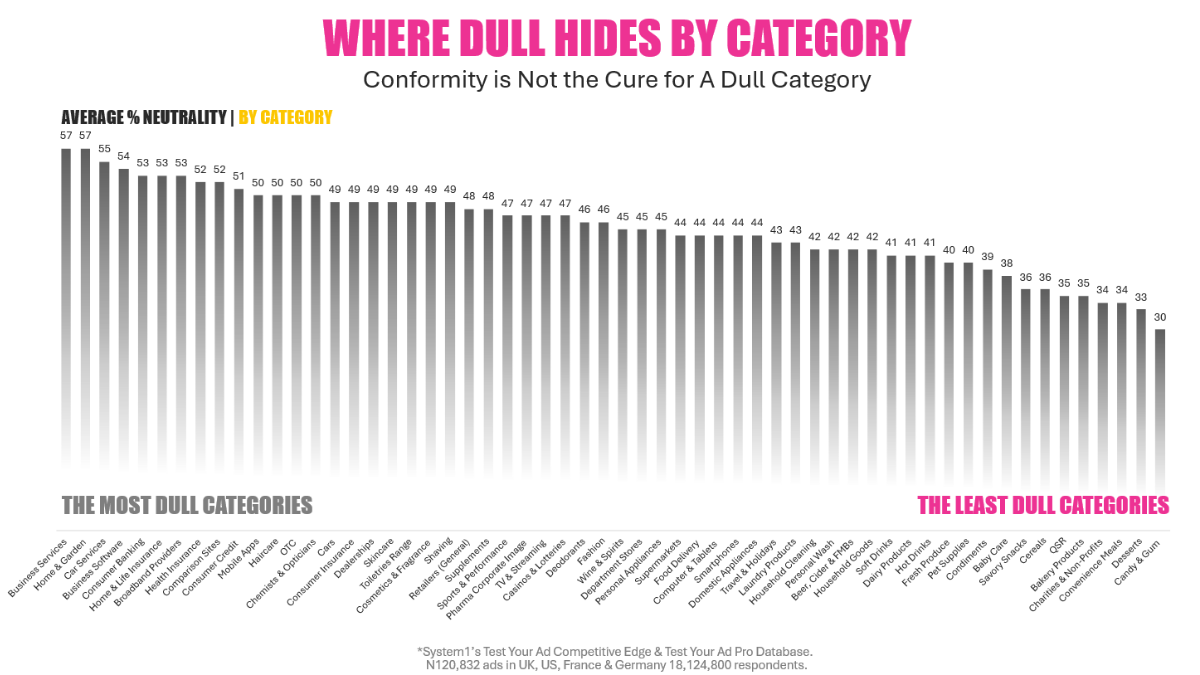
But even the most inherently engaging categories are not immune to sameness. As a category becomes less dull, the bar for standing out rises. Distinctiveness takes more effort. The brands we remember are the ones that do something unexpected, and that is often much easier in categories where expectations are low to begin with.
Conformity is Not a Strategy
When you operate in an emotionally engaging category like chocolate, it is easy to fall into a “don’t fix what isn’t broken” mindset. Consumers already love the category, so the instinct is to give them more of the same. More of what they expect. More of what makes every brand look reassuringly similar.
And on paper, it can look like it is working. Benchmark against System1’s full Test Your Ad Competitive Edge database and a 30% neutral response might feel like a win against a norm closer to 50%. But shift the lens to your category, where 30% is typical, and the picture changes. You are not outperforming. You are conforming. And conformity is not competitive advantage.
The same pattern plays out at the other end of the spectrum. In B2B, categories tend to take themselves seriously. Messaging leans on superior features, better performance, and claims of difference that blur together. Functional. Rational. Safe. It feels secure. It feels sensible. It will not get you fired. Here, 50% neutrality can start to look acceptable. Better than the category. But is that really success, or just a lower bar?
Safe comes at a cost.
Because safe is easy to ignore. Safe is easy to forget. Safe is where dull lives.
Even as adults, it seems we still need the reminder. Just because everyone else is doing it does not mean you should. Following the crowd rarely produces work that stands out, or stays in memory.
So consider this your warning. Do not follow the herd into a sea of sameness.
Whatever the category, the principle holds.
Defy the norm.
Category can set expectations, limit ambition, and anchor brands to the status quo. With billions spent on production, creative, and media each year, that is a costly place to stay.
Or it can create clarity. I am a finance brand, but there’s no reason I cannot compete with chocolate. I am a chocolate brand, and 30% neutrality is still too high. Cut-through requires risk, and risk often means going against the grain.
Cut Through in Practice
To bring this to life, it helps to look at the extremes. One example from “Candy & Gum”, and one from “Business Services”. Categories at opposite ends of the spectrum, but both with brands finding ways to defy dull.
Let’s start with “Candy & Gum”, or what we would call chocolate and confectionery here in the UK. This is a category where neutrality sits at around 30%. It is inherently appealing and highly competitive. Standing out takes more than indulgent product shots and the familiar snap of a chocolate bar.
KitKat is a standout. A brand that consistently defies dull, and for a simple reason. It does not rely on the product.
While competitors focus on glossy close-ups and sensory cues, KitKat builds its communications around its platform, “Have a break, have a KitKat”. Storytelling comes first. Characters, everyday moments, work, school, small frustrations, all used to bring the idea of a break to life.
It works because it is consistent. You recognise the idea before you ever see the product. The brand leads, not the pack shot.
And it works because it is flexible. By removing the product from the centre of the story, KitKat opens up far more creative space. There is no debate over lighting, angles, or how best to show melting chocolate. The focus shifts to context. When people want a break. Why they need one. What it feels like.
That shift changes everything. It moves the work out of the category codes and into the consumer’s world.
And that is where distinctiveness lives.
Now, business services.
Not a category known for its entertainment value. You can almost predict the formula. A robotic voiceover. Product demos. In-app features. A “customer” testimonial delivered straight to camera with unwavering eye contact. Functional. Box-ticking. Built for the small fraction of people in-market, and easy for everyone else to ignore.
It is a category that often forgets there is a broader audience watching. One that still expects to feel something.
Which is what makes Adobe stand out. One of the strongest performers with just 19% neutrality, it showcases its tools, features, and AI capabilities through the story of a young girl. It is human. It is disarming. It draws you in.
You are not being told how powerful the product is. You are shown, in a way that feels effortless. If a child can navigate it, imagine what you could do.
That is the difference. The message lands without ever feeling like a message.
Now imagine the alternative. The standard execution. A typical day in the life of a designer walking through features and workflows. Perfectly clear. Entirely forgettable.
Same product. Very different outcome.
Because in a category built on function, it is the brands that bring feeling that stand out.
Create with Confidence®
Do not let your category define your ceiling. Use System1’s Test Your Ad Competitive Edge platform to understand the codes shaping your category, then work with our expert consultants to challenge them. Step beyond the status quo, break from convention, and turn category norms into a springboard for more distinctive, emotionally engaging work.
And download The Cure for Dull report today to learn more.