
Swicy, Dirty and Dill, Oh My!
Trend #1: Swicy
I only recently learned the word “swicy,” which means I am officially at the age where trends arrive faster than my ability to emotionally process them.
But once you see it, you realize it’s everywhere.
Brands are increasingly combining sweetness with heat in ways that feel intentionally contradictory. Not extreme enough to feel risky. Surprising enough to earn attention.
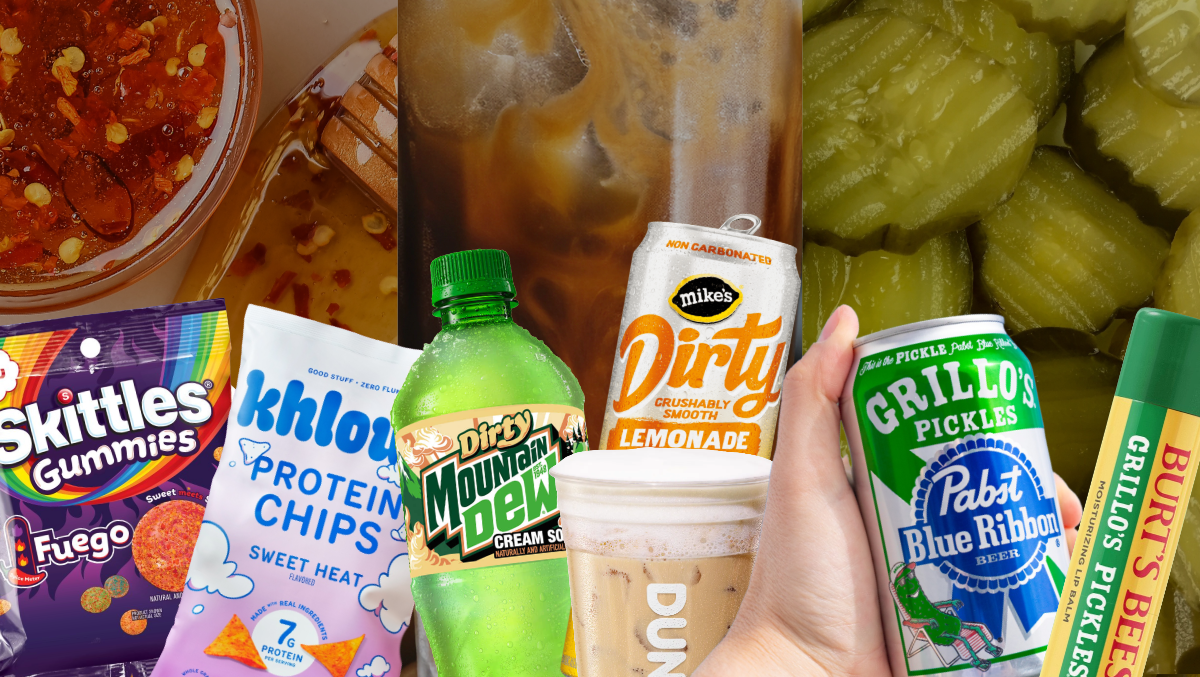
Products like Skittles Gummies Fuego, Khloud Foods Sweet Heat Chips, and the rise of spicy consumer hacks around gummies and candy all point to the same thing: consumers are rewarding flavor combinations that create a little tension.
Even the ongoing hot honey takeover tells the same story. What started as a niche foodie obsession now feels embedded across menus, snacks, sauces, and fast food innovation. And at festivals like Coachella this year, sweet-and-spicy mashups showed up less like novelty products and more like social content engineered for reaction.
Which makes sense, because swicy isn’t really about flavor.
It’s about emotional pacing.
Sweetness gives consumers something familiar to hold onto. Spice interrupts the experience just enough to make it memorable. Together, the combination creates a low-stakes thrill. Something recognizable with a little edge.
That balance feels particularly relevant right now. Consumers increasingly want discovery without discomfort. They want products that feel new, but not alienating. Swicy sits perfectly in that space.
And importantly, it photographs well, reacts well, and performs well socially. Heat creates visible reactions. Sweetness keeps the experience approachable. The result is a flavor profile that naturally generates conversation.
That’s not accidental. Increasingly, products aren’t just designed to taste good.
They’re designed to be talked about.
Trend #2: Dirty
The rise of flavors that sound wrong… until suddenly they don’t.
If swicy is playful tension, dirty is controlled chaos.
“Dirty” products are having a moment right now, particularly in beverages, where brands are leaning into combinations that would have sounded deeply questionable not that long ago.
Dirty Mountain Dew. Mike’s Dirty Lemonade. Mug Brotein’s “Dirty Protein.”
And then — as a Dunkin’ fan who checks their newsroom the way some people check sports scores — I got the news I didn’t know I needed: Dunkin’ just launched their own Dirty Soda. Launching as part of their new Spring line, the Dunkin’ Dirty Soda combines their beloved coffee milk with Pepsi and tops it with Sweet Cold Foam, creating something with classic soda flavor and a smooth, creamy, coffee-forward finish. Honestly, it reads like something a very online Dunkin’ superfan would hack together at the counter — and now it’s an official menu item.
I love Dunkin’ for exactly this reason. They consistently read where culture is going and meet it with something that feels authentically them. This isn’t Dunkin’ chasing a trend. It’s Dunkin’ arriving at the trend from their own direction. Coffee + soda + foam is a very Dunkin’ way to say “we’ve been doing remix culture since before it had a name.”
What’s fascinating about the broader “dirty” moment isn’t just the flavor combinations themselves. It’s the framing.
For years, innovation language often centered around optimization. Cleaner. Lighter. Functional. Better-for-you. Everything polished to the point of emotional neutrality.
Dirty flips that entirely.
The word signals imperfection. Customization. Internet humor. Remix culture. It suggests a product that doesn’t take itself too seriously.
And culturally, that matters.
Consumers have spent years being sold aspiration, routine, optimization, and self-improvement. Increasingly, brands that feel a little messier, weirder, and more self-aware are standing out because they feel human.
The appeal of “dirty” innovation isn’t necessarily indulgence itself. It’s permission.
Permission to mix categories. Permission to break flavor rules. Permission to prioritize fun over polish.
That’s why these launches tend to travel well online. They invite reactions.
Some consumers genuinely want to try them.
Others just want to send them to a friend with the caption: “This feels illegal.”
Either way, the product wins attention.
And in today’s innovation landscape, attention is often the first battle.
Trend #3: Even More Dill
Pickle flavor has officially escaped containment.
Merely a few weeks ago, dill felt like an emerging curiosity.
Now it feels like a fully operational cultural movement.
Grillo’s Pickles in particular seems to understand something important: pickle fandom is no longer just about taste. It’s identity.
That helps explain why a Burt’s Bees collaboration somehow feels less random than it should. Or why Pabst Blue Ribbon launching pickle beer feels less like a stunt and more like a logical next chapter.
Pickle flavor has become surprisingly adaptable because it carries multiple emotional signals at once.
It can feel nostalgic and ironic. Bold and familiar. Hyper-online and comfortingly old-school.
And unlike some flavor trends that peak quickly, dill continues expanding across categories because it functions almost like a cultural shorthand. It immediately tells consumers something about the tone of the product.
It says:
- this brand has a sense of humor
- this product doesn’t take itself too seriously
- this is probably going to be a little weird
Increasingly, weirdness itself has become commercially valuable.
Not alienating weirdness. Approachable weirdness.
The kind consumers want to photograph, discuss, review, and share.
That’s why dill keeps escaping its original category boundaries. Once a flavor becomes socially expressive, it stops being limited to food.
It becomes part of culture.
What All Three Trends Have in Common
On the surface, swicy candy, dirty lemonade, and pickle lip balm have very little to do with each other.
But emotionally, they’re operating from the same playbook.
All three trends create products that feel familiar enough to understand immediately, but unexpected enough to trigger a reaction.
That balance matters more than ever because consumers are living in an environment of constant exposure. Endless launches. Endless content. Endless products optimized to offend absolutely no one.
The challenge is that truly safe ideas often become invisible.
The products breaking through right now tend to create some form of emotional friction. Curiosity. Amusement. Confusion. Delight. Sometimes all four simultaneously.
Importantly, none of these trends are truly extreme.
Swicy still gives you sweetness.
Dirty products still anchor themselves in recognizable formats. (A Dunkin’ Dirty Soda is still, fundamentally, something delicious to drink on your commute. It just has a little more going on.)
Dill still taps into familiarity before introducing absurdity.
That’s what makes them commercially smart.
The innovation feels adventurous without requiring consumers to completely abandon comfort.
And increasingly, that seems to be the sweet spot for modern innovation: products that feel culturally brave while remaining emotionally accessible.
Why Speed Matters More Than Ever
The challenge for brands is that these kinds of trends evolve incredibly fast.
By the time traditional innovation cycles finish validating an idea, culture has often already moved on to the next unexpectedly spicy, dirty, pickle-adjacent obsession.
That creates a difficult balancing act for innovation teams.
Move too slowly, and the moment disappears.
Move too quickly without confidence, and brands risk launching products that feel gimmicky, confusing, or disconnected from what consumers actually want.
Dunkin’ is a good example of a brand that consistently threads this needle. As a fan, I notice how often their launches feel timed — not chasing a trend in its final inning, but arriving while the conversation is still building. The Dirty Soda launch today feels like exactly that.
At System1, we’ve consistently seen evidence that emotionally distinctive ideas outperform safer, more forgettable ones over time. The brands that create emotional response build stronger memory structures, stronger cultural traction, and ultimately stronger commercial outcomes.
But emotional distinctiveness only works if brands feel confident enough to act on it.
That’s where fast, emotion-based innovation testing becomes critical.
Our Test Your Innovation solution helps brands quickly understand whether a concept is creating the right kind of reaction before it ever reaches shelf. Not just whether consumers “like” an idea, but whether it generates intrigue, excitement, distinctiveness, and memorability.
Because increasingly, the winning products aren’t always the most rational ideas.
Sometimes they’re spicy gummies.
Sometimes they’re dirty soda made with Pepsi and coffee milk.
Sometimes they’re pickle lip balm.
And while those launches may look chaotic on the surface, the smartest brands behind them aren’t guessing.
They’re moving quickly because they have confidence in the emotional response their products are likely to create.
Right now, culture rewards brands willing to experiment a little.
The opportunity is knowing which experiments are worth moving fast on.
Honestly, consumers seem remarkably open to strange combinations right now.
The real risk may not be being too weird.
It may be being too forgettable.
Now if you’ll excuse me, I have a Dunkin’ Dirty Soda to go try…
Move Fast With Confidence
The brands winning today aren’t guessing, they’re moving quickly because they understand the emotional response their ideas will create. Test Your Innovation helps you identify which concepts spark intrigue, excitement, and memorability before they hit the shelf, so you can act fast without losing confidence.