
Coachella is No Longer a Sponsorship. It’s a Stress Test.
There was a time when brands came to Coachella to be seen.
Now they come to see if their ideas survive.
Because Coachella 2026 isn’t a backdrop. It’s a pressure cooker. Heat, noise, distraction, competition for attention measured in milliseconds. If your product, experience, or idea can’t earn attention here, it won’t magically earn it in the real world.
Which is why more brands are treating the festival less like a media buy and more like a live beta environment.
Not polished. Not protected. Tested.
From Activations to Experiments
Look at what’s actually happening on the ground.
Pinterest isn’t just building a booth. It’s testing a behavior shift.
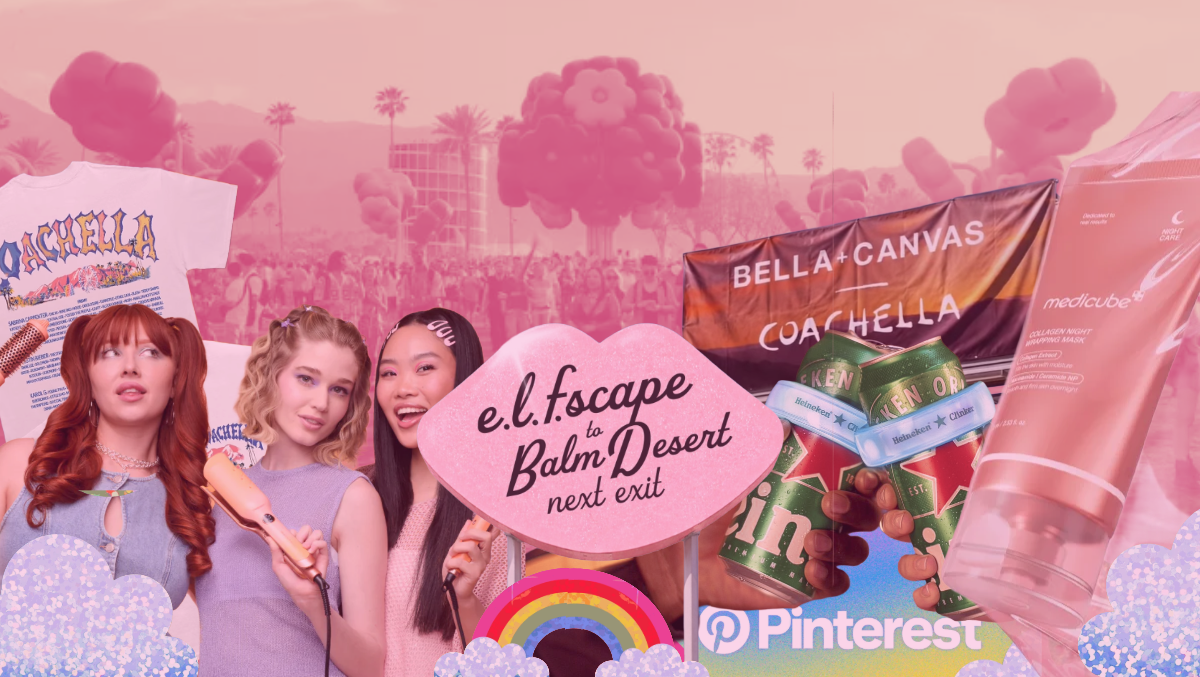
Its phone-free experience asks a real question: can a digital platform win by helping people disconnect? Guests lock away their phones and step into analog-inspired spaces, with beauty moments powered by e.l.f. Cosmetics. This isn’t just experiential. It’s a hypothesis about culture, played out in public.
Heineken is testing something different with The Clinker.
A smart band that turns a simple cheers into a signal of shared music taste. It’s lightweight, slightly playful, maybe even a bit odd. Which is exactly the point. Instead of claiming to “bring people together,” Heineken is prototyping what that could physically feel like.
In beauty, brands are pushing product into context.
Medicube is putting its Booster Pro device directly into people’s hands, shifting it from something clinical to something social.
Wavytalk is doing the same with hair tools, using creators and real-time styling to turn product utility into visible identity.
And then there’s BELLA+CANVAS, quietly reframing merch.
Not as inventory, but as participation. Their on-site customization experience turns a blank tee into something made, not just bought. A small shift with big implications: ownership increases when people co-create.
Across the festival, the pattern repeats. From AI-powered photobooths to immersive brand worlds, companies aren’t just showing products. They’re testing use cases, behaviors, and meaning.
This is What “Test Your Innovation” Looks Like in the Wild
At System1, we talk a lot about Test Your Innovation as a way to predict whether new ideas will drive growth before they scale.
Coachella is what happens when that philosophy goes physical.
Because every one of these activations is answering the same set of questions in real time:
- Do people notice this?
- Do they choose to engage with it?
- Do they come back, share it, or ignore it completely?
- Does it feel like something they actually want in their life, or just something that looked good in a deck?
You don’t need a survey to see the answers. You can watch them happen.
A product that gets picked up, used, photographed, and talked about is passing a very real test.
One that sits surprisingly close to what we measure: emotional response, distinctiveness, and behavioral pull.
The Winners Aren’t the Loudest. They’re the Most “Useful”
The most effective ideas at Coachella right now aren’t just attention-grabbing. They’re contextually useful.
- A product that solves a real festival problem
- A tool that enhances how people connect
- An experience that fits how people actually want to spend their time
That’s why so many of this year’s innovations feel less like ads and more like prototypes of future behavior.
Always proved this in 2025 with its Pocket Flexfoam launch, embedding the product directly into bathrooms and real needs. Buldak did it by turning spicy noodles into an experience that blended sampling, entertainment, and retail in one loop.
In both cases, the question wasn’t “Did people see it?”
It was “Did people use it, want it, and remember it?”
That’s a far higher bar.
Where Feeling Still Matters (But Earns Its Place)
Of course, none of this works without emotion.
System1’s research shows that ideas need to create feeling to drive long-term growth. Coachella just raises the stakes. If something doesn’t spark joy, surprise, curiosity, or even a bit of delight, it disappears instantly.
But here’s the shift:
Feeling alone isn’t enough in this environment.
At a festival, emotion has to be earned through experience.
- The joy of discovering something useful
- The social hit of sharing it with friends
- The small thrill of “this is actually cool”
That’s where Feeling and Fluency still play a role. The strongest ideas are recognizable, easy to grasp, and emotionally rewarding. But they’re now anchored in something more concrete:
Does this innovation deserve to exist in people’s lives?
The Real Opportunity: Test What’s Repeatable
The smartest brands at Coachella aren’t chasing a moment.
They’re looking for a signal.
A signal that says:
- This product format works
- This behavior resonates
- This experience is worth scaling
Because the goal isn’t to win the weekend.
It’s to identify what should live on long after the desert clears.
That’s exactly the mindset behind Test Your Innovation.
Not just asking if something is new. But whether it has the emotional and behavioral strength to grow.
Coachella, Decoded
Coachella has become something rare:
A place where innovation, culture, and human behavior collide in real time.
No filters. No safety nets. Just thousands of people deciding, moment by moment, what deserves their attention.
For brands, that’s not just exposure.
It’s one of the clearest signals you can get.
Not “Did we show up?”
But “Did it work?”
And more importantly:
Is it worth building on next?
We’ll be keeping our eyes on what creates that emotion and builds value, come find out what we can do for your innovations.