
Invented Love in the Frozen Food Aisle: What the End of Frozen Orange Juice Teaches Us About Innovation
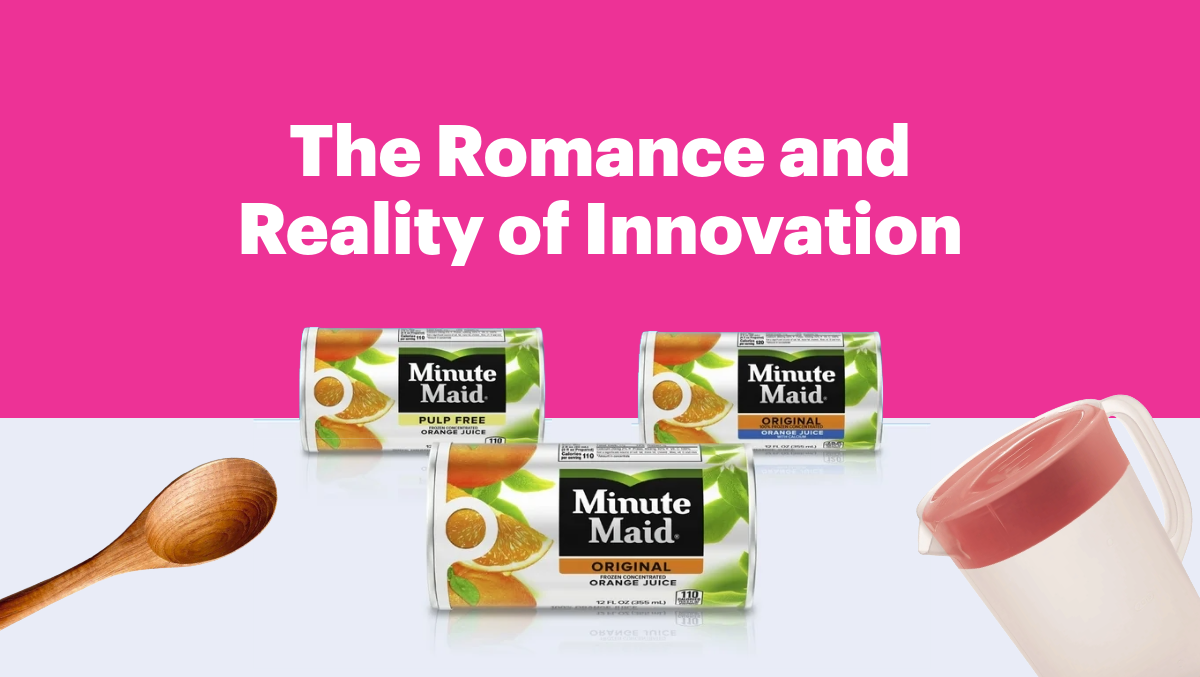
Somewhere in a freezer aisle, a small cylindrical legend is taking its final bow.
The canned frozen version of Minute Maid orange juice is being discontinued. That humble paper-wrapped tube that required a can opener, a pitcher, and a little patience is officially sliding into the archives.
For many of us, it was not just orange juice. It was a ritual woven into the choreography of childhood kitchens.
In mine, it lived in the freezer door like a citrus time capsule. Weekends meant prying off both metal lids, tapping the frozen column into a plastic pitcher, adding three cans of water with scientific precision, and stirring until the icy core surrendered. The first sip tasted like effort and victory. Bright. Slightly sharp. Unmistakably “orange” in a way that brought joy and optimism.
And now it is gone. OK, that’s dramatic, but it’s true.
What makes a product iconic in one era and obsolete in another? That question sits at the heart of innovation, and it is exactly why testing new ideas before scaling them matters so much.
The Romance and Reality of Innovation
Innovation follows a lifecycle. It begins as a breakthrough, becomes a habit, and eventually blends into the background. Sometimes it evolves. Sometimes it gets replaced. Sometimes it quietly exits while we are busy falling in love with something newer.
The frozen concentrate was once a marvel. It solved storage constraints, reduced shipping weight, extended shelf life, and democratized orange juice beyond Florida. It was efficient, clever, and modern. For its time, it likely would have passed any reasonable “test your innovation” filter with flying colors because it addressed a real tension and did so memorably.
But context shifts. Refrigeration improved. Distribution scaled. Expectations around convenience accelerated. We moved from “add water and stir” to “twist cap and pour.” What once felt futuristic began to feel like friction.
Innovation is not linear. It pulses. Surge. Stabilize. Plateau. Disrupt. Repeat.
Valentine’s Day and the Things We Love
With Valentine’s Day around the corner, it feels fitting to talk about love, not just romantic love, but brand love.
We often assume that nostalgia guarantees future performance. If something meant something to us once, surely it still does. Surely it always will.
But love in the market behaves differently than love in memory. You can adore something deeply and still choose something else at shelf. You can remember it fondly and not buy it again.
This is where innovation becomes vulnerable. Teams fall in love with ideas. Founders fall in love with formats. Marketers fall in love with heritage. None of that guarantees consumer love in the present tense.
That is why testing innovation before scaling is not just cautious. It is strategic clarity.
At System1, we focus on emotional response. The question is not simply “Is this new?” It is “Does this make people feel something strong enough to change behavior?” Our Test Your Innovation approach evaluates early stage concepts based on their ability to generate emotional intensity and distinctiveness. It helps brands understand:
- Will this idea create a positive emotional response?
- Does it stand out in a sea of sameness?
- Is it strong enough to survive real world competition?
The frozen orange juice cylinder once generated that emotional voltage. It solved a problem and embedded itself into family routines. But innovation is temporal. What works brilliantly in one context can quietly lose relevance in another.
Here is the second, subtler connection. The ritual that once created attachment can become the very friction that erodes it. Participation felt charming in the 1980s. In 2026, it can feel like effort we are unwilling to spend. Testing helps brands see not only whether an idea sparks affection, but whether it aligns with the realities of how people live right now.
Launching without that evidence is like declaring love on the first date and immediately booking the wedding venue. Bold. A little crazy. Occasionally tragic.
A Toast to the Freezer Door
There is something poetic about a product that required participation. You had to open it, dilute it, stir it, and wait. It asked something of you, and in return it delivered a small moment of satisfaction.
In a world of instant everything, that pause feels almost romantic.
So here is to the frozen concentrate. To childhood kitchens. To giant plastic pitchers. To the satisfying glug of that first pour.
And here is to the brands navigating their own innovation cycles. Some ideas will endure. Some will evolve. Some will retire with quiet dignity. The goal is not to preserve everything forever. The goal is to understand, before you scale, whether what you are building has the emotional power to be loved in its moment and the contextual fit to remain relevant.
Innovation is not just about making something new. It is about earning affection in real time.
This Valentine’s Day, whether you are celebrating a person, a product, or a pipeline of new ideas, remember this:
True love shows up in the data. ❤️
Love at First Sight Isn’t Enough
Before you fall in love with your next big idea, make sure consumers will too.
Test your innovation with System1 and see if it has the emotional power to win hearts in the real world.