
Did AI Kill the Super Bowl Star?
2026 will go down as a defining year in Super Bowl advertising, less for the hype and more for what it revealed about where the industry is headed. For starters, more brands than ever earned the coveted 5-Star Rating, a benchmark only seven brands had reached across the previous six years combined. At the same time, AI made its boldest Big Game appearance yet, accounting for 18% of all ads. Innovation has officially arrived on advertising’s biggest stage.
Expectations were high heading into Super Bowl LX. Pregame releases averaged an impressive 3.2 Stars (on a scale of 1.0-5.9) setting the tone for what System1 predicted would be the highest scoring year yet. That momentum carried into game day, but the final numbers told a more layered story. Overall Super Bowl ads averaged 2.7 Stars, with AI-focused spots averaging 2.1. Innovation showed up in force, but performance varied depending on how it was applied.
But this is not a cautionary tale. It is a growth story.
Newcomers vs Returners
The influx of AI was not surprising. If anything, it was inevitable. What is compelling is the contrast it created between seasoned returners and ambitious newcomers. Brands like Budweiser, Dunkin’ and Michelob Ultra have mastered the art of the Super Bowl moment. They have built distinctive, repeatable campaign platforms that compound over time. They know what works and more importantly, what works for them.
For newer entrants, especially challenger brands, cracking the code on the first try is harder. The Super Bowl does not reward novelty alone. It rewards clarity, emotional fluency and a deep understanding of audience expectations. As more brands and technologies step onto the field, the margin for error shrinks, but the opportunity to stand out in fresh ways and reach new audiences grows.
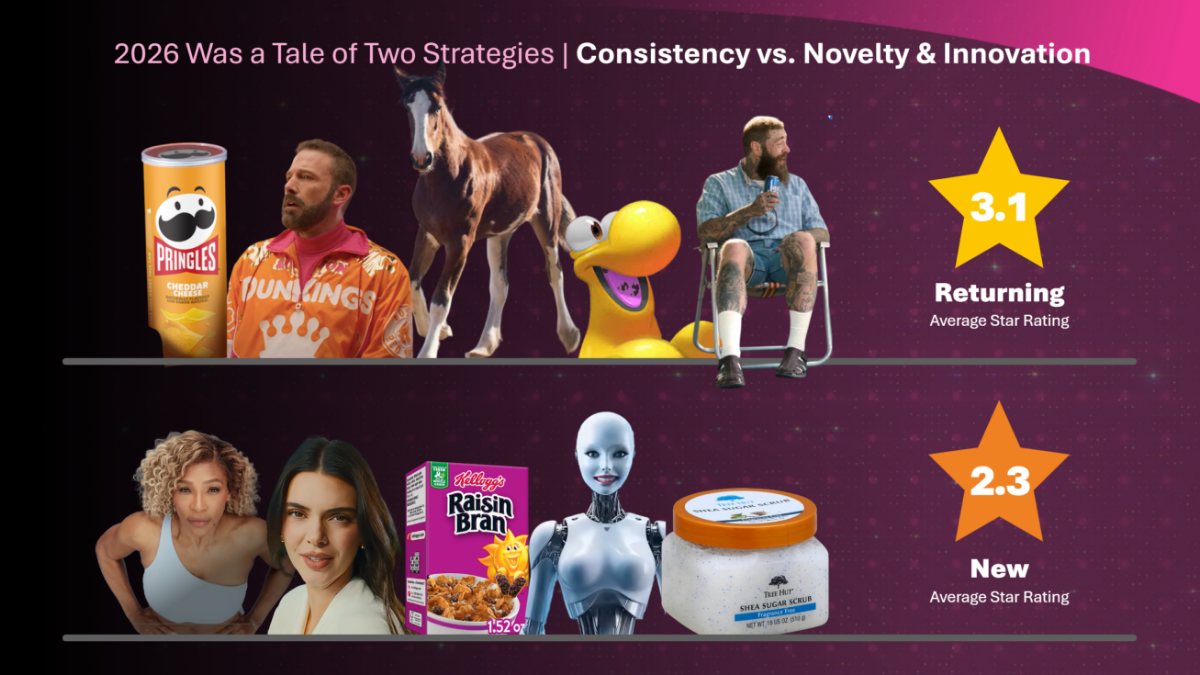
So, what is the playbook for newcomers, and did AI really kill the Super Bowl star?
Did AI Really Kill the Super Bowl Star?
Let’s settle this quickly. No, AI did not kill the Super Bowl star. But many of the brands that featured it defaulted to functional storytelling, leaning heavily into differentiation, features and platform superiority. In those cases, the spotlight shifted from people to product. A disproportionate share of lower-scoring ads came from brands that took this approach. The common thread was not the AI category. It was the execution.
That distinction matters.
A 2.1 average for AI-led spots does not mean they were ineffective. It means they were optimized for something different. Star Rating reflects long-term brand building, emotional resonance and attention at scale. Challenger brands, especially those appearing in the Super Bowl for the first time, are often playing a different game. A sales-led, product-forward strategy can be deliberate. Driving search, sign-ups, downloads or retail traffic the next day can be the primary objective. Short-term uptake builds the runway for long-term equity.
So how do we know it was positioning, not the presence of AI itself?
Look at Google Gemini’s “New Home,” which earned a 3.3 Star Rating. Google integrated AI into a deeply human story about a mother helping her son navigate the emotional transition of moving house. The technology was present, but it was not the protagonist. It acted as a catalyst for connection. The ad leaned into storytelling craft: character, dialogue, a clear sense of place and emotional stakes.
The brands that won with AI treated it as an enabler of human experience, not a replacement for it. They embedded the product inside a narrative that felt relatable and lived in. The difference was not whether AI appeared on screen. It was whether audiences saw themselves in the story.
AI did not kill the Super Bowl star. But it did expose a familiar truth. Technology alone does not create impact. Storytelling does.
The Newcomers Playbook
I can hear the pushback already. Google is an established giant with decades of equity behind it. That advantage is real. Bigger, more famous brands that have invested in distinctive assets over time walk onto the Super Bowl stage with built-in recognition and trust.
So what can you do if you are not Google?
The first step is clarity. As a newcomer, your job is not to win every metric in year one. It is to define what success looks like for you and focus relentlessly on it. A tight brief beats an ambitious one. Set measurable goals. Decide whether you are driving awareness, trial, distribution pull or search lift. Build a campaign that is learnable, repeatable and rich with signals you can take back to the drawing board for year two.
Focus is a strategy, not a compromise.
Poppi is a strong example of what that discipline looks like in practice. In 2024, the challenger brand used the Super Bowl to introduce itself with unmistakable product visuals, distinctive brand codes and a clear message about who they were and where to find them. The ad generated short-term impact and fluency, even if it did not rival legacy soda brands on long-term Star Rating.
By 2025, after building awareness and distribution, Poppi evolved. The brand leaned further into emotional, mass-market storytelling while maintaining the same product cues, differentiation and distinctive assets established the year before. The foundation held. The storytelling expanded. Long-term performance strengthened.
The lesson is not that size determines results. It is that size should shape strategy. Newcomers win by building memorability first through consistent codes and unmistakable product clarity. Once that memory structure is in place, broader brand-building can layer on top and drive sustained impact.
The Super Bowl is not a single shot at glory. For challengers, it is the first chapter. Write it with precision.
The Distinctiveness Dilemma
As a Super Bowl newcomer, you do not have the advantage of years of emotional equity built on this particular stage. You do not yet have Big Game fluency. But that does not mean you are starting from scratch. Most challengers arrive with assets they have already invested in elsewhere.
Poppi is a case in point. While new to the Super Bowl, it was not a new brand. By the time it aired its first spot, Poppi had built a recognizable social presence, established a distinctive typeface and pack design, and cultivated a fluent founder in Alison Ellsworth. When it stepped onto the Super Bowl stage, it did not reinvent itself. It amplified the brand codes it had already made famous in other channels. The creative was not a blank canvas. It was an extension.
That is the strategic unlock for newcomers.
In year one, the objective may not be to maximize Star Rating. For challengers and disruptors, the sharper focus is often Fluency and Spike Rating. If 125 million people see your ad but cannot attribute it to you, the scale becomes irrelevant. Visibility without distinctiveness is waste.
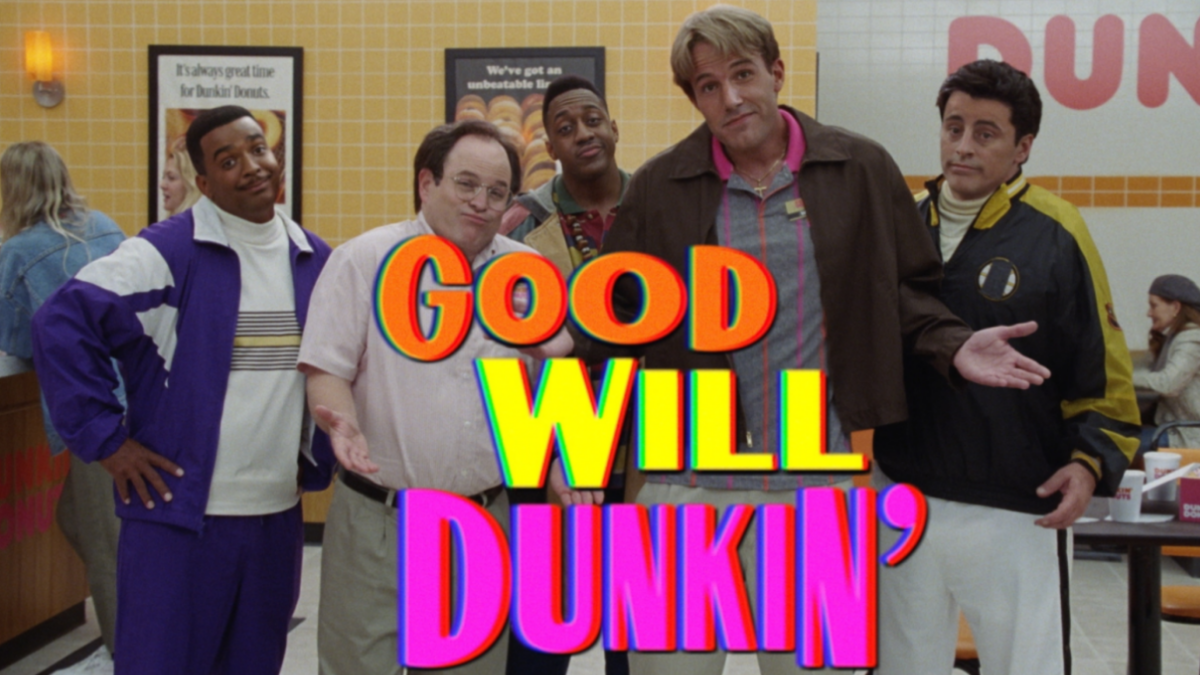
Even established returners understand this risk. Dunkin’ is a masterclass. Yes, Ben Affleck brings star power. But there is never any confusion about who the ad belongs to. The brand leans heavily into its colors, features its logo prominently, uses repeated sonic cues, and integrates its symbols and typeface throughout. Across its 2026 campaign, distinctive brand codes appeared 30 times in 60 seconds. The result was not just entertainment. It was attribution. The brand was remembered by 91% of audiences.
However, when we look at this year’s Super Bowl newcomers, a more concerning dilemma emerges. Spike Rating was modest, and Fluency averaged just 74%. That means 26% of viewers could not correctly recall which brand the ad was for. On a stage as expensive and high-reach as the Super Bowl, that is a significant leakage of value.
It becomes even more revealing when you examine how newcomers used their distinctive brand codes. On average, they featured just four across an entire ad. Now consider how people actually consume the Super Bowl. They are hosting, chatting, checking their phones, grabbing food, stepping away. Attention is partial at best. In that context, can you afford to signal your brand only four times in 30 seconds? Realistically, no.
The pattern holds for AI-led newcomers as well. Fluency hovered around 75%, with an average of four codes per ad, despite it being their first appearance on the biggest advertising stage in the world. AI did not undermine performance on its own. Weak or inconsistent branding did. Execution, not category, is what diluted distinctiveness.
30 brand cues in a Dunkin’ ad may feel excessive to some. It is cautious. It prioritizes attribution over subtlety. But the takeaway is not that every brand needs to flood the screen with logos and colors. The takeaway is that repetition works.
The good news is that you do not need 30 cues to drive recall. Research conducted by System1 in partnership with Effie shows that seven clear and consistent brand codes within a 30-second ad can lift Fluency to near 100%. Seven. Not dozens. Not saturation. Just disciplined, deliberate repetition.
For newcomers, that number is more than a guideline. It is a safeguard. On a stage where attention is fragmented and stakes are high; distinctiveness is not decorative.
It is what gets you back on the big stage.
Create a Newcomer Ad with Confidence
Planning your first Super Bowl moment, or looking to refine your approach for year two? The difference between showing up and standing out often comes down to how clearly you define success and how rigorously you measure it.
System1’s Test Your Ad platform helps newcomer and challenger brands understand whether their creative is driving the right outcomes, from short-term sales to long-term brand growth and branding fluency. Our expert consultants then help you optimize with precision, drawing on past campaign benchmarks, cross-channel creative analysis and second-by-second audience response data.