
4 Festive Themes from 2025

The snow has settled on Christmas and the rankings are in. So…what did we actually learn this year?
In 2024 the big lesson for brands was “be consistent” whether you re-air, repurpose, or invest in a mighty character Fluent Device. But did anyone listen?
On the surface, 2025 looked like a fantastic festive season: a record-breaking 4.4-Star average in the UK and 3.6 Stars in the US. AI grabbed headlines, new characters appeared on the scene, and unexpected celebrity cameos made waves in the trade press. But what did consumers feel about it all, and are brands paying attention or just chasing buzz?
We’ve analyzed every Christmas ad that aired this year, tested with real customers on System1’s Test Your Ad Competitive Edge platform. That’s 200+ ads and 30,000+ emotional responses from real people, coded for distinctive brand assets, humor, and left and right brain features as defined by Orlando Wood in Lemon and Look Out. This is your ultimate, evidence-backed guide to engaging customers at Christmas.
Let’s defrost the data…
1. New Isn’t Necessarily Unfamiliar
Across both US and UK festive ads, one lesson cuts through the tinsel: consistency still wins. Andrew Tindall, using System1, Effie and IPA data, shows that the most consistent brands see the biggest effects on long-term growth. Whether you invest in a Fluent Device or stay loyal to your creative agency, sticking with what works delivers reliably favorable results.
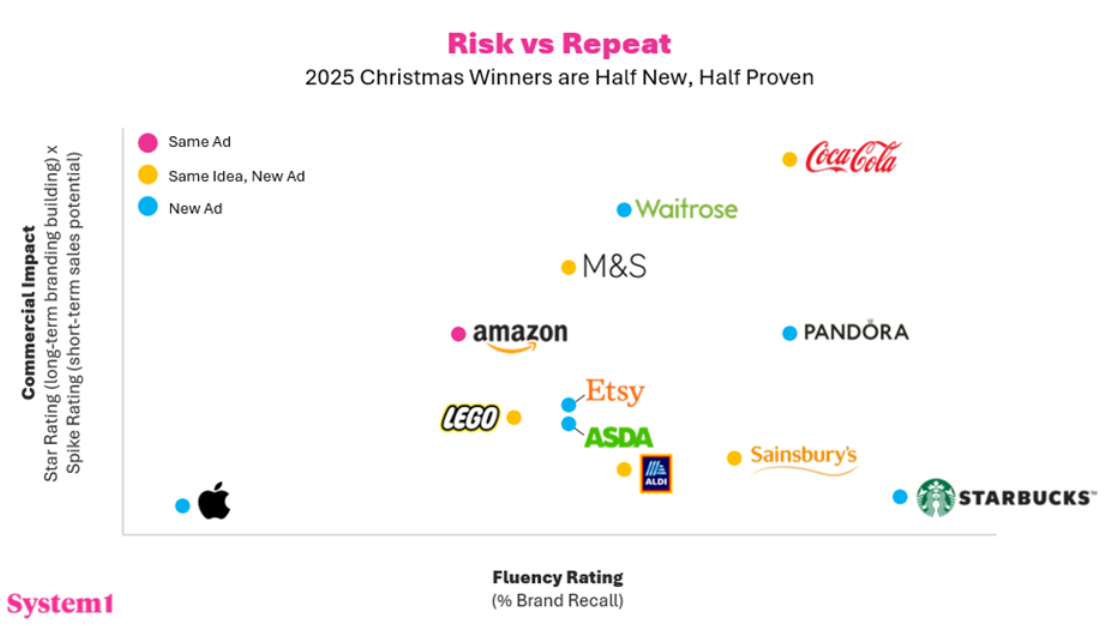
In the UK, Coca-Cola’s AI remake of its 1995 classic “Holidays Are Coming” topped the charts, smashing both Star Rating (long-term brand building) and Spike Rating (short-term sales). It was also the most recognizable ad, so all that commercial success is correctly attributed to Coke. No surprise: the red color palette, nostalgic jingle and iconic trucks all cue the same memories, even in a “refreshed” version.
The US told the same story. Repeats and re-airs dominated the top three, with Hershey’s melodic “Bells” from 1989 taking the crown and putting brand and product center stage. Amazon’s re-air of its 2023 spot “Joy Ride”, a simple, emotional ode to tradition and friendship returned and performed even better on brand recall the second time around.
Consistency, again, doing exactly what the evidence says it should.
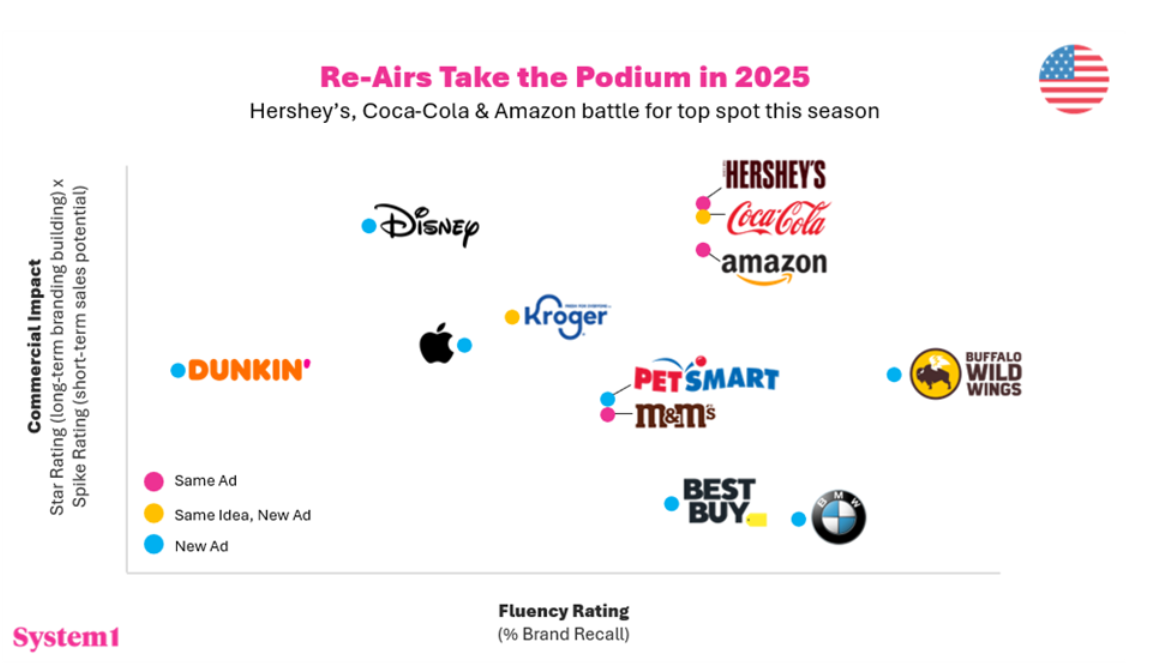
But while consistency kept proving its worth, some newcomers cut through too, earning real love from consumers. In both the UK and the US, the split between new and established campaigns in the top 10% was roughly 50:50.
But new did not mean unfamiliar. Most brands happily leaned into familiarity on loan, borrowing Christmas cues, movie references or other IP to deliver instant gratification. It works. Waitrose topped the Supermarket category for the first time in five years with Love Actually references woven into a humorous story, while PetSmart stepped straight into a Christmas tale. The ads may be new in theory, but they are preloaded with emotions that already exist. It is an effective strategy for brands running their first Christmas ad or looking to shake things up next year.
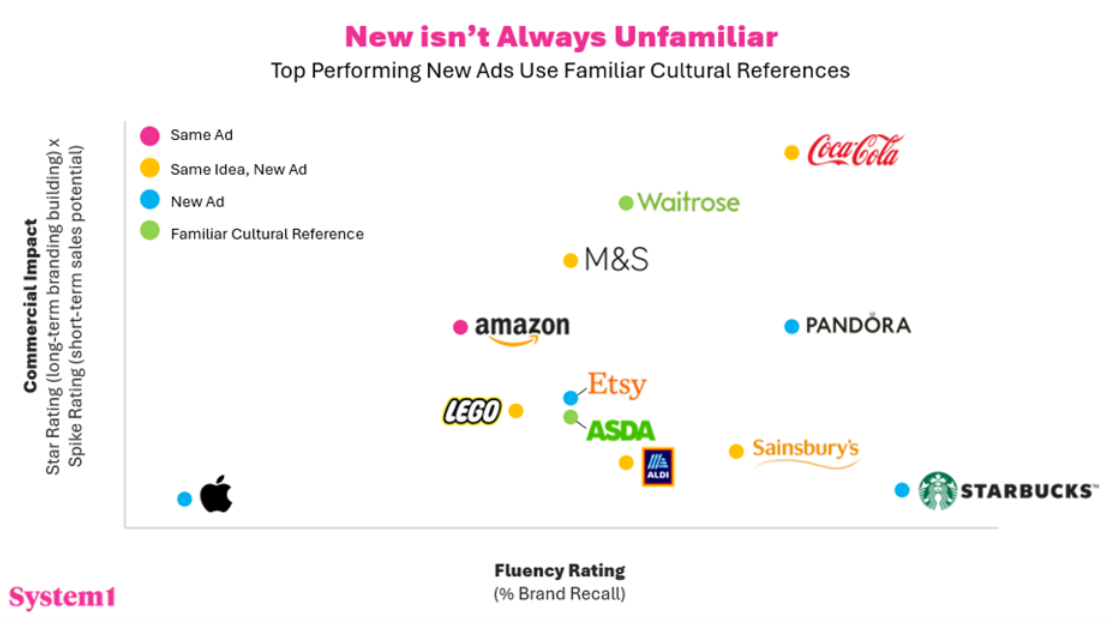
The caveat? You cannot borrow festive familiarity all year. Unlike Aldi UK, whose own Fluent Device can run in summer, spring or autumn, consumers are not expecting the Grinch to turn up for Walmart or McDonald’s in July. It is a short-term seasonally dependent strategy, a fast way to build emotional equity at Christmas, but it cannot be owned and it is not relevant year-round, so you have to do the hard work again.
So, lesson one from the 2025 holiday season?
2. Craft will Conquer AI (Eventually)
Ah yes, everyone’s favorite ad land talking point, and one that, in my opinion, gets far more airtime than it deserves. AI. Christmas is no exception. The new kid on the block has quickly become a go-to creative tool for brands and advertisers.
Last year, Coca-Cola sent shockwaves through the snow globe when it dared to remake its iconic, nostalgia-soaked, culturally sacred “Holidays Are Coming” ad. But did consumers actually care?
In the short term, no. Quite frankly, most didn’t even notice.
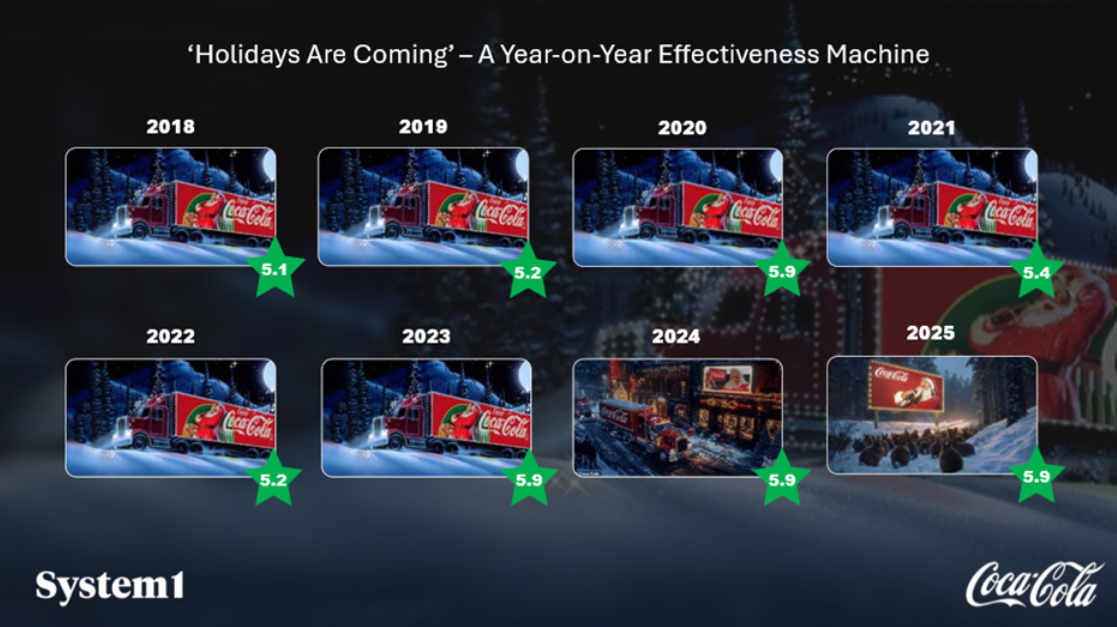
Years of testing “Holidays Are Coming” with real people backs this up. In fact, some might even argue the latest rendition is preferred. After all, it introduces a whole new cast of festive animals which, as Orlando Wood’s work suggests, can be a reliable shortcut to winning viewers over.
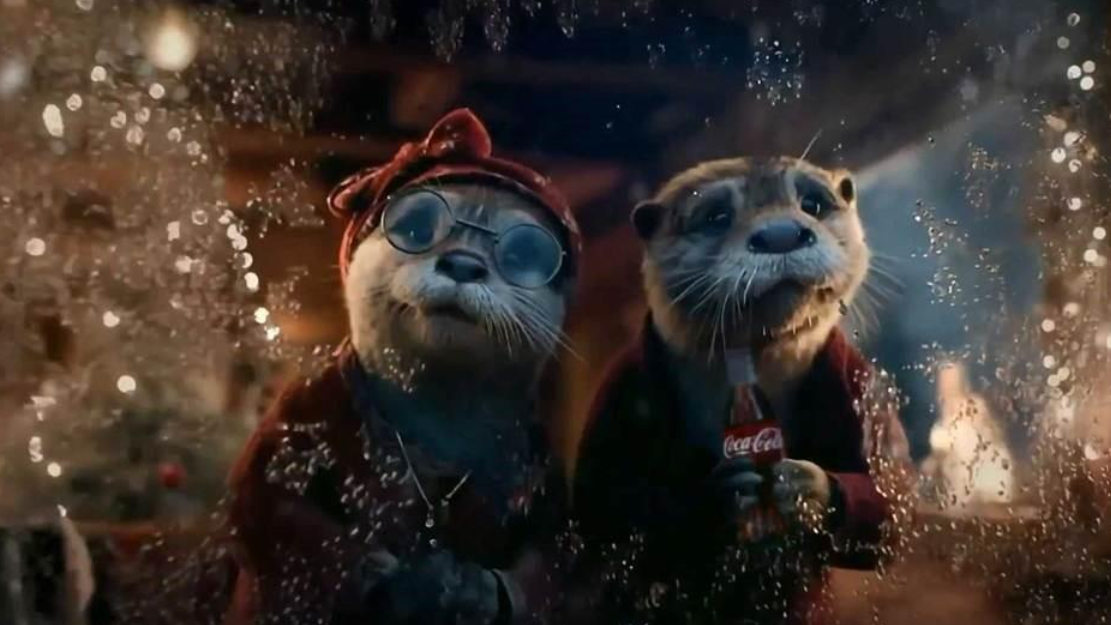
But is AI sustainable in the long term? Is it novelty that gives it a boost? Right now, the fact that consumers generally do not even notice when an ad is AI-made suggests novelty is not doing the heavy lifting. After all, how can something benefit from being “new” if the viewer does not realize it is new in the first place?
My concern is that, eventually, people will start to spot the difference and that it will chip away at the magic of craft. That concern is not just gut feel. It is grounded in the data.
While the general population may not collectively recognize AI in advertising today, one group often can. Gen Z. This is the generation raised through a digital revolution, on social media, and alongside relentless technological change. They grew up with it, they recognize it, and crucially, they do not always respond to it.
This first emerged in our research titled Seeing Gen Z, a deep dive into the likes, emotional triggers and stereotype traps often associated with the future generation of today. When ads featured AI, we saw a decline in emotional resonance, and AI was mentioned spontaneously in negative and neutral ad comments.
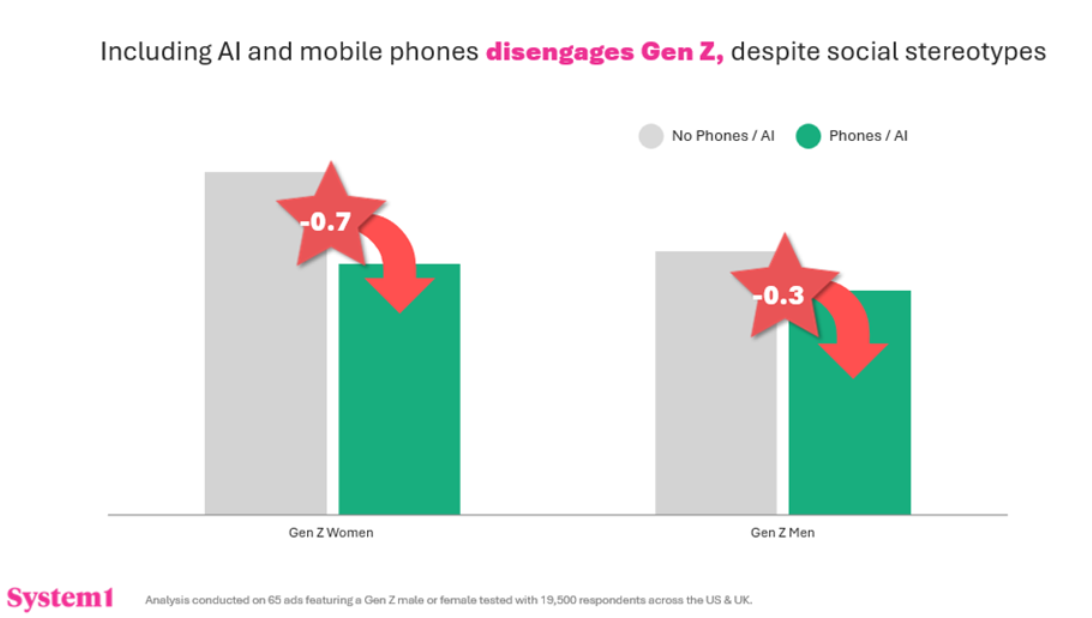
So of course, we put the most beloved festive ad to the test. And our prediction held. A 5.9 Star Rating with mass audiences, but a 2.2 Star Rating with Gen Z men and a 2.5 Star Rating with Gen Z women, effectively cutting long-term effectiveness in half among younger audiences. The most prominent negative response centered on the fact the ad was AI generated, with some agreeing that brands should be investing in “actual artists”.
All that said, it is worth being clear about the caveat. AI can be an effective strategy right now, particularly for brands that have already banked decades of distinctiveness, trust and emotional equity. For a brand like Coca-Cola, that equity acts as a buffer, giving it more freedom to experiment with AI tools without risking the fundamentals. The bigger watch-out is for brands still building their meaning. If you have not yet earned your magic, it is much harder to outsource it.
Lesson 2 is more of a “food for thought” for future festivities:
3. Character, Incident and Place Build the Best Ads
My favorite insight from this year is not a surprising one at all. The best ads lean heavily into character, incident and place. In fact, before the final rankings were even in, I wrote about this in a blog outlining How to Create a “Clear Sense of Place”, which goes into the topic in more detail.
From sets to soundtrack, building “place” is something holiday ads do particularly well, and there’s a lot that brands can learn from it.
This insight sits at the heart of Orlando Wood’s work and his exploration of left- and right-hemisphere attention. Put simply, right-hemisphere features that tap into broad-beam attention tend to engage us and pull us into the world of the story. Left-hemisphere features are often more suited to people already in “buying mode”, with a narrower, more functional appeal.
The best ads, the ones that engage broader audiences and deliver stronger long-term brand-building effects, are not necessarily devoid of left-brain devices like voiceover or words on screen. They simply tend to use less of them, and let character, incident and place do more of the heavy lifting.
For 2025 Christmas ads, here are the most used features versus the least used features in the top 10% of Christmas ads for long-term and short-term commercial impact. It is also worth noting that every single one featured character, incident and place.
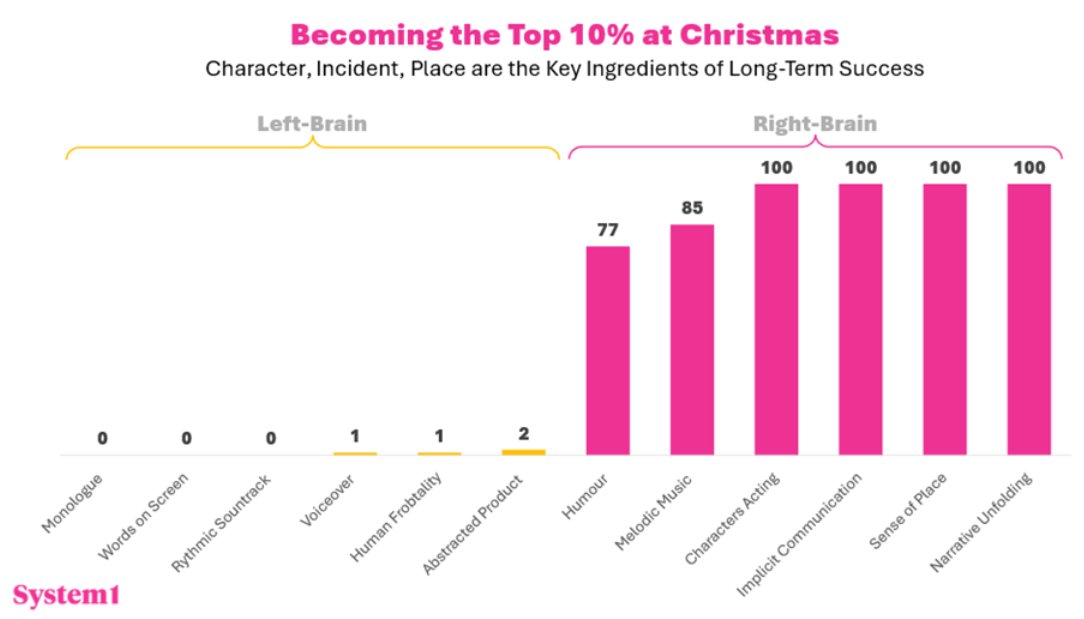
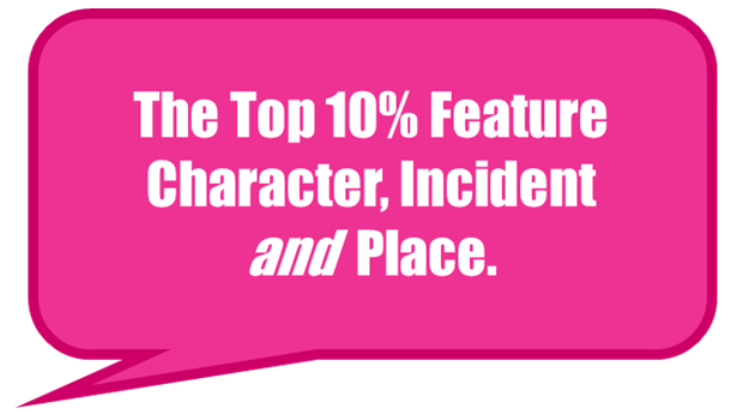
Lesson 3 suitably suggests prioritizing three features in your festive advertising:
4. Brand Codes are Just as Vital at Christmas, if not More!
Codify, codify, codify. Mark Ritson’s famous rallying cry still holds, because brand codes are one of the simplest ways to make advertising work harder. Your distinctive assets, like your logo, colors, characters, sonic cues, taglines, and pack shots, are not just nice-to-haves. They are memory shortcuts that help people recognize you quickly and remember you later.
That matters even more when the festive season rolls around. The Christmas period is consistently one of the busiest times for ads airing, with more campaigns running from October to December than at any other point in the year. It is a crowded, competitive window where brands are fighting to be seen and remembered, and that makes brand codes more important than ever.
Andrew Tindall’s research with System1 and Effie put a useful number on this. The “magic number” of brand codes in a 30-second spot is seven. When ads include around seven clear brand cues, brand recall rises sharply. In other words, if you want people to remember who the ad was for, you need enough distinctive assets on screen and in earshot to make recognition effortless.
So we applied the same thinking to festive fluency. We looked at how many brand codes it took to drive Fluency Rating, the percentage of viewers who correctly attribute the ad to the right brand, to its highest levels during Christmas. The result was reassuringly consistent. The Christmas magic number is still seven, and it works just as hard in the festive rush.
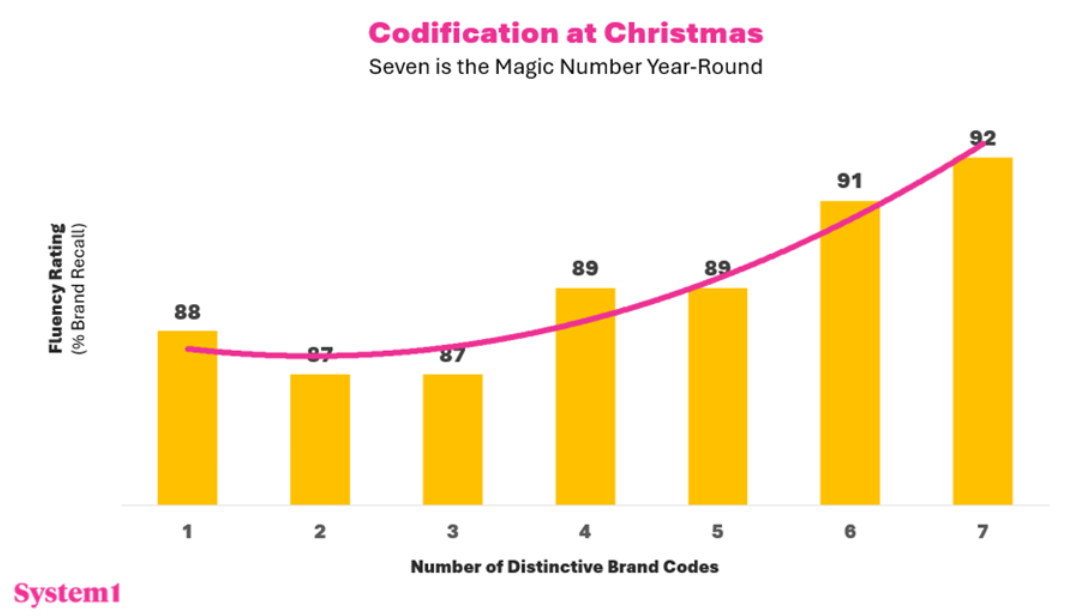
The implication is straightforward. If you want your Christmas campaign to deliver, you need to brand boldly and consistently throughout the story. Do that, and you increase the chance that the emotion you create is credited to your brand, not to the category or the season. That is how you turn festive feeling into stronger commercial outcomes and long-term brand growth.
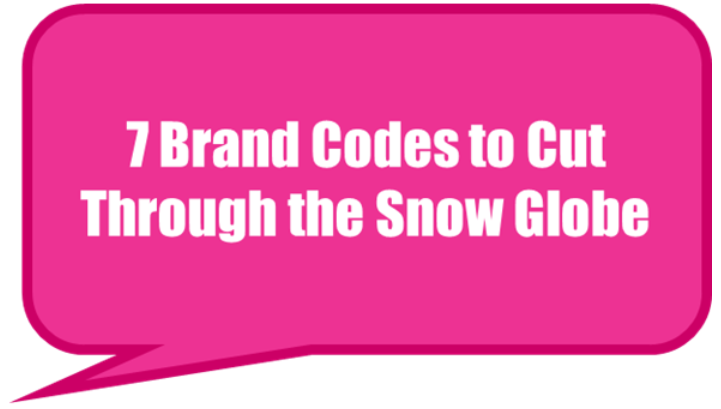
Lesson 4 is not a chore, it’s core:
Create with Confidence®
If you want Christmas ads that cut through, the lesson from 2025 is simple. Craft matters. Consistency matters. And your distinctive brand codes do a lot of the heavy lifting, especially when festivities are at their peak.
That’s where System1’s Test Your Ad Competitive Edge comes in. It shows you how your ad is landing against the Christmas competition, with second-by-second emotional response so you can spot exactly where character, incident, and place are doing the work, and where the story or branding needs a bit more sparkle.
And you are not on your own with the numbers. Our expert team can help you turn the data into clear, practical creative decisions, so your ad is not just loved, it is remembered.