• About
    • About Us
    • Leadership Team
  • Products
    • Test Your Ad
    • Test Your Ad Competitive Edge
    • Test Your Innovation
    • Test Your Brand
    • Case Studies
    • Methodology
  • Insights
    • Latest & Upcoming
    • The Creator Effectiveness Playbook
    • The Creative Dividend – Effie
    • The Startling Power of Surprise
    • Super Bowl 2027 Ads
    • Orlando Wood
    • Advertising Principles Explained
    • Lemon
    • Look Out
    • Achtung! How to attract and sustain attention
    • Advertising Effectiveness
    • Living Room Legends – ITV
    • Putting on a Show – Aardman
    • The Extraordinary Cost of Dull
    • The Multiplier Playbook
    • Compound Creativity
    • Category Insights
    • How Creativity Boosts ROI
    • Ritson on Ad Effectiveness
    • Sports Sponsorship
    • Unlocking Profitable Growth
    • Cultural Moments
    • Super Bowl 2027 Ads
    • The 12 Gifts of Christmas
    • Olympics Advertising
    • Olimpíadas (Portuguese)
    • World Cup
    • Futebol (Portuguese)
    • Media Channels
    • Audio
    • Digital – TikTok
    • Digital – Pinterest
    • OOH – JCDecaux
    • TV
    • Representation
    • Seeing Gen Z
    • Feeling Seen USA
    • Feeling Seen UK
    • Wise Up!
    • Sustainability
    • The Greenprint USA
    • The Greenprint
    • The Greenprint Brazil
  • News & Events
    • News
    • Ad Of The Week
    • Blog
    • Uncensored CMO
    • In The Press
  • Investors
    • Investor Info
    • The Board
    • ESG
  • Work With Us
    • Careers
    • Culture
  • Contact Us
    • Get In Touch
    • Offices
Request a Demo
  • About
    • About Us
    • Leadership Team
  • Products
    • Test Your Ad
    • Test Your Ad Competitive Edge
    • Test Your Innovation
    • Test Your Brand
    • Case Studies
    • Methodology
  • Insights
    • Latest & Upcoming
    • The Creator Effectiveness Playbook
    • The Creative Dividend – Effie
    • The Startling Power of Surprise
    • Super Bowl 2027 Ads
    • Orlando Wood
    • Advertising Principles Explained
    • Lemon
    • Look Out
    • Achtung! How to attract and sustain attention
    • Advertising Effectiveness
    • Living Room Legends – ITV
    • Putting on a Show – Aardman
    • The Extraordinary Cost of Dull
    • The Multiplier Playbook
    • Compound Creativity
    • Category Insights
    • How Creativity Boosts ROI
    • Ritson on Ad Effectiveness
    • Sports Sponsorship
    • Unlocking Profitable Growth
    • Cultural Moments
    • Super Bowl 2027 Ads
    • The 12 Gifts of Christmas
    • Olympics Advertising
    • Olimpíadas (Portuguese)
    • World Cup
    • Futebol (Portuguese)
    • Media Channels
    • Audio
    • Digital – TikTok
    • Digital – Pinterest
    • OOH – JCDecaux
    • TV
    • Representation
    • Seeing Gen Z
    • Feeling Seen USA
    • Feeling Seen UK
    • Wise Up!
    • Sustainability
    • The Greenprint USA
    • The Greenprint
    • The Greenprint Brazil
  • News & Events
    • News
    • Ad Of The Week
    • Blog
    • Uncensored CMO
    • In The Press
  • Investors
    • Investor Info
    • The Board
    • ESG
  • Work With Us
    • Careers
    • Culture
  • Contact Us
    • Get In Touch
    • Offices
  • The Creator Effectiveness Playbook
    The Creator Effectiveness Playbook
Download Now

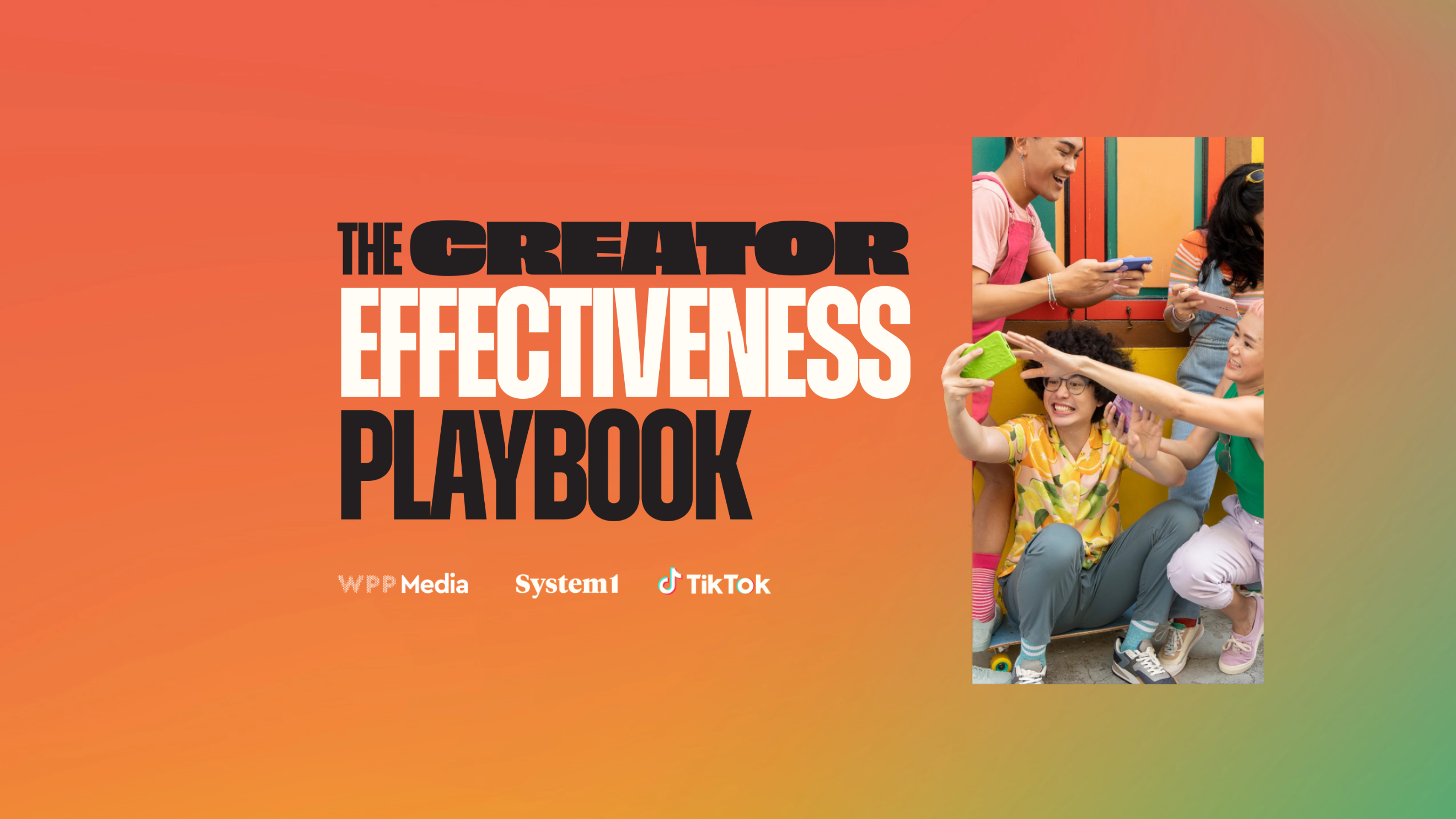
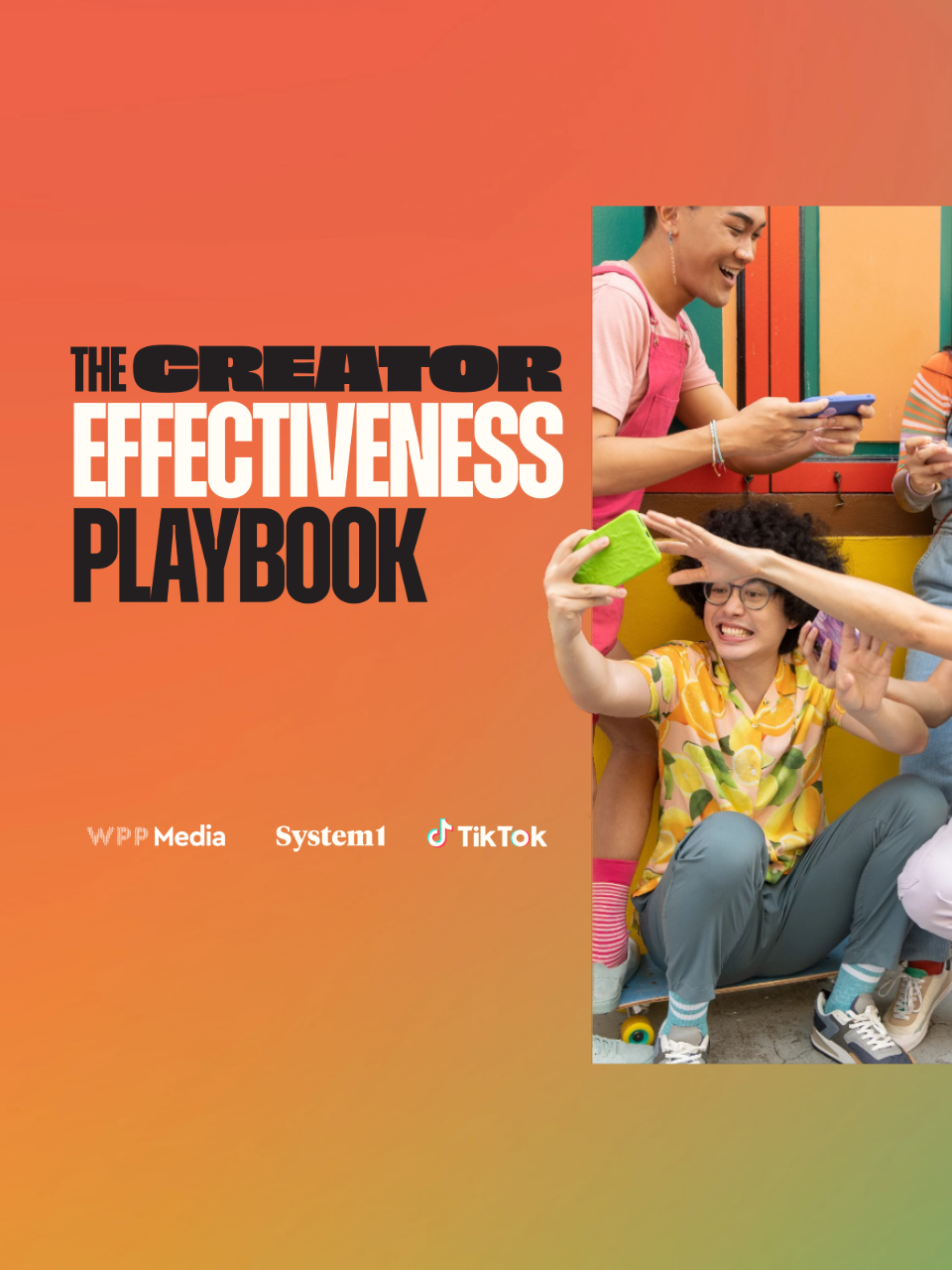
The Creator Effectiveness Playbook from WPP Media, System1 and TikTok

Marketers are investing more in influencer marketing and creators than ever before. But one challenge still remains. While creator content captures attention, it doesn’t always translate into brand growth.

Following IPA research that established creators as genuine brand builders, WPP Media, System1 and TikTok are launching The Creator Effectiveness Playbook, the highly anticipated follow-up to The Long and the Short (Form) of It, revealing how to close that gap.

Built from a major new study, this report provides the most practical, evidence-based guidance yet on how to make creator advertising work harder for your brand. Drawing on analysis of hundreds of creator ads, it uncovers how different types of creators drive attention, emotion and branding, and how to choose the right approach based on your objectives.

The research was unveiled at the Palais during Cannes Lions in a session featuring Andrew Tindall (System1) and Eugene Healey (Studio EH).

Submit your details now to access the full report.

.

Watch the webinar

In this webinar, Andrew Tindall, Chief Growth Officer at System1, alongside Josh Gornell, Vice President of Commercial Paid Social at WPP Media, and Sarah van den Eertwegh, Product Marketing Lead at TikTok, unpack The Creator Effectiveness Playbook and reveal how brands can leverage creator marketing to drive long-term growth.

FAQs

What is the Creator Effectiveness Playbook?

The Creator Effectiveness Playbook is a global study of paid creator advertising effectiveness, built by WPP Media, System1 and TikTok. It is one of the largest studies of its kind ever conducted. The research identifies three levers: Creative Quality, Creator Fame and Brand Fit. These predict whether a creator ad will build Brand Memory Lift.

Methodology

The report was built from an analysis of 1,217 paid TikTok ads across 8 markets (US, UK, Germany, France, Italy, Spain, Brazil and Mexico), tested among 182,550 TikTok users and matched to 350+ TikTok Brand Lift Studies. The total dataset represents an estimated $70.5 million in media spend and 23.6 billion impressions.

Creative performance was measured using System1’s Test Your Ad Social platform, which captures emotional response (Star Rating), attention, and early brand recognition among 150 TikTok users per ad in a skippable environment.

What is Brand Memory Lift and Why Does it Matter?

Brand Memory Lift measures whether exposure to an ad increased people’s memory of the brand compared to a matched control group. It is a weighted composite of Brand Awareness Lift and Ad Recall Lift (2:1 ratio, with Brand Awareness weighted more heavily because it captures whether the memory linked back to the brand).

WPP Media research across 1.2 million purchase journeys shows that 84% of purchases go to brands people were already biased toward before they began actively looking. This is why Brand Memory, not engagement, is the right metric for creator advertising.

Do Creator Ads Build Brands?

Yes. Creator ads deliver 23% more Brand Memory Lift than brand-made ads on short-form video.

According to IPA Influencer Benchmarking data, creators carry the highest long-term ROI multiplier of any advertising channel measured, ahead of linear TV.

System1 and Effie’s book, The Creative Dividend looked at 1,265 Effie Insights campaigns, nearly $140 billion in category revenue and found that creators rank as the strongest touchpoint for building long-term Brand Effects, ahead of TV, radio, print and cinema.

Is Engagement Rate a Reliable Measure of Creator Advertising Effectiveness?

It’s time to rethink Engagement Rate. Across 129.6 million engagements analyzed in the study, Engagement Rate shows no significant relationship with Brand Memory Lift. Engagement Rate explains approximately 0.2% of Brand Memory Lift. Even the strongest engagement signal tested, the ratio of comments to likes, explains only 11.3%.

What Actually Predicts Brand Memory Lift?

Creative Quality is a better predictor. It is defined as the combination of emotional response (the type of emotion predicts long-term brand building potential, measured by System1’s Star Rating) and Early Branding (correct brand recognition within the first 2 seconds, measured by System1’s Fast Fluency metric).

Creative Quality explains 54.6% of Brand Memory Lift. This is 4.8 times better than the strongest engagement metric tested. Emotion alone (Star Rating) explains 28.1% of Brand Memory Lift. Adding Early Branding increases this to 54.6%.

The Three Levers: Creative Quality, Creator Fame and Brand Fit

Creative Quality

Creative Quality is the combination of emotional response (Star Rating) and Early Branding (Fast Fluency). It is the single most powerful predictor of Brand Memory Lift, explaining 54.6% of outcomes. Showmanship features such as characters acting, story unfolding, humor, recognizable environments, etc. increase emotion. Salesmanship features like many words on screen, hard calls to action, facts and figures, etc. reduce emotion by 7% to 12%.

Creator Fame

Creator Fame is defined as whether the brand’s target audience recognizes the creator. Importantly, it is not how many followers the creator has, as follower count does not reliably predict recognition. 72% of micro-creator audiences (10k–100k followers) show the lowest levels of recognition. The average recognition rate for celebrities (1M+ followers) is 23.5%, compared to 8–10% for micro and macro creators. Creator ads with above-average Creator Fame drive 58% more emotion and 17% more attention than those with below-average Creator Fame.

Brand Fit

Brand Fit measures whether the brand has a natural, credible role in the creator’s world. Creator ads with above-average Brand Fit drive 23% more emotion and 10% more attention. When brands must prioritize one creator lever over another, they should opt for Brand Fit over Creator Fame. A smaller creator in the right world, with a product role that feels natural, outperforms a larger creator where the brand feels bolted on.

What’s the Impact of Stacking the Three Levers Together?

When Creative Quality, Creator Fame and Brand Fit are all high, Brand Memory Lift rises to almost 4 times the weak baseline. High Creative Quality alone delivers 2.53x the Brand Memory Lift of a weak baseline. Adding high Creator Fame raises this to 3.49x. Adding high Brand Fit on top raises it to 3.88x.

Distinctive Brand Assets and Early Branding

The four highest-performing early brand cues in creator ads are: logo in context, spoken brand name, written brand name and sonic assets. Sonic assets deliver the highest Brand Memory Lift of any cue tested, yet fewer than 5% of creator ads use them in the opening seconds.

Two cues are overused and associated with lower Brand Memory Lift when used in the opening seconds: brand colors and product shots.

The optimal number of Distinctive Brand Assets in the first 2 seconds of a creator ad is two to four. Using both audio and visual brand cues together drives 2x the early brand recognition of visual branding alone.

What is a Social Device?

A Social Device, coined by System1’s Andrew Tindall in the research, is a Distinctive Creator Asset. It is a recognizable, repeatable format like a place, prop, persona, phrase, sound or behavior, that audiences recognize on sight before the content has to explain itself. It is a creator-owned asset that a brand can benefit from.

A Social Device compounds in effectiveness over time. Used consistently, it signals a payoff is coming and primes the audience to engage. It simultaneously lifts Creator Fame (the creator’s world becomes instantly recognizable), strengthens Brand Fit (the product has a pre-built role), enables Early Branding (brand cues can be designed into the setup), and secures Platform Fit.

Does Entertainment Level Matter?

Entertainment greatly impacts Creative Quality and overall impact. The most entertaining creator ads score 21% higher on emotion (2.7 Star Rating vs 2.2 Stars) and earn 82% more attention in the first 6 seconds than the least entertaining ones.

Entertainment also levels the playing field across creator size: the most entertaining micro-creator ads (10k–100k followers) deliver Brand Memory Lift comparable to macro (301k–1M) and celebrity (1M+) creators. Without entertainment, Brand Memory Lift clusters at the same low level regardless of creator size.

The Planning Model for Creator Advertising

The Creator Effectiveness Framework outlined in the playbook operates in two stages.

– Stage 1 (Strategy) focuses on Creator Fame and Brand Fit. Start with the human need the brand wants to dramatize, find the creator world where that need lives naturally, verify the audience recognizes the creator or world (i.e., Creator Fame), and confirm the brand has a credible role there (i.e., Brand Fit).

– Stage 2 (Brief) builds Creative Quality. Brief for entertainment over explanation, ensure the brand is both seen and heard in the opening seconds using two to four native cues, and brief with discipline rather than visible control.

Notably, a strong strategy with a weak brief still outperforms a weak strategy with a strong brief. You cannot outbrief a bad strategy.

Get in touch

Want to make 5-Star Marketing? Need to understand your customers better? Interested in knowing more about anything we do?

We’d love to hear from you.

Contact Us
FANCY A CLOSER LOOK?

Request a demo
with one of our experts

Complete the form to book your demo.

  • Discuss your use cases and business needs
  • Our expert will give a hands-on demonstration of the platform
  • We’ll show how deep consumer insights can guide your marketing strategy

Get the Ad Of The Week in your inbox

By subscribing you agree to the use of your data in accordance with our privacy policy

Got a specific question? Get in touch

Services are conducted in accordance with ISO 20252 and MRS standards.

  • Instagram icon
  • Privacy & Cookies
  • Terms & Conditions
  • Corporate Social Responsibility
  • Contact
  • Modern Slavery Statement
  • Company Info
  • Financial Info
  • Share Details
  • Investor News
  • Shareholder Info
  • Corporate Governance
  • AIM Rules

Please note that www.system1group.com is the official and trusted source for information about our company and services. Exercise caution when accessing information from other sources.

© 2026 System1 Group PLC. All rights reserved.