
Will Graze’s Brownies Grow the Brand, or Cannibalise It?
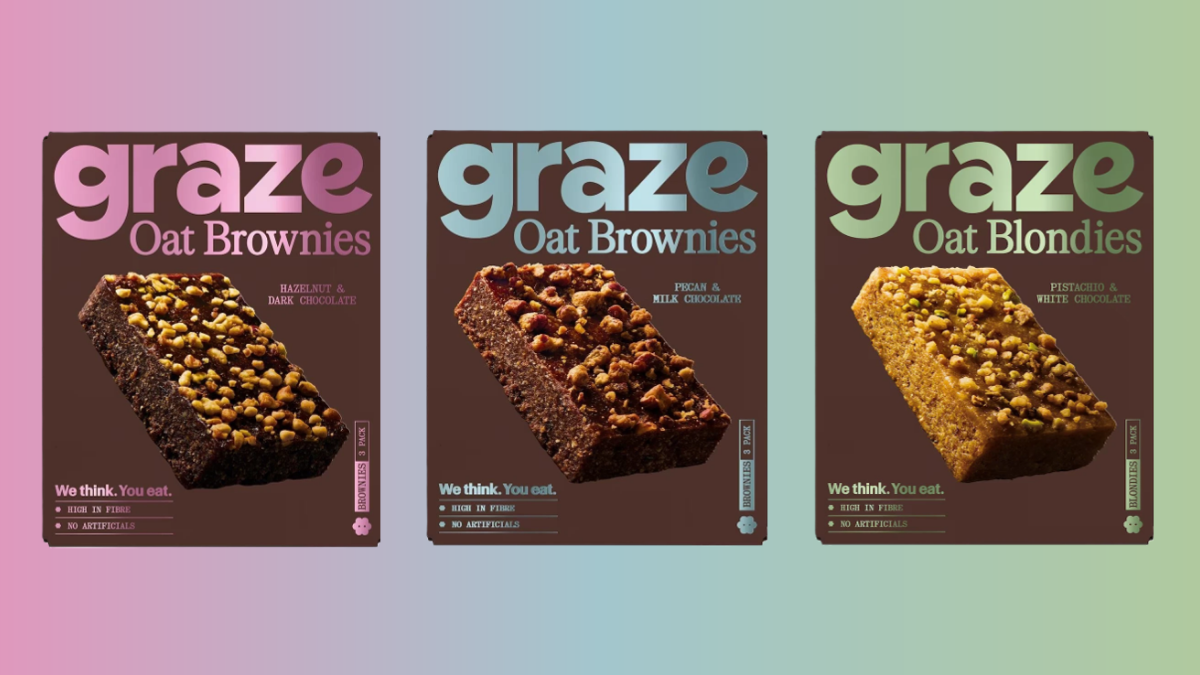
Jamie Laing is no stranger to building brands. As Candy Kittens takes the reins at Graze, the brand best known for nut mixes and virtuous snacking is entering new territory with a range of decadent oat brownies.
It’s an exciting move for a brand whose personality has always been “healthy, but make it fun”. But whenever an established brand stretches into a new category, one question quickly follows: are we winning new shoppers, or just moving existing ones around?
System1 tested the new Graze Oat Brownies range using our Test Your Innovation platform, and the topline is hard to argue with: a 4.8-Star Rating. Only around 15% of ideas we test make it past the 4-Star mark, making this a strong signal of commercial potential.
But the more useful story sits underneath that number. Because when a brand stretches into adjacent territory, a great innovation score is only half the picture. You also need to know who is buying, what they’re buying instead, and whether you’re genuinely growing the brand.
A Strong Innovation is Only the Starting Point
We tested the brownies across three audiences: a nationally representative sample, people aware of Graze, and people who had never heard of the brand.
The emotional response was strong across all three. Happiness was the dominant emotion, negativity was almost nowhere to be found, and “Fits with the brand” scored above 95% in every audience.
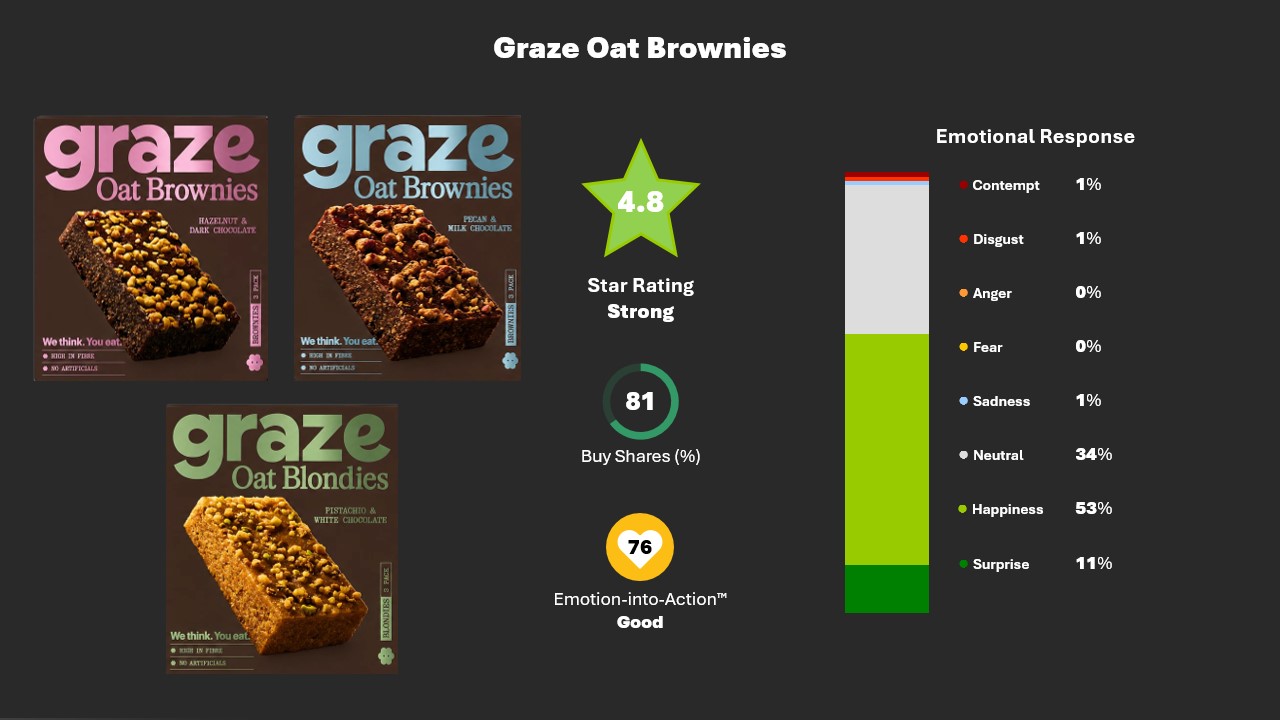
That’s important. Despite moving into a more indulgent format, Graze hasn’t lost its brand halo. Shoppers aren’t looking at an oat brownie and thinking, “Since when?” They’re thinking, “That works.”
So the question isn’t whether the idea works.
It’s who it works for.
The Cannibalisation Question Every NPD Team Should Ask
We asked people whether they would buy the brownies instead of something they currently buy, or as well as it.
The difference between those answers is where the commercial story gets interesting.
Among people who already know Graze, 37% said they’d buy the brownies instead of something they currently buy, compared with 39% who would buy them in addition to their existing purchases.
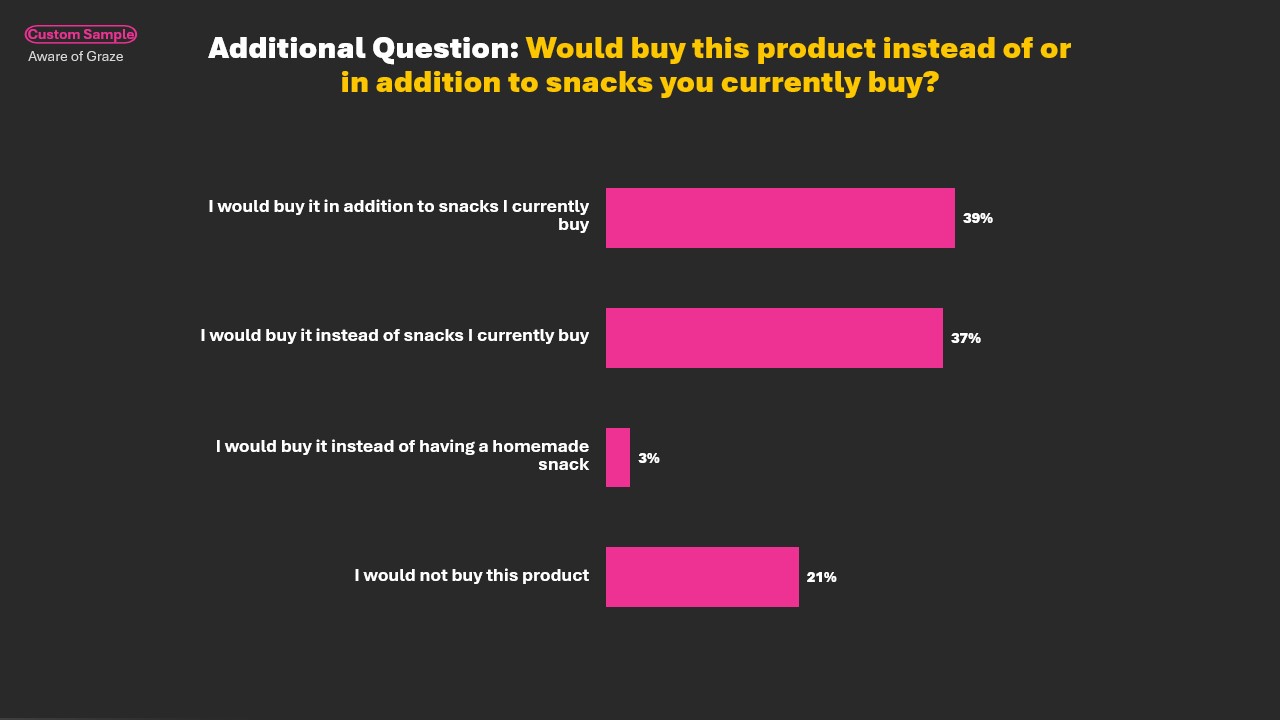
Among people new to the brand, just 25% said they’d buy the brownies instead, while almost half would add them to their existing snacks.
That suggests the risk of cannibalisation is concentrated among existing Graze shoppers. New-to-brand consumers are more likely to see the brownies as an incremental purchase.
There’s another important clue. When asked what they would buy if the brownies weren’t available, existing Graze fans were just as likely to choose another brand, such as Kellogg’s or Jordans, as another Graze product. Those aware were even more likely to choose Eat Natural or Nature Valley as an alternative, while new-to-brand shoppers were more likely to turn to Kellogg’s.
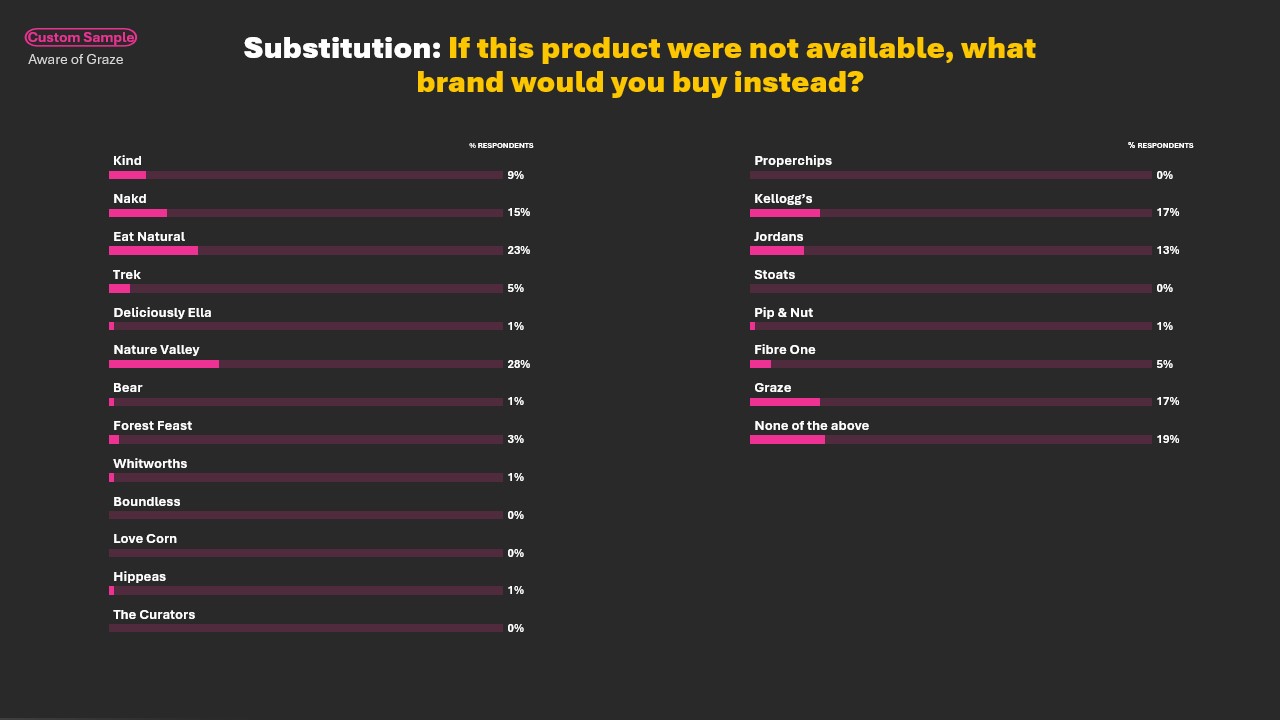
In other words, Graze’s loyalists may be reshuffling their basket rather than expanding it. And if the brownies aren’t available, that demand isn’t necessarily captured by another Graze product. It can go straight to a competitor.
That isn’t a reason not to launch. It’s a reason to understand the implications before the product hits the shelf, and to use that insight to inform everything from distribution and shelf space to sales forecasting.
What This Means for Brands Moving Into Adjacent Territories
For CMOs signing off a rebrand, NPD teams developing a range extension, or insights teams trying to get everyone to pause before launch, the takeaway is simple:
Test the risk, not just the idea.
Handily, these are questions Test Your Innovation is already designed to answer. The metrics give you the detail behind the headline Star Rating, so you can move from “is this a good idea?” to the more useful question: “how do we make this idea work?”
A few lessons from Graze are particularly useful:
- Strong concept performance alone is not always enough. Test Your Innovation includes a substitution question and consumer claimed sourcing to indicate which concepts are likely to cannibalise the existing franchise.
- Look beyond demographics. Cut the results by brand awareness as well as age and gender. Graze scored 4.8 nationally, 4.0 among people who already knew the brand and 3.8 among those who didn’t. The same idea can work very differently for existing and new customers.
- Know what people associate with your brand. If you’re trying to make a brand healthier, more premium or more indulgent, check you’re not losing the qualities that made people choose it in the first place.
- Use the data to advance retailer conversations. If shoppers can’t find your innovation, where do they go instead? For Graze, existing fans were just as likely to switch to competitors as another Graze product. That makes availability a growth opportunity, not just a logistics issue.
Jamie Laing and Ed Williams built Candy Kittens around a challenger mindset, and that ambition now sits behind Graze too. That ambition is exactly why testing matters here: bold moves are much easier to back with confidence when you know precisely where the risk sits, and precisely what to do about it.
A 4.8-Star Rating is a fantastic start. What Graze and every brand eyeing an identity shift does with the cannibalisation data underneath it is what will actually decide whether this launch drives incremental growth or just gets very good at redistributing the growth it already had.
Access the full Graze Brownies report here
Create with Confidence®
Graze’s brownies show the opportunity in stretching a brand into new territory. Additional insights from substitution questions and demographic splits shows why understanding the risks matters just as much as measuring the upside.
From new product concepts to packaging, System1’s Test Your Innovation helps you understand how consumers feel and how they’re likely to behave in-market, before you commit to launch.
And because every test is bespoke, you can ask the questions that matter most to your specific innovation. Whether that’s “will people buy this instead of something else?”, “does this feel right for the brand?” or “what happens if they can’t find it?”, you can build the test around the decisions you need to make.
With results validated against real in-market sales, you’re not just finding out whether people like your idea. You’re finding out whether it has what it takes to grow your brand.