
This Isn’t Another “Just Stick a Logo on It” Piece
The Last One Branding
Logo placement, and when to brand, comes up almost weekly in our conversations with brands and agencies about ad optimization. There’s a familiar tension at play. Brands worry that showing the logo too early might puncture emotional engagement, flatten the story, or spoil the big reveal.
The irony? Holding back often does the exact opposite of what’s intended.
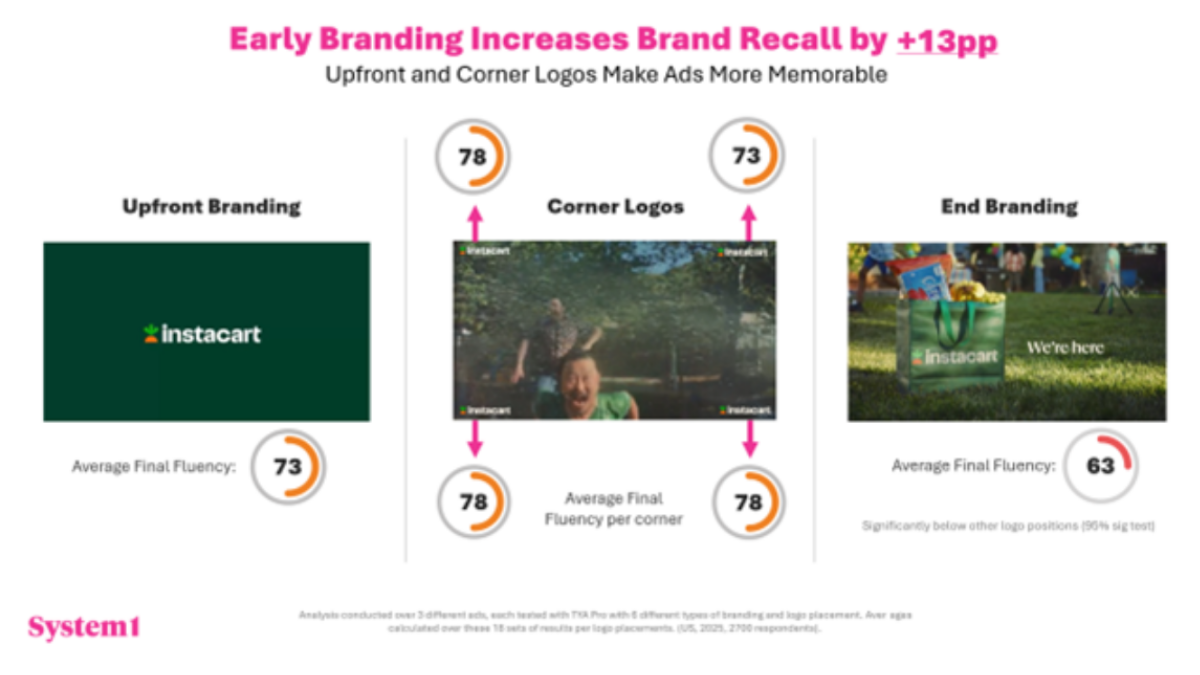
Our research shows that branding as early as possible, within the first 2–5 seconds, is strongly linked to higher Fluency, System1’s measure of brand recall. Put simply, if people know who the ad is for early on, they are far more likely to remember it by the end.
Fortunately, this is not something our consultancy team has to guess at. With access to hundreds of thousands of ads via Test Your Ad Competitive Edge, our expert consultants can provide answers tailored to each client’s specific challenges. We replace instinct with evidence, resolving debates through testing, guidance, and real-world competitive insight.
And this is exactly what we did.
Logo Limitations
Before diving into the results, it is worth saying this clearly. Branding is more than a logo.
Logo placement is often a practical, cost-effective lever, particularly for brands optimizing in post-production or smaller brands still building their distinctive asset toolkit. But as our work with Effie highlights in The Creative Dividend, logos are relatively weak brand codes compared to characters, sonic devices, or jingles.
If you already have strong assets like these, absolutely use them. If you do not, it might be time to start building them.
That said, even the strongest brand codes do not work in isolation. The most iconic brands, KitKat, Coca-Cola, McDonald’s and Apple, know that branding is a team sport, not a singles match. Our research shows that achieving near-perfect Fluency in a 30-second ad typically requires around seven different brand codes working together.
This study is just an example of how testing and guidance can solve your questions and deliver your brand maximum commercial outcomes.
This study focuses on just one of those codes, but it is a powerful example of how testing can turn uncertainty into commercial confidence.
And now, let’s get to the results.
The Study: Logos, Tested Properly
We carried out independent research across three brands, testing six different logo placements (upfront, corner and end frame). In total, we spoke to 2,700 US consumers to understand how logo placement affected:
- Fast Fluency (time-weighted brand recall)
- Overall Fluency (total brand recall)
- Emotional engagement, measured by System1’s Star Rating
- Short-term sales impact, measured by System1’s Spike Rating
No opinions. Just data.
Logo Placement & Brand Recall
No surprises here, but the scale of the effect is worth paying attention to.
All ads featuring early logo introduction (upfront or corner) saw clear improvements in both Fast Fluency and overall brand recall, regardless of exact placement.
On average:
- Fast Fluency increased by +39%
- Overall brand recall increased by +13%
These are not marginal gains. They translate directly into stronger brand awareness, reduced misattribution, and better returns on both media and creative investment.
Our Advice
If brand awareness and recall are your priority, brand as early as possible, using an upfront logo or a corner logo. Do not save the reveal for the end and hope viewers are still watching, still paying attention, or even still in the room.
Logo Placement & Emotional Engagement
What about the fear that logos kill emotion?
There is some truth to it, but with an important caveat.
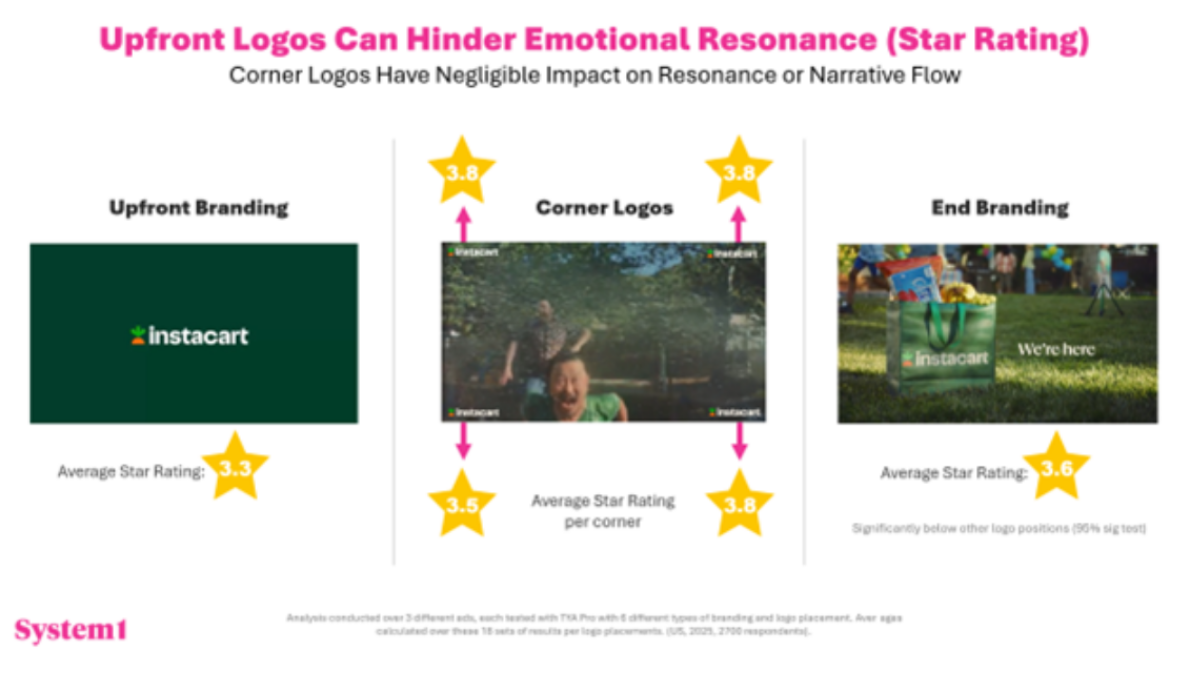
Our findings show that corner logos protect emotional engagement far better than logos featured prominently in the opening frame. So yes, clients are right to be cautious, but there is a solution. Corner logos have a negligible impact on happiness levels, while still delivering branding benefits.
Our Advice
If emotional appeal is your main objective, open with a corner logo. It keeps the narrative flowing while ensuring viewers know who the story belongs to. Waiting until the end may preserve emotion, but if audiences cannot remember the brand, that emotional equity may end up benefiting the category, or worse, a competitor.
Logo Placement & Short-Term Sales
Branding early does not just help memory. It affects action.
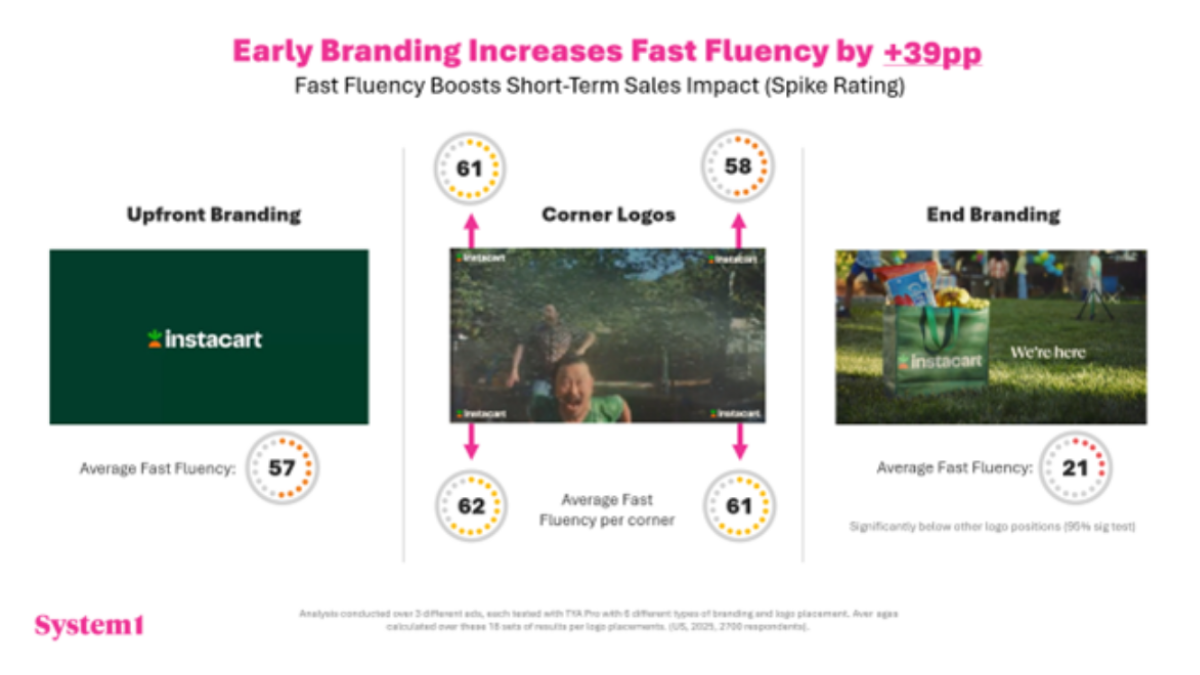
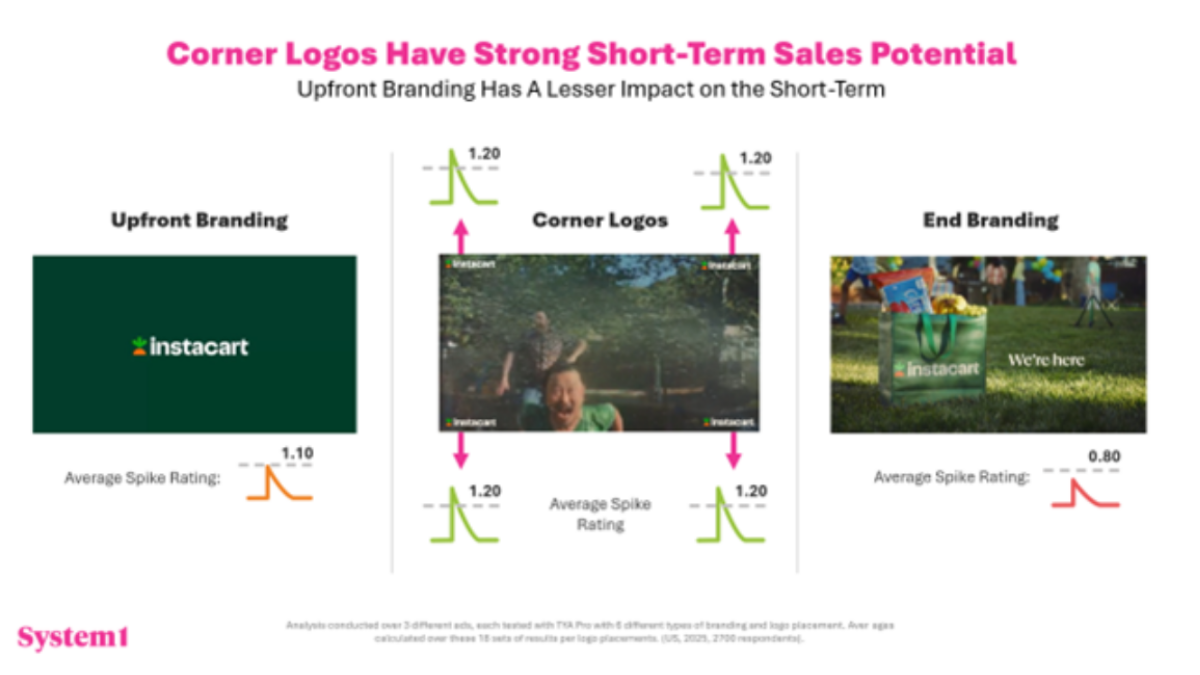
By tripling Fast Fluency compared to end-frame-only branding, early logo placement also improved Spike Rating, System1’s predictor of short-term sales and activation effects. Spike combines emotional intensity and Fast Fluency, making it a powerful indicator of immediate commercial impact.
In short, yes, logo placement can influence sales.
But there is a catch.
The emotional dip caused by upfront logos also drags on short-term sales, because emotional intensity is a key part of the Spike equation. As happiness falls and neutrality rises, sales effects soften too.
Our Advice
If short-term sales are your priority, corner logos are the safest choice. They boost Fluency while preserving emotional strength, giving you the best of both worlds.
The Final Score
Logo placement should always be driven by objectives. But across brand recall, short-term sales, and emotional engagement, one option consistently outperformed the rest.
Corner logos.
They improve memorability, support sales activation, and maintain emotional impact for long-term brand growth.
Create with Confidence®
System1’s expert consultants support brands throughout the entire creative process, acting as a true guidance partner from early script development through finished film and post-launch optimization. Through Test Your Ad Competitive Edge, we combine an unrivalled database of norms, examples, and case studies with iterative testing and refinement, helping brands shape work that maximizes emotional resonance, strengthens distinctive brand assets, and ultimately delivers greater impact in market.
Beyond client projects, our consultancy team also runs independent research to unlock even more value from this extensive database. By proactively exploring creative questions and identifying patterns across categories, formats, and markets, we generate fresh insights and practical solutions to everyday challenges. This ensures brands are supported whether they are tackling major strategic shifts or simply looking to make small creative improvements that add up to meaningful gains.