
Colour Grading Is Not Just a Finishing Touch

Shifting the Colour Dial
Colour grading has long been treated as creative polish. The finishing touch. The layer that elevates atmosphere, sharpens mood and makes an ad feel more cinematic, premium or emotionally charged.
But what if grading is doing far more heavy lifting than we give it credit for?
For years, marketers and creatives have instinctively understood that colour influences perception. Warmth can create comfort. Cooler tones can signal tension, sophistication or drama. Brightness, contrast and saturation all shape how a story feels before a single word is spoken.
The bigger question is whether those creative decisions meaningfully influence commercial outcomes.
Can colour grading improve emotional response strongly enough to drive effectiveness? Does it shape memory, attention and long-term brand growth potential? Or is it simply a visual enhancement that makes creative look better in the edit suite, without materially changing performance?
It is a question we hear increasingly often from clients, particularly as production timelines tighten and every creative decision comes under greater scrutiny. In that environment, grading can sometimes be deprioritised as a “nice to have” rather than treated as a strategic lever.
Naturally, that got the research instincts of our System1 expert consultants firing.
From C- to A+: Testing the Commercial Impact of Colour Grading
To understand whether colour grading could genuinely influence commercial performance, we analysed seven ads across the UK and US, testing the original creative alongside an alternative grading treatment.
The objective was simple: isolate the effect of colour grading on emotional response and long-term effectiveness.
Each ad received one of the following grading treatments and was evaluated against a nationally representative sample of 2,100 consumers across both markets:
1. The original ad grading
And either:
2. A warmer overall grade
3. A cooler overall grade
4. A dynamic shift from cool to warm grading throughout the ad
By testing each variation side by side, we were able to identify how subtle shifts in colour tone influenced both emotional engagement and commercial potential. Effectiveness was measured using System1’s Star Rating, our long-term predictor of brand growth and market share gain.
Importantly, this research was not about identifying whether one colour palette is universally “better” than another. It was about understanding how grading can strengthen storytelling, reinforce emotional intent and shape the consumer experience in ways that support effectiveness.
We were also interested in whether changes in grading could function as emotional turning points within a narrative. Could a shift in tone create momentum? Build anticipation? Heighten contrast between emotional states?
In short, this was not simply about whether an ad looked more aesthetically pleasing.
It was about whether grading could help ads work harder.
The Effectiveness Report: Which Treatment Earned the Best Grade?
1. Blanket Grading
The first approach we tested was “blanket grading”: applying a consistently warmer or cooler hue across the entire ad.
On average, this delivered a modest but meaningful uplift in effectiveness, increasing Star Ratings by up to +0.4 Stars. In many cases, grading strengthened atmosphere and emotional tone, improving how consumers responded to the creative overall.
But one insight became clear almost immediately: effective grading is highly contextual.
Going into the research, I expected warmer and brighter tones to perform best across the board. The assumption felt intuitive. Warmth is emotionally positive, after all.
The data disagreed.
In Hyundai’s case, warmer grading actually reduced emotional congruency. The ad’s Viking-inspired setting and dramatic narrative felt less believable and less natural when overlaid with warmer tones. Cooler grading, by contrast, amplified the atmosphere and reinforced the story world more effectively.
Etsy showed the opposite pattern. Here, warmer grading strengthened feelings of intimacy, celebration and joy, enhancing the emotional payoff in the ad.
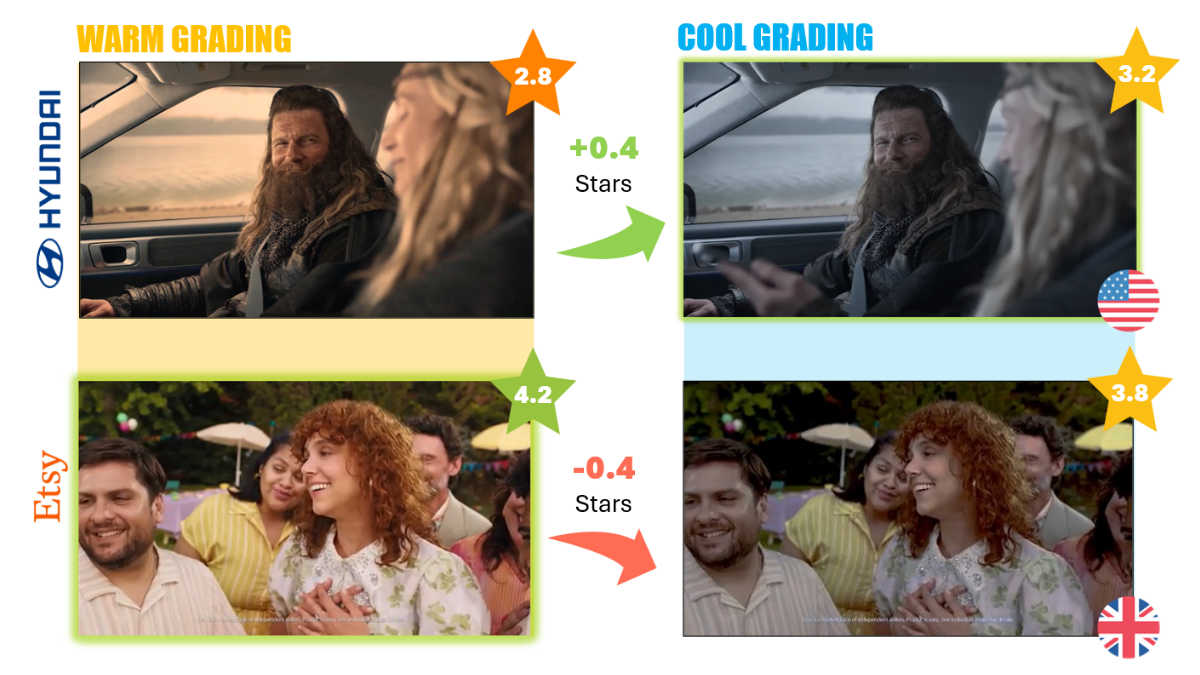
Across the study, warmer tones generally performed best in celebratory, optimistic and high-energy narratives. Cooler tones proved more effective in dramatic, tense or atmospheric storytelling, particularly in darker or colder environments.
The broader lesson for brands is important: grading should not be treated as an aesthetic trend decision. It works best when it reinforces the emotional logic of the story.
Perhaps most interestingly, consumers rarely mentioned grading explicitly in their Test Your Ad verbatims. People were not consciously saying, “the cooler tones improved my experience” or “the warmer palette made this more emotional”.
And yet the impact showed up clearly in emotional response and effectiveness scores.
That suggests colour grading operates largely at a non-conscious level. Consumers may not actively notice it, but they absolutely feel it.
2. Dynamic Grading
If blanket grading improved atmosphere, dynamic grading proved even more powerful.
Rather than applying a single tone across the entire ad, this approach introduced shifts in grading at key emotional moments within the narrative. Cooler tones were used to heighten tension, uncertainty or drama, before transitioning into warmer grading as the story moved towards resolution, happiness or emotional release.
In essence, the colour journey was designed to mirror the emotional journey.
This treatment delivered the strongest results in the study, increasing Star Ratings by an average of +0.7 Stars. Based on System1’s effectiveness modelling, that equates to around a 0.5% uplift in potential market share growth.
What makes this particularly interesting is how subtle many of the changes appeared visually. In several cases, consumers may not have consciously registered the grading shifts at all. Yet emotionally, the impact was clear, leading to higher Star but also to higher Emotional Intensity.
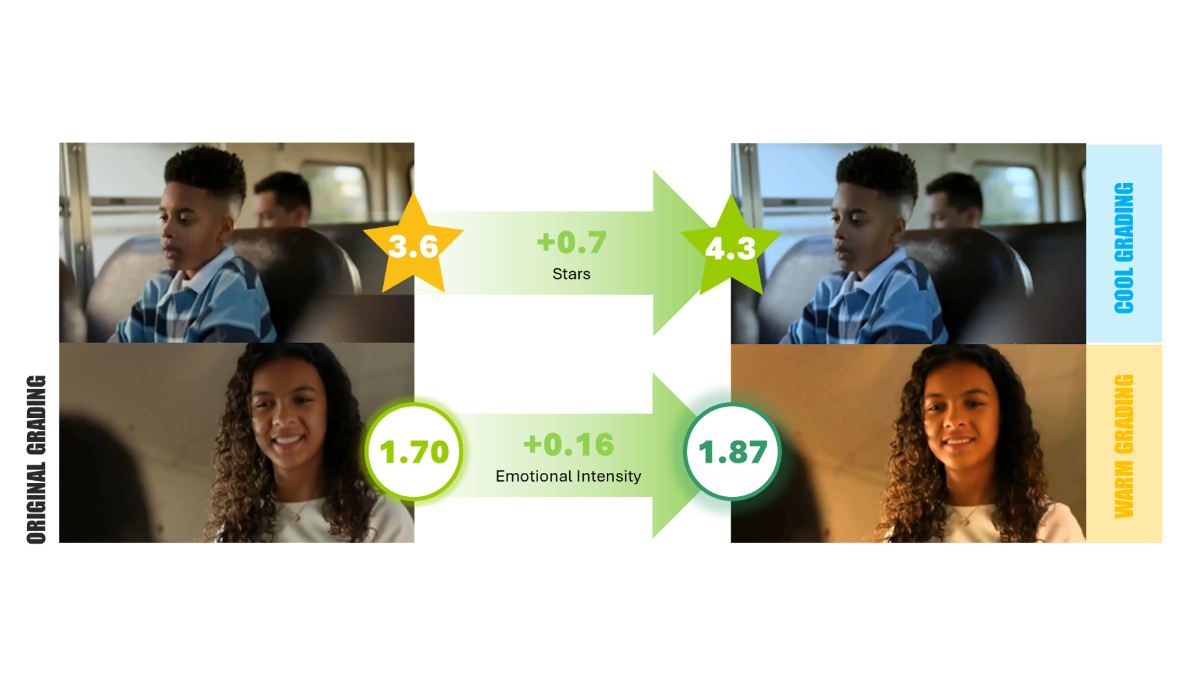
For senior marketers, this highlights an important creative principle: emotion is not static. The strongest ads take consumers on a journey. Dynamic grading appears to help reinforce that journey, creating emotional contrast, momentum and payoff in ways that strengthen effectiveness without changing the core creative itself.
In other words, grading is not simply helping ads look better. It may be helping stories land more powerfully.
Create with Confidence®
At System1, we help brands maximise creative effectiveness at every stage of the creative process, from early development through to final edit and optimisation. Through Test Your Ad Pro and Guidance, our expert consultants combine iterative testing with one of the industry’s richest databases of emotional and commercial effectiveness data to help brands understand how creative decisions, including subtle elements like colour grading, shape consumer response and long-term growth potential.
Because as this research shows, subtle creative tweaks should never be underestimated when they have the power to meaningfully influence how consumers feel and how campaigns perform.