
Are Super Bowl Ads Worth the High Price? A Cost and Effectiveness Analysis
Is a Super Bowl Ad Worth It? The Cost, and What the Data Really Shows
It might seem early to be talking about the Super Bowl but many brands are currently considering whether the Big Game is worth the investment. With every passing year the cost rises, so how much is a Super Bowl commercial? According to Variety, Disney has informed advertisers they’d like $10 million for a 30-second ad for the 2027 telecast of Super Bowl LXI.
Despite the high price tag, they are incredibly effective for the brands that prioritize creative quality. Let’s explore through a data-led approach the current gaps in Super Bowl advertising effectiveness and why this is a good thing for brands that want to break through on football’s biggest night.
How much does a Super Bowl ad cost?
The cost of a Super Bowl commercial depends on a few factors. First, the broadcaster of the next Big Game will assess the rates the previous broadcaster secured. It will review these alongside the current economic climate to determine whether it will be feasible to put forward a price hike and how much that will be. Prices may also fluctuate depending on when advertisers secure their slots – early vs. last minute – and what additional media buys they place alongside their Super Bowl ad.
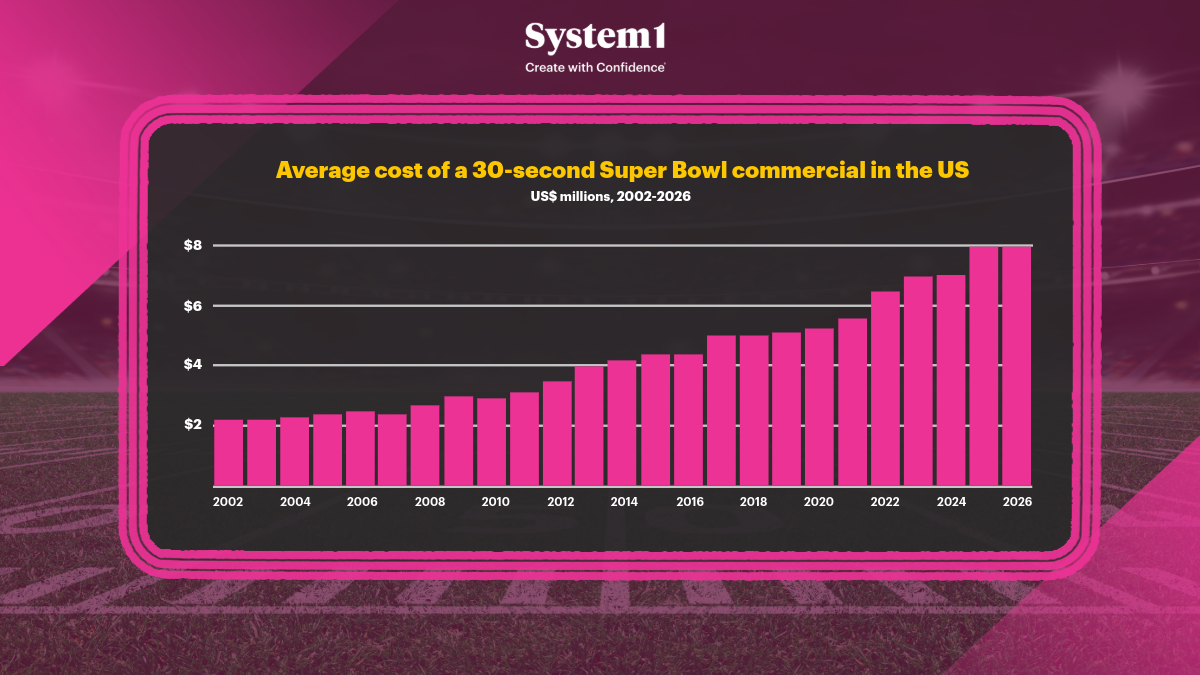
According to Statista, the average cost of a 30-second Super Bowl commercial from 2002 through 2008 fell between $2 and $3 million. The next five years saw $3 million and up as standard.
From 2014 to 2016, $4-4.5 million was the average. In 2017, they topped $5 million and stayed within that range for 5 years. The 2022 Super Bowl saw a new higher average of $6.5 million, followed by two years of $7 million.
So, how much does a Super Bowl ad cost today?
Both 2025 and 2026 averaged $8 million, despite NBC managing to sell a few last-minute ad slots for the 2026 game at $10 million. With Disney aiming to secure $10 million as its standard, that would put the price at $333,333 per second.
Are Super Bowl ads worth it?
Yes, Super Bowl ads are worth the cost if your brand has the creative quality to match the level of investment, and has a plan to extend the lifespan of the ad beyond just game night. Super Bowl advertising effectiveness is a major consideration given its impact on both short-term business results and long-term impact.
When Super Bowl ads are worth it
There are many cases to be made for investing in a Super Bowl commercial, including:
- Mass Reach: Super Bowl LX averaged 125 million viewers, a massive audience for a single event and something that’s difficult to replicate. That figure is still double the number of Americans that watched the World Cup final. Remember though, reach without the right creative is wasted spend. This is why pre-testing a Super Bowl ad can pay back immensely.
- Engaged Audience: The Super Bowl is the one time during the year when people actually seek out and talk about the commercials, and for some it’s the main reason they tune into the game. Rather than skipping, muting or blocking Super Bowl ads, many people watch them with interest.
- Cultural Impact: There’s a rich history of funny, wacky and sentimental Super Bowl ads that have became long-time favorites. Today, Big Game ads can also go far beyond conversations at watch parties, propelling themselves onto bigger stages as part of trends and memes, like Mountain Dew’s 2025 ‘Kiss from a Lime’ ad featuring singer Seal.
- Aligning the Brand with Entertainment: The most successful brands understand that creative that elicits emotion, ideally positive emotion, will drive commercial impact. Humor is one of the best creative routes for seeing returns. It effectively entertains audiences, driving higher Star and Spike Ratings in System1’s testing.
- Short-Term Effects: All of the above factors, when combined with creative quality, can help brands see a short-term spike in KPIs like website and store visits, sign-ups and downloads, purchases and more. System1’s Test Your Ad platform measures short-term potential via our Spike Rating.
- Consistency: Consistently showing up at the Super Bowl compounds its benefits. Brands like Hellmann’s and Budweiser turn up year after year, reinforce their positioning and brand associations through consistent messaging and score well in System1’s testing. System1 and Effie’s book, The Creative Dividend, highlights how the most consistent brands deliver more brand effects and business results and make their advertising more distinctive.
- Long-Term Commercial Impact: Creative quality plus mass reach supports long-term profit gain and market share growth. In 2026, several Big Game advertisers achieved 5-Stars in System1’s testing, predicting ‘Exceptional’ long-term potential. If Super Bowl advertisers get it right, they can drive impact for months if not years.
- The Lifespan of Creative: One of the best ways to extend the benefits of a Super Bowl ad is to air it for a longer period of time, rather than considering it a one-and-done viewing on game night. Increasingly, Super Bowl ads are dropping early in the weeks leading up to the game. In fact, in 2026, 7 out of the top 10 performing Super Bowl ads in System1’s Test Your Ad platform aired their full-length version before game night.
Advertisers should also consider how their creative choices will impact the relevance of the ad beyond game night. More advertisers are now airing their ads months beyond the game, some even the following year to make the most of the investment in production and high creative quality.
When Super Bowl ads aren’t worth it
Is a Super Bowl ad worth it if your creative isn’t properly optimized? The answer is no. There are some risks to consider, especially if you’re not confident that your creative will effectively entertain and be remembered.
- High Costs: The cost of a Super Bowl ad doesn’t just include the game night media buy. It also requires a sound creative strategy, often months of finetuning, production that may include fees for music licensing and celebrity appearances, pre-testing and optimizations, and additional media buys to sustain the campaign beyond the Big Game.
If creative underperforms, this presents a real risk to brands, especially challengers that have put the bulk of their year’s media spend into one campaign. The reality is that most Super Bowl ads are average, as System1’s testing shows they averaged 2.7 Stars in 2026, out of a maximum 5.9 Stars. Ads in the 2-Star range are only predicted to drive modest brand-building results, vs. good (3 Stars), strong (4 Stars) and exceptional (5 Stars and above).
- Short Termism & Performance Mindsets: The goal of the Big Game goes beyond just driving short-term effects, as these don’t guarantee lasting brand growth. System1’s testing measures both short-term sales potential (Spike Rating) and long-term brand building potential (Star Rating) to help marketers understand whether creative will continue working in the months after the game, and how best to optimize it further.
- The Recall Problem: In order for brands to realize the short-term and long-term potential of good creative, they need people to make the link to their brand. Despite so much being invested in Super Bowl ads, there is still a very real recall problem among consumers. In System1’s testing of Super Bowl ads in 2026, 22% of viewers couldn’t remember the brand after watching the commercial. This represented a 7-year low. Advertisers must brand more boldly so that they are remembered.
This is an even greater consideration for challenger brands that will have less recognition than established category leaders. The Super Bowl stage presents a massive opportunity, but only if creative is both distinctive and emotional. Thankfully pre-testing can help measure both the emotional response to creative but also brand recognition.
- Category Rivals Create Competition: The Super Bowl is a popular stage for advertising and it has resulted in many brands from the same category competing against one another at the same time. This has included beer and spirits, auto, snacks, weight loss solutions, AI tools, streaming platforms and more. Often advertisers frame the Super Bowl as a competition between themselves and every other brand. However, winning the category matters most.
What makes a Super Bowl ad effective
There are several principles that help make Super Bowl ads more commercially impactful. These ad effectiveness learnings are rooted in System1’s extensive testing and analysis of Super Bowl creative for the past seven years as well as thousands of ads beyond the Big Game.
Consider the following for Super Bowl advertising effectiveness:
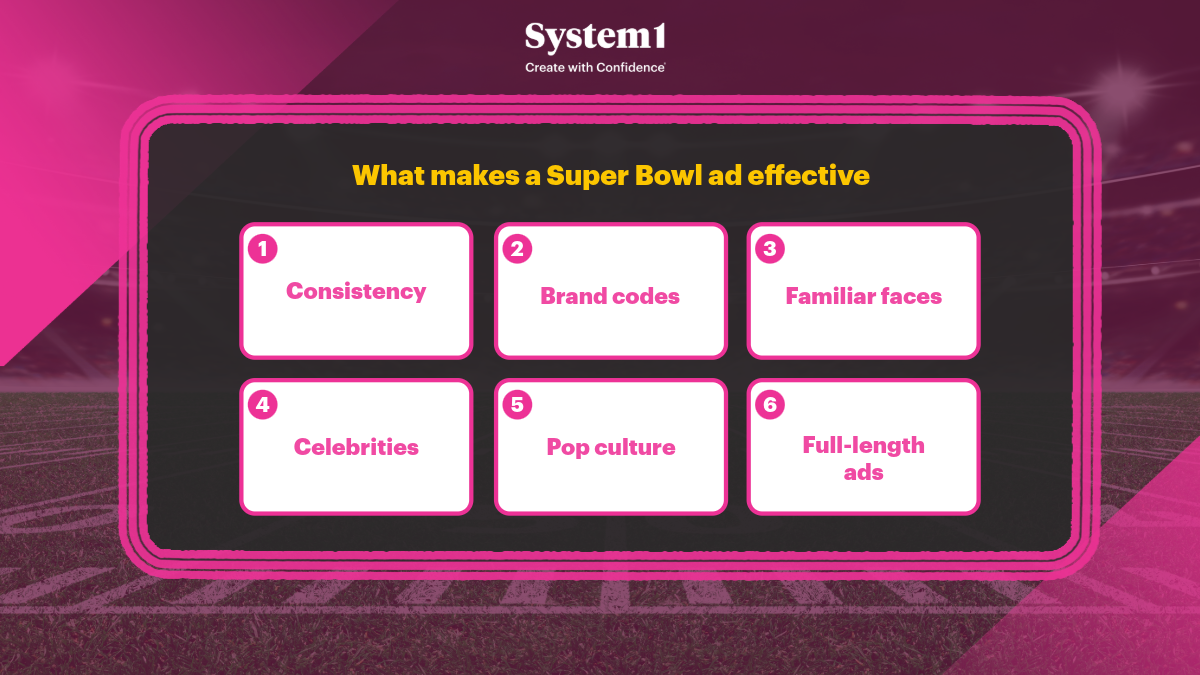
- Consistency: A consistent look and feel may not feel fresh to a lot of marketers hoping to make a splash on Super Bowl Sunday, but it’s one of the surest ways to effectiveness. This could mean the same setting, the same story or a continuation of a previously told one, the same celebrity or the same character.
In 2022, T. Mobile Home Internet introduced Super Bowl audiences to the iconic stars of Scrubs, Zach Braff and Donald Faison. The two went on to star in the brand’s 2023 and 2024 Super Bowl ad, each year building on the same neighborhood theme with new friends joining them to sing new iterations of classic hits. Their 2nd year marked a meaningful effectiveness uplift, with Test Your Ad metrics dramatically increasing for both Star and Spike Ratings.
- Distinctive Brand Codes: As we’ve previously discussed, many brands advertising in the Super Bowl are too shy about branding. From logos to packaging to sonic devices and jingles to characters, brand colors, typeface and slogans, there are plenty of brand codes that marketers can lean into.
Dorito’s fan-created 2025 Super Bowl placed the bag in the lap of the main character right from the first frame. The result was 98% Fluency in System1’s testing.
- Familiar Characters: Fluent devices, recurring characters and scenarios, are often big winners at the Super Bowl. Think E*Trade and its talking baby, the M&Ms spokescandies, the Budweiser Clydesdales. These characters quickly and effectively signal the brand and elicit emotion, supporting short-term effects, long-term impact and brand recognition.
System1’s analysis finds that while fluent devices are not very common (just 16% of ads in 2026 featured them), they drive greater long-term brand building than ads with celebrities (3.4 Stars compared to 2.7 Stars).
- Celebrities: While celebrities haven’t proven to be as effective on average compared to fluent devices, they are still a widely used tool, and can work in a brand’s favor if done right. One of the smartest approaches is to leverage a celebrity consistently, like T. Mobile has done with Braff and Faison or Dunkin’ with Ben Affleck.
If working with a celebrity on a one-off appearance, ensure the story makes sense with them included and plays into their strengths and personality. Hellmann’s “When Sally Met Hellmann’s” reunited Meg Ryan and Billy Crystal in Katz’s Deli, the setting of the famous movie, but still made the brand feel central to the story. The result was a strong Star Rating (long-term potential) and exceptional Spike (short-term potential).
- Pop Culture References: Pop culture references drive positive emotions by leveraging nostalgia and trends consumers know and love. Hellmann’s fits as an example here too, as does Häagen-Dazs’ ad referencing the Fast and Furious film series (strong Star, exceptional Spike) and Tide’s 2018 Super Bowl ad which referenced other well known Super Bowl ads like Old Spice’s “The Man Your Man Could Smell Like.” Tide scored strong on Star and exceptional on Spike and Fluency.
- Full-Length: Because teasers don’t provide the whole story, are intentionally vague and leave the viewer wanting more, they typically don’t perform well in System1’s testing (an average of 2.2 Stars for teasers compared to 2.7 Stars for full length).
Brands should instead opt to maximize the effectiveness of their full-length ad and release it in advance of the game. Increasingly, more brands are debuting their ads 1-2 weeks ahead of game night, giving their ads time to become part of the cultural conversation and wear in. Ads that reward repeat viewing with creative Easter Eggs and surprising elements still leave room for enjoyment on game night even if they’ve been viewed previously.
Real examples: ads that paid off
We’ve pulled some exceptional examples of Super Bowl advertising from System1’s extensive Test Your Ad Competitive Edge database, where you can see how this year’s Super Bowl ads scored as well as Big Game commercials from years past.
- Lay’s: To showcase that its chips are made from real potatoes grown on American farms, Lay’s centered its 2025 Super Bowl ad, called “Little Farmer,” on a young girl living on a farm and attempting to grow her own potato plant. The narrative had ups and downs, creating a dynamic emotional journey that kept audiences engaged and entertained. It also featured a well-matched soundtrack, an effective ‘Showmanship’ feature that drives long-term brand building potential.
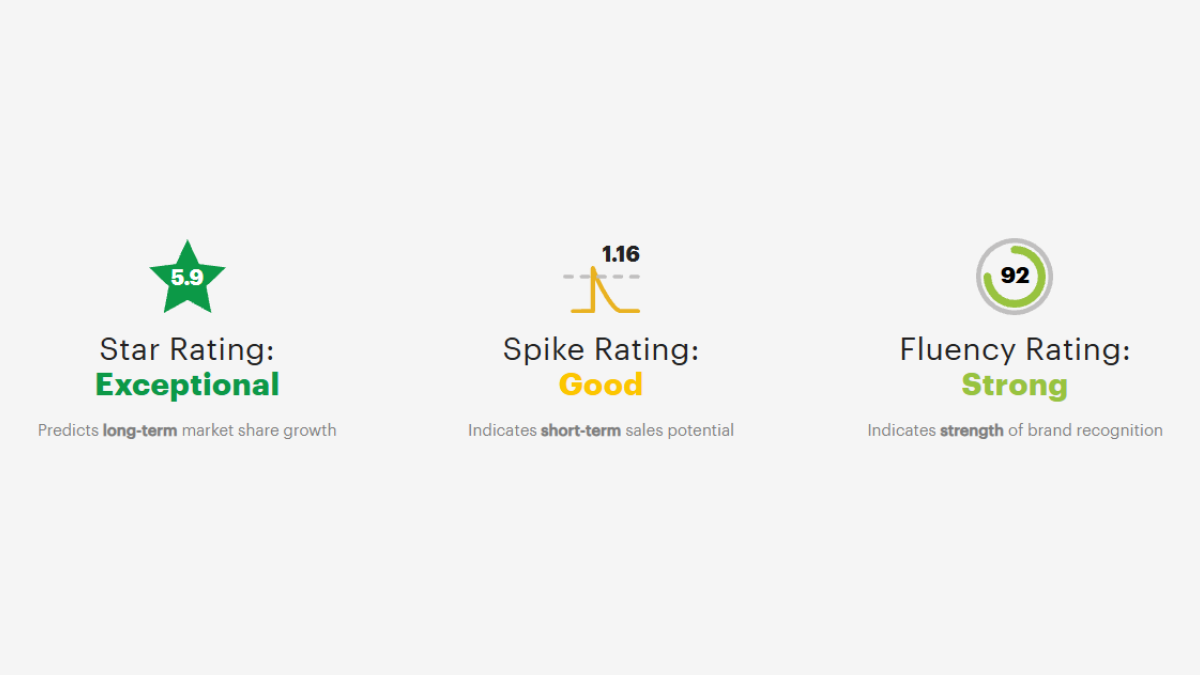
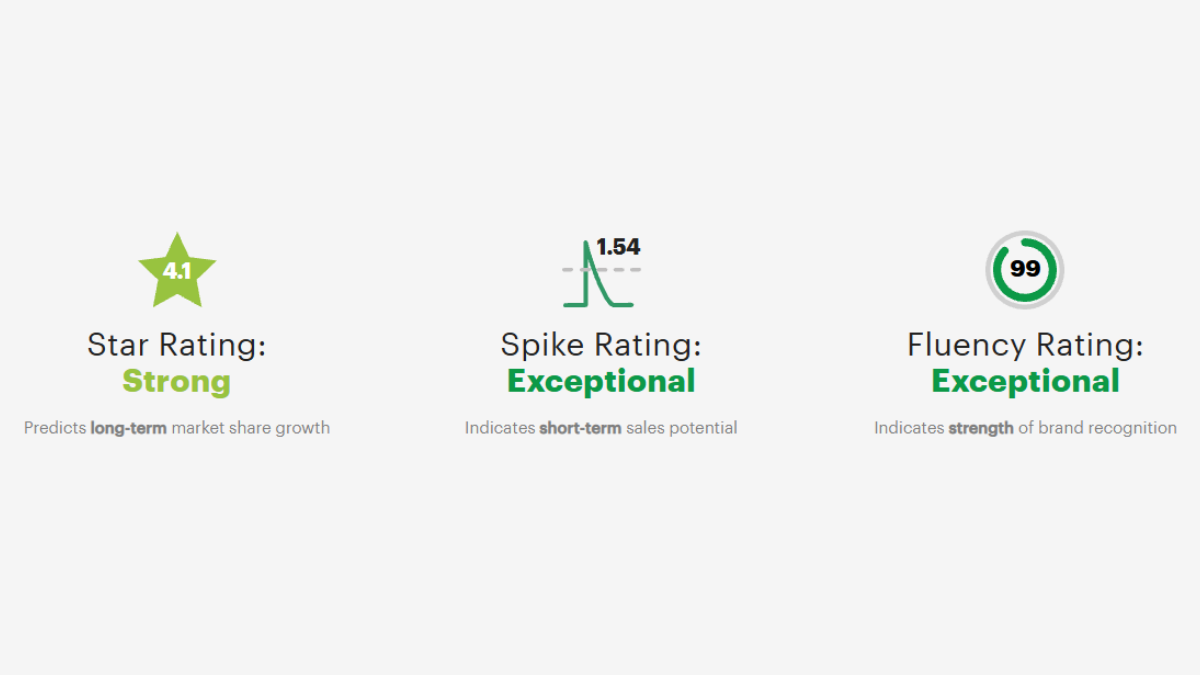
The result is an ad that hit the maximum Star Rating in System1’s testing, good Spike and Strong Fluency.
- Oreo: The 2024 Super Bowl saw Oreo master putting its brand and a customer ritual at the center of its ad, a brilliant move that supported brand recognition. The brand showed pivotal decisions and moments in history, like the Trojan Horse being allowed entrance to the city of Troy, and boy bands getting the green light for record deals, all being decided based on which side of the cookie the cream falls on after twisting the Oreo.
The humorous and distinctive approach secured strong long-term brand building potential, and Exceptional Spike and Fluency.
- Michelob ULTRA: The beer brand brought sports legends to the green with its golf-themed Super Bowl ad in 2023, showcasing the power that celebrities can have when they’re used in the right way as well as cultural references with a nod to the film Caddyshack. The ad featured Serena Williams, Brian Cox and a host of other athletes, including Jimmy Butler, WNBA star Nneka Ogwumike, soccer champion Alex Morgan, boxer Canelo Alvarez and former NFL quarterback Tony Romo.
Michelob has smartly framed itself as a beer brand for those who earn it. Blair Warren, creative director at Wieden+Kennedy noted that the starting point for Michelob is always, “Where else do the players play when they’re not playing?”
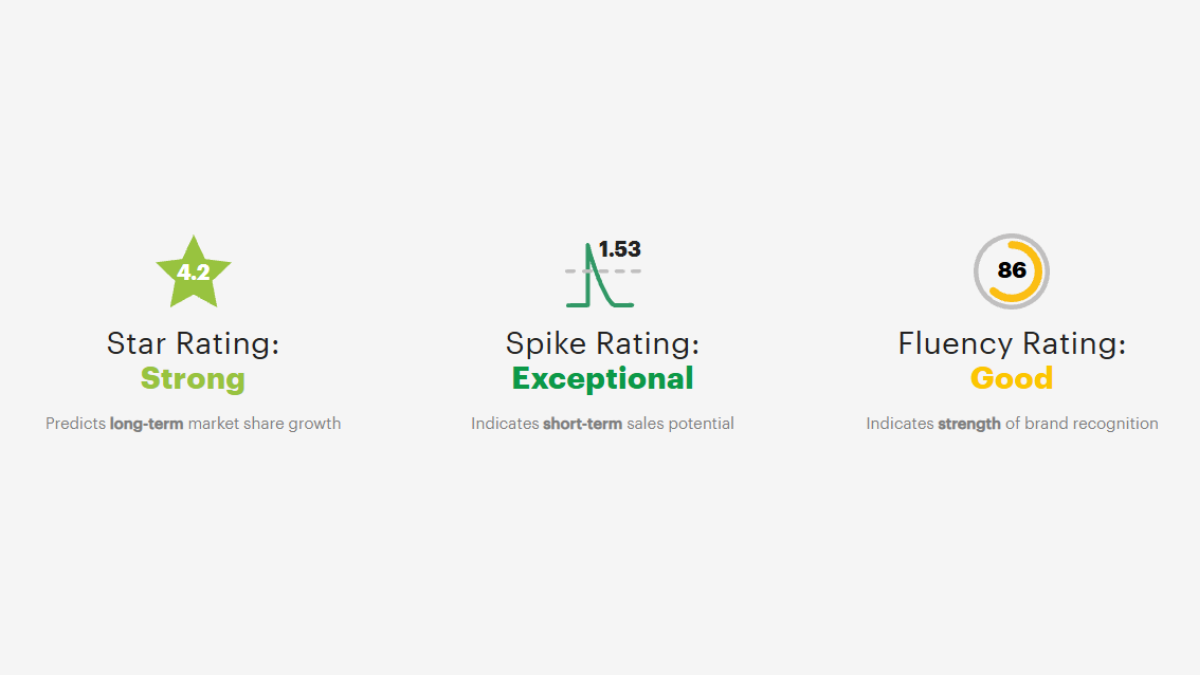
This consistent positioning pays off, with the ad securing a strong Star Rating in System1’s testing, exceptional Spike and good Fluency. The most important lesson: make sure that celebrities don’t outshine your brand when it matters most. They’re in so many ads on game night that it’s a risk to consider when you’re building out your creative brief.
Does celebrity casting guarantee a great Super Bowl ad?
Star power alone isn’t a strategy. A celebrity can’t carry an ad without the creative quality to back their appearance. A famous face should be paired with strong branding, a clear narrative and additional Showmanship edits that will yield an emotional response and engage the right brain, the side responsible for ‘broad-beam attention’ that supports long-term brand building.
Celebrities are certainly popular but they should be used thoughtfully.
Why do some Super Bowl ads get remembered years later?
There are many iconic Super Bowl commercials that are remembered even decades later. These often lodge into long-term memory because they:
- Feature distinctive brand assets like Doritos’/Cheetos’ “Push It”
- Showcase recurring characters like Planters’ ad showcasing the death and rebirth of Mr. Peanut
- Are long-running campaigns that are consistent with the brand’s previous work, like Uber Eats’ “Hungry for the Truth” ad building on its “Football is for Food” campaign
- Apply sonic cues that get stuck in people’s minds and quickly signal the brand, like Budweiser’s “Wassup?” and Mountain Dew’s “Puppy Monkey Baby”
- Use celebrities strategically, like Snickers putting Betty White in the middle of a football game
- Drive an emotional response. The more ads can elicit feeling, the greater their chance for commercial impact.
Does humor work better than sentimentality in Super Bowl ads?
If you’re going to make a Super Bowl ad, you have to be emotional. In The Extraordinary Cost of Dull and The Cure for Dull, System1, eatbigfish’s Adam Morgan and Uncensored CMO’s Jon Evans explore the need for creative to elicit a feeling over no feeling at all.
It’s why System1’s testing is rooted in Paul Ekman’s seven universal emotions, plus neutrality. Feeling helps build mental availability for brands, associations that consumers can rely on when they are ready to make a purchase. As we often say, “entertain for commercial gain.”
A logical next question for marketers is, “which emotional route is the most effective?”
Many Super Bowl ads leverage humor to drive surprise and happiness, positive emotions that support short-term effects and long-term impact. Humor is one of the most effective routes because it appeals to the right side of the brain which appreciates metaphors and seeing things from multiple perspectives.
Humor’s strengths don’t mean that a sentimental approach isn’t as impactful. Plenty of other Super Bowl ads lean into nostalgia. This can be incredibly effective, as sentimental ads can drive a bit of sadness and then resolve them with happiness and even surprise. This makes for a more dynamic emotional journey, which can actually prove more effective than ad that only elicits positive emotion.
No matter which route you choose, it’s best to pre-test creative to see the second-by-second emotional response to the creative. This can help pinpoint areas where positive emotion can be increased or where the emotional journey may benefit from more dynamism.
The bottom line
Why are Super Bowl ads so important?
It’s because they can build fame and drive lasting commercial impact for both category leaders and challenger brands alike. This is true as long as creative is emotional and distinctive and paired with a smart media plan.
Super Bowl advertising can pay off, but the conditions matter more than the price tag. If you’re planning on investing in a Super Bowl commercial, consider the total cost beyond just the main event media buy, understand how your ad performs across short-term and long-term metrics and brand recognition, review whether it is consistent with your previous creative, and determine how you will maximize the lifespan of the campaign ahead of and after game night.
The only way to know creative quality for certain is to test your Super Bowl commercial before game night.
System1’s Test Your Ad platform helps brands and agencies pre-test their creative before it hits screens on gameday, providing you with predictive metrics on long-term brand building potential, short-term sales potential as well as a read on brand recognition. Test Your Ad can test from early-stage versions of your advertisement to finished films, enabling you to test early and often with different iterations as your creative process progresses.
Want to see how this year’s ads rated?
System1’s Test Your Ad Competitive Edge database of more than 150,000 ads provides category benchmarks and a closer look at what it takes to stand out at the Super Bowl. Access your own ad reports in addition to the competition’s to pinpoint what’s working, areas of optimization and more.