“You’re not everybody”: the phrase that ends arguments now sells… sandals
There is a phrase that ends negotiations with children anywhere in the world, with no appeal and no reply. It tends to be said a second before the child realizes the conversation is over: “You’re not everybody.”
Now imagine that phrase coming from a child. In Ipanema’s new film, it is the little ones who say it. And it is the adults who get the ticking-off.
The ad, from AlmapBBDO, launches the Sempre Nova range, with a series of styles for women, children, and babies. Tested with our Test Your Ad, the ad achieves a high score of 4.3 Stars, against a Brazilian TV average of 2.7. That puts the film among the top 10% of ads in the country, with above-average Fluency: 89% of people recognize the brand.
Humor and Surprise
This year in Cannes, Adam Morgan (eatbigfish) and Jon Evans (Uncensored CMO), with data from System1 and contributions from Peter Field, Karen Nelson-Field, and Orlando Wood, argued that Surprise is one of the most powerful strategic tools there is, and that almost nobody treats it that way.
What happens in the brain: Surprise amplifies emotion by around 400% and lasts only a fraction of a second (something like 1/125 of a second). In that instant, it focuses attention and then imprints the moment on memory. The mechanism is simple: the brain only pays attention to what it did not predict.
Surprise that changes behavior picks a belief and dismantles it. Ipanema’s limiting belief could be: sandals are all the same, and wearing what everyone else wears is normal. Ipanema challenges the norm with a familiar cultural phrase that creates interest and even a certain tension, much like a plot twist. In the test, we can see that the 21% Surprise, together with all the positive verbatims, captures attention and makes room for Happiness, humor, and irony.
And humor has mechanics. One of them is the break in prediction. The brain guesses what comes next. When the twist arrives and the surprise lands, it leaves autopilot and enters a more intense, more pleasurable state.
Another is holding two truths at the same time. The phrase remains the telling-off everyone knows and, at the same time, becomes a provocation aimed at the adult. This kind of double reading is the territory of the brain’s right hemisphere, and purely literal communication cannot deliver it.
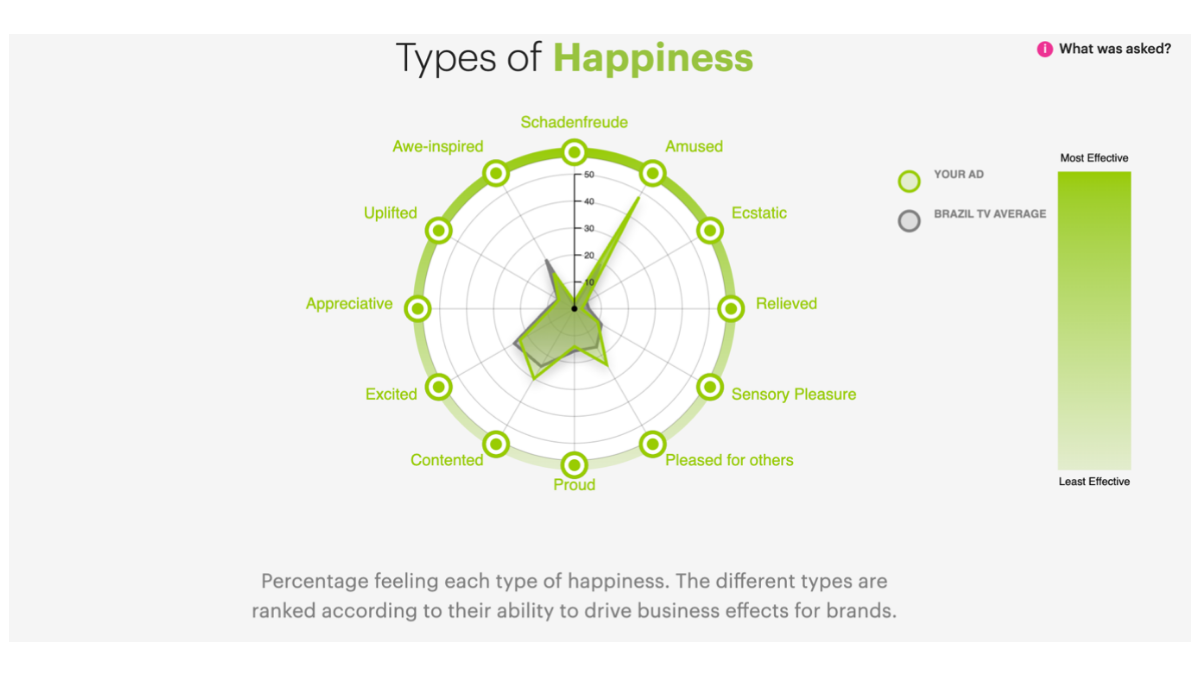
The third is letting the audience complete the joke. Recognizing the situation, reading the characters, and spotting the twist is part of the fun. Viewers are not receiving a message; they are taking part in it. In the test, we see this in the emotional journey, where it is possible to capture the moment the audience reacts with surprise to the role reversal and the double meaning, and, zooming in on Happiness Types, a predominance of “Amused.”
But Surprise is not one thing only. There is the short “oh” and the long “ohhh.”
The short “oh” is the narrative unexpected. The benefit is attention and memorability, and the memory stays tied to the execution.
The long “ohhh” changes the person’s relationship with the brand or the category. The benefit is a shift in attitude over the long term.
Ipanema’s film seems to have both. The child saying the phrase is a short “oh”: nobody expected to hear that from a child. The question that comes with it, “why do you wear the same as everyone else?”, reaches for the long “ohhh,” because it challenges the person’s relationship with the status quo. That is one of many possible readings, and whether this long “ohhh” is fulfilled, only time and consistency can tell.
And if we are talking about irony, there is one about budgets. The adman Greg Hahn put it this way: you don’t have the budget to be boring. Anyone trying to be remembered on a small budget needs more surprise, not less.
"In a market with so many options, we believe Ipanema’s role goes beyond the product: it is to encourage authenticity and to keep pace with the many ways Brazilian women express themselves. That is only true because the brand has spent years building a broad and diverse product portfolio.
“Você não é todo mundo” (“You’re not everybody”) captures exactly that: the recognition that there is no single way to be, to dress, or to live. The campaign brings this message to life in a way that is ownable and creative, with just the right touch of daring.
It is a powerful and genuine cultural insight, and it delivers exactly what we were looking for in this new moment: distinctiveness, boldness, and emotion. “Você não é todo mundo” marks this turning point for Ipanema and is the starting point for everything that comes next."
Daiane Fischer, Brand and Communications Manager
Ipanema
"When we look at performance among the core audience, we see very strong results across all three metrics — an especially significant achievement for a brand relaunching with a new positioning, a new language, and challenging category conventions.
It shows that when a brand finds a genuine connection between its differentiators, people’s behavior, and the ability to reshape codes, it doesn’t just capture attention: it generates emotion, builds memorability, and earns a space of its own. This is the differentiator we want to keep strengthening for Ipanema within the category."
Curious to learn more? Get in touch with Renata Buess
Create 5-star ads
The more people feel, the more they buy
The most effective ads boost sales and drive long-term growth. They do it by making people feel more - building positive associations with a recognisable brand. We predict sales and growth impacts by measuring emotion, letting you make ads that entertain for commercial gain.