“Don’t forget my Caloi” became a meme before social media even existed, trending for years on end and becoming a neat way of reminding someone about anything at all.
In October this year, Caloi launched a film with a distinctly 1980s feel, made entirely of photographs and featuring an ending familiar to everyone who grew up renting VHS tapes: having to rewind the tape before returning it. And all this in a market where everyone is chasing the latest format and the platform of the moment.
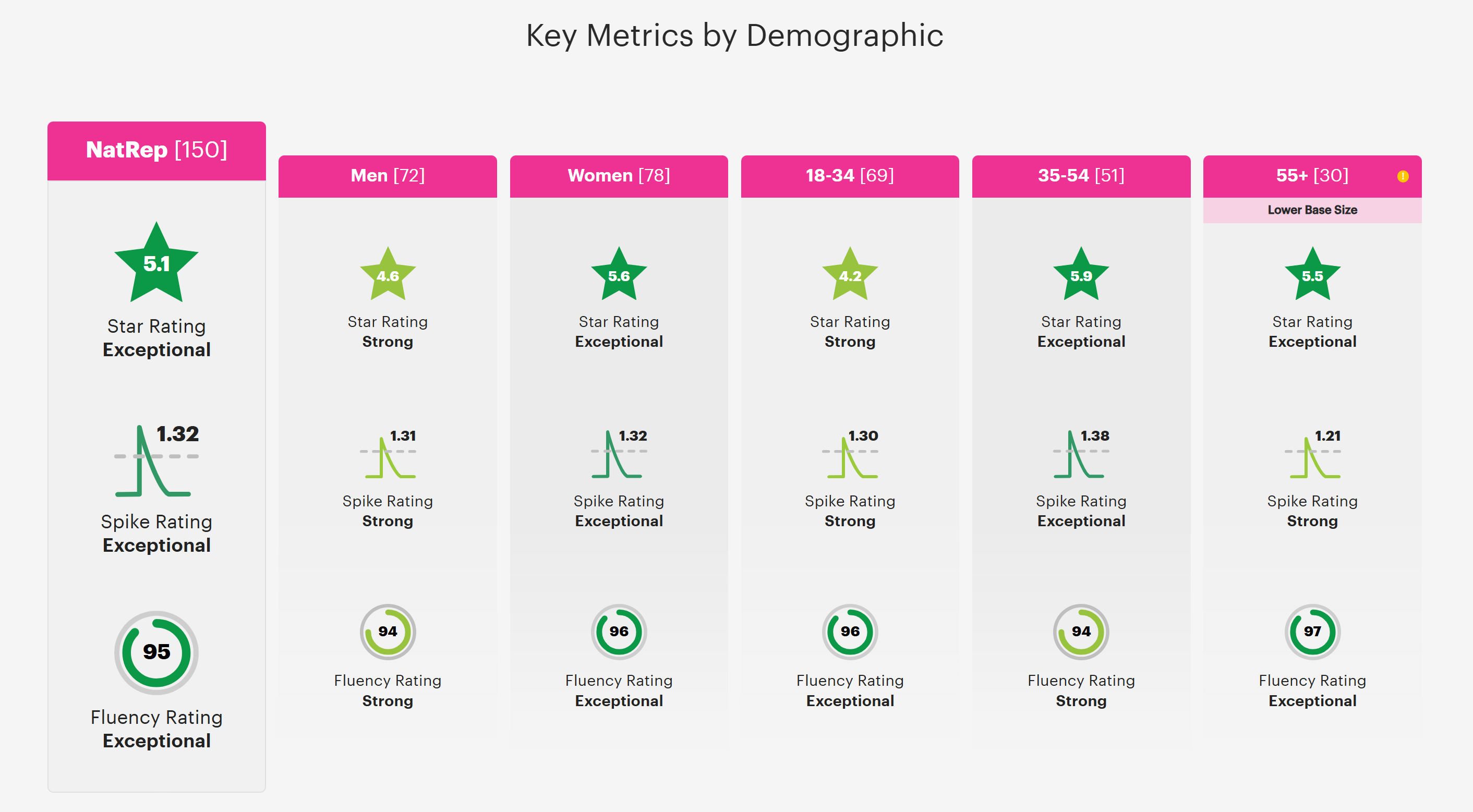
In Test Your Ad Pro, the film achieved 79% Happiness, against a Brazilian average of 53%. Emotional Intensity was 2.49, against a norm of 1.96. It scored 5.1 Stars, indicating long-term growth potential, while Spike and Brand Fluency were also Exceptional. A rare triple crown.
An ad that looks backwards has won on every front in an industry that is often fixated on the future, almost like a cult. The advertising world is obsessed with novelty: new campaigns, new positioning and new platforms. But often, the most effective advertising emerges when brands look to their legacy of campaigns and brand assets to revive earlier successes. Frequently, this involves reinventing them in new ways.
When the psychologist Daniel Kahneman won the Nobel Prize in Economics, he brought forward evidence that the more we feel, the more we buy. That motto was, and still is, embraced by the most effective agencies and brands. We know that emotion sells and that nostalgia is a vehicle for it. But that’s not to say nostalgia-core is here to stay.
The children of the 1980s, now around 45, were the ones who wanted to leave the house and ride their bikes, feel the wind in their hair, meet their friends and set off on an adventure.
Forty years on, those children are parents, and some are even grandparents. The campaign makes an almost imperceptible shift: the line becomes “Don’t forget your child’s Caloi”. The Caloi ad now rewinds the tape but speaks to the adult rather than directly to the child. This keeps it, in principle, out of the more sensitive territory of advertising regulations. It’s an interesting angle: using nostalgia as a strategy to reach children through the adults who make purchasing decisions. The same message has a new recipient. The child who used to ask is now the adult who decides, and the consumer’s memory stops being merely a recollection and becomes a purchasing instruction for the next generation.
But what actually happens inside someone who remembers? I have covered this in another analysis, but there is more research worth exploring, which the strategist Richard Shotton also frequently references. Jannine Lasaleta, Constantine Sedikides and Kathleen Vohs conducted six experiments published in the Journal of Consumer Research. Participants placed in a nostalgic state were willing to pay more for products, spent more money (but not more time) and placed less value on money. The authors’ explanation: nostalgia weakens the desire for money because it creates a feeling of social connection.
Looking at the Test Your Ad results for Caloi, we can see that nostalgia takes people back to a time when their decisions were based less on price and more on feeling. The memory surrounds the consumer with loved ones, and the same familiar people, places and objects appear in almost everyone’s recollections: family, friends, the street and the bicycle. In the comments, people talk about their own childhood adventures and how children today need to play outdoors. The ad acts as a door, and each person walks through it to reach their own story.
It is worth heeding Byron Sharp’s caution: these experiments are laboratory-based and measure willingness to pay, not sales. It is a plausible and well-documented mechanism, not a promise of margin. But our test suggests that Caloi stands to reap the rewards, both now and in the future.
Here, though, I want to highlight the central idea of System1’s study, The Magic of Compound Creativity: creativity doesn’t add up, it accumulates. Every ad that uses the same assets, characters, tone and codes inherits the memory of those that came before it. Caloi has an asset with four decades of accrued interest.
But an old asset, repeated in the same way, becomes tiresome. This is what Sarah Carter’s idea of “disguised repetition” helps us to understand. The message stayed the same – “get out of the house and play” – but the outfit changed. The recipient, the line and the context all changed, while retaining the familiar feel that allows the brain to recognise the origin.
The results are evident across all the metrics, but Brand Fluency is particularly noteworthy at 95%, meaning only one in 20 viewers failed to correctly identify Caloi as the advertised brand. Our report always highlights the Distinctive Brand Assets identified by consumers, and here, the setting, logo and style were recognised as especially distinctive. The dominant spontaneous associations were “Bicycle”, “Childhood” and “Nostalgia”. The old memory became a code for instant recognition.
People are moved by bonds, which are generated by memory, which in turn is generated by emotion.
For those who lead brands, memory is a financial asset, and the brand is the manager of that portfolio. Every old campaign is a bond in the portfolio, with accumulated value in people’s minds.
Again, this is not about falling into nostalgia-core. It is about asking: what memories of my brand already exist in people’s minds, and am I treating them as heritage or as clutter?
Not every brand will have a campaign from the 1970s, 1980s or 1990s to pay tribute to. But every brand has assets, characters, phrases, slogans and images that someone, at some point, once loved. Many of those consumers are now adults with purchasing power and… fond memories.
Nostalgia takes people back to a time when their decisions were based less on price and more on feeling. Caloi looked to its legacy, remembered those who once loved it and asked them to pass that love on. What looked like a glance backwards was, in fact, a decision aimed at the brand’s future – and something almost impossible to copy.
"Childhood has changed, but some things remain essential. Playing, exploring, meeting friends, feeling the freedom of riding a bike and discovering the world beyond screens are experiences that belong to a childhood worth living. Caloi has accompanied generations of Brazilians and, with this new campaign, we want to invite parents to rediscover a little of their own childhood and give their children those same experiences. 'Don't forget your child's Caloi' is more than a campaign: it is an invitation for families to choose to spend more moments together, outdoors and on the move."
Ana Paula Nogueira
Senior Marketing and Trade Manager at Caloi
“The data from System1 confirms what our intuition told us: the emotional connection of this classic Caloi campaign would have the power to transport those children of the 70s, 80s and 90s back to their own childhood. It was a small change in the message to connect with this target once more. In the end, emotional connection is perhaps the most effective tool for building brands and businesses.”
Filipe Cuvero
CCO & Founding Partner at D'OM Soluções Improváveis
Create 5-star ads
The more people feel, the more they buy
The most effective ads boost sales and drive long-term growth. They do it by making people feel more - building positive associations with a recognisable brand. We predict sales and growth impacts by measuring emotion, letting you make ads that entertain for commercial gain.