"So much marketing thought is recycled. But this research stands out with genuinely original thinking and big ideas. And the best bit is that these ideas are brilliantly explained and immediately applicable. A book that cannot and should not be ignored.”
In a world where marketing budgets are increasingly scrutinized, media is fragmented, and short-term metrics often overshadow long-term growth, marketers require a modern advertising playbook that addresses challenger brands and category leaders alike. One that proves the combined power of creative quality and media support, with tools for maximizing brand and business effects, and enhancing confidence in advertising’s ability to drive profit.
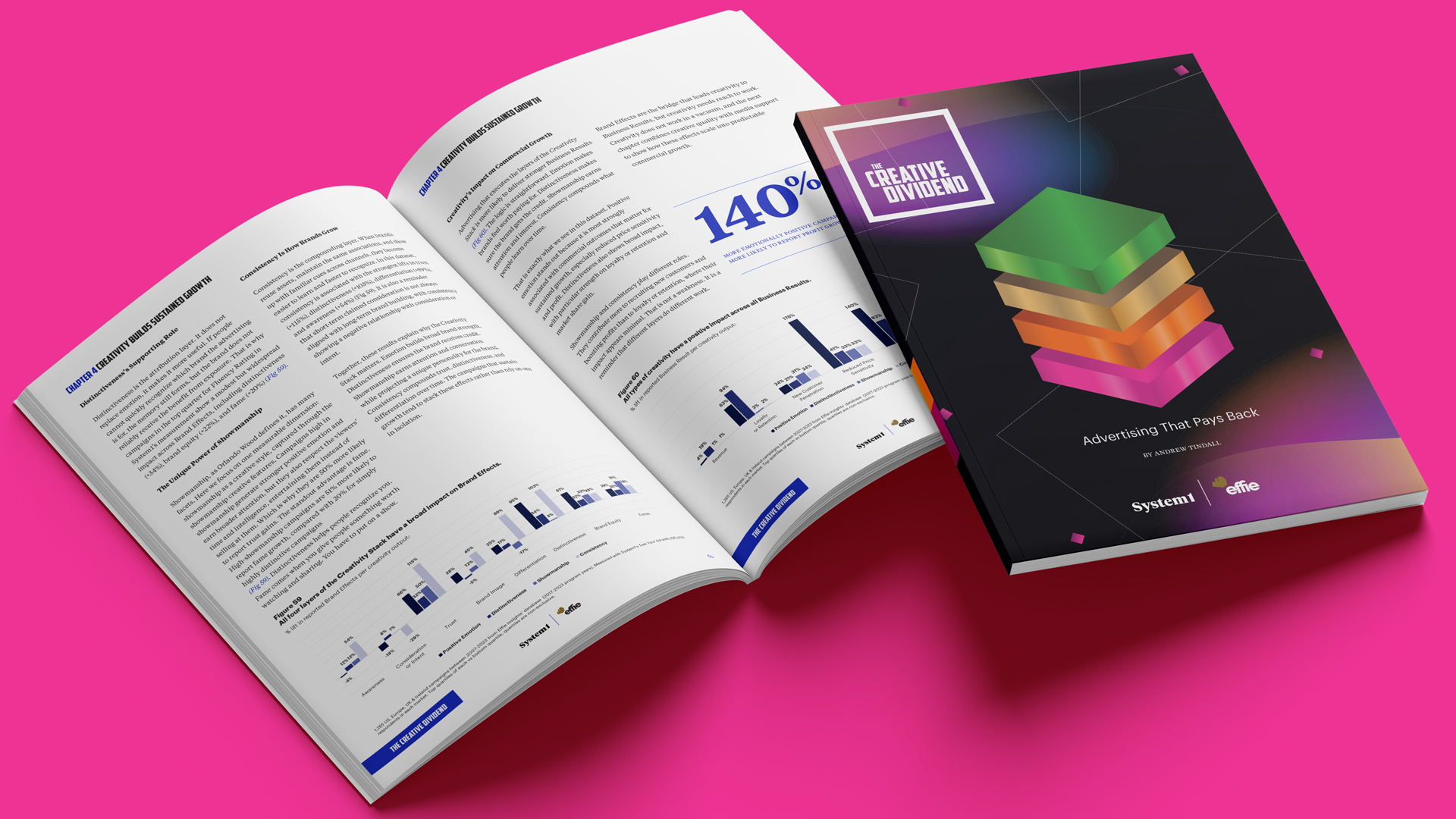
Introducing The Creative Dividend from System1 and Effie, a practical guide for making advertising predictable, effective and a priority investment.
This new book brings together large-scale effectiveness case evidence (1,265 campaigns across the U.S., Europe, UK, and Ireland, representing $139 billion in market share) and creative measurement (consumer responses from more than 200,000 people), derived from:
Effie Insights,the world’s most comprehensive database of award-winning effectiveness cases. Structured around the Effie Framework and enriched with expert analysis covering every category, channel and region.
The Creativity Stack:great advertising is built layer by layer. The book introduces a practical framework for improving creative effectiveness across four proven dimensions—Emotion, Distinctiveness, Showmanship, and Consistency—showing how each contributes to stronger business impact when thoughtfully developed.
Creativity and media do not work in isolation. When planned together, the two account for 60.1% of campaign Business Results on average, and as much as 98.3% in certain categories. The book shows how to diagnose whether teams should focus on the work, increase support, or scale what’s already winning.
Profit does not rise linearly, it accelerates. The book introduces Excess Share of Creativity (ESOC), which captures how much creative advantage enters the market once media support is considered. As ESOC rises, the likelihood of reporting profit growth increases exponentially, demonstrating why “good enough” creative is often the most expensive choice.
The barrier is not belief, it is confidence. While most marketers say creativity matters, 41% say it is seen as a risk. The Creative Dividend provides case evidence, shared language, and diagnostics to help teams make confident, effectiveness-led decisions.
Improve creative quality, defend investment in advertising and make advertising a more dependable driver of growth. Complete the form to download The Creative Dividend today.
Get in touch with System1 about creative testing here.
In this webinar, Andrew Tindall, Chief Growth Officer at System1 and author of The Creative Dividend, walks through the book’s findings and shows how brands can improve creative quality, defend investment in advertising, and make advertising a more dependable driver of growth.
FAQs
What is The Creative Dividend?
The Creative Dividend is a book from Effie and System1 that shows how creative quality and media support work together to drive advertising’s Business Results. It links Effie Insights’ database of effectiveness case studies with System1’s Test Your Ad creative measurement data to show, for the first time at this scale, how the two combine to make advertising a reliable, repeatable driver of growth.
Methodology
The research analyzed 1,265 campaigns from Effie Insights’ database across the US and Europe (823 and 442 campaigns respectively), spanning B2C and B2B brands and representingnearly $140 billion in category revenue. Each campaign was linked to System1’s Test Your Ad Competitive Edge database, with long-form assets tested among close to 200,000 respondents to measure creative quality. 49% of campaigns used TV as their primary touchpoint.
Why Do Creativity and Media Need to Be Considered Together?
Because their effects in market are inseparable. The research found that creative quality and media support together explain 60.1% of reported Business Results from advertising. Marketers who can recognize when a campaign is more creative than its category peers, and back it with proportionate media investment, make advertising predictable and repeatable rather than a gamble. The relationship isn’t linear, either. It’s exponential. As creative advantage increases, the odds of profit growth accelerate rather than climb steadily.
Why Are Marketers Losing Confidence in Creativity?
A 2025 global survey of 386 marketers across the US, Europe and APAC found that around half report low confidence in advertising’s ability to deliver effectiveness, and four in ten are unsure their team can use creativity to achieve it. 41% say creativity is seen as a risk to the business. This isn’t a knowledge gap,it’s a confidence gap, and it leaves teams most exposed at the exact moment judgment matters most: deciding whether the work is strong enough to back with real media weight.
What Is the Creativity Stack?
The Creativity Stack is the book’s framework for defining and measuring creative quality. It’s made up of four layers that consistently boost effectiveness:
Emotion:the starting point of effective advertising; emotional campaigns build stronger memories and outperform rational ones, especially for long-term growth.
Distinctiveness:how easily and correctly people recognize the brand in an ad, measured by System1’s Fluency Rating (the average across Effie Insights’ database is 81%).
Showmanship:the narrative, character and entertainment craft (drawing on Orlando Wood’s research) that makes an idea worth watching and drives broader attention and emotion.
Consistency:how disciplined a brand is over time in its positioning, creative execution and distinctive assets, measured by the Compound Creativity Score.
All four layers are declining industry-wide, which the book links directly to advertising’s declining brand-building power.
What Is “The Cost of Dull”?
Neutrality, feeling nothing at all, is the clearest signal of dull advertising, and it’s expensive. Campaigns that generate more neutrality than their category peers see campaign-spend returns that are 40% lower. The most dull campaigns in the dataset averaged a $4.40 ROI, compared to $7.10 for the least dull. Some categories (pharma, B2B, finance) trend more neutral than others (food & drink, retail, travel), but the book argues this is a choice, not an inevitability. Any category can be made interesting with creativity.
What Are the Creative Dividend and Excess Share of Creativity (ESOC)?
Creative Dividend:measures how creatively advantaged a campaign is relative to its competitors, combining its relative emotion, distinctiveness, showmanship and consistency into one score.
Excess Share of Creativity (ESOC):extends this by factoring in media support: ESOC = Creative Dividend × Media Spend. It captures how much creative advantage a campaign actually brings into the market once its media weight is accounted for. Creative Dividend alone predicts market share growth well, but ESOC is what predicts profit. As ESOC rises, the likelihood of reporting profit growth increases exponentially. This is why “good enough” creative paired with weak media support is often the most expensive choice a brand can make.
How Much of Business Results Can Creative Quality and Media Support Explain?
Across categories, including both B2C and B2B, creative quality and media support together explain between 40.5% and 98.3% of reported Business Results, depending on the category. B2B (Insurance & Professional Services), for example, saw creative quality and media support explain 84.5% of Business Results, showing that B2B does not get a “free pass” on creative quality.
Does Distinctiveness Actually Drive Revenue and Profit?
Yes, but its role is specific. Distinctive advertising makes media spend more efficient at turning into revenue. Campaigns with above-average distinctiveness and an extra-large budget are 29 percentage points more likely to report revenue growth than less distinctive ones at the same spend level. On its own, though, distinctiveness is a weak predictor of profit. Profit comes when distinctiveness is paired with positive emotion: at small spend levels, campaigns strong in both are 7x more likely to report incremental profit than those weak in both.
How Does Consistency Compound Creativity?
The book’s Compound Creativity Framework measures consistency across three dimensions — Consistent Creative Foundations (holding the same positioning, idea and creative team), a Culture of Consistency (stretching campaigns across time and channels), and Consistent Creative Execution (maintaining the same look, feel and distinctive assets). Measured across 139 US and UK brands over five years, consistency was found to have an exponential impact on Business Results. Yet brands have become 25% less consistent over the past decade, as the industry chases new ideas, tools and channels over sustained brand-building.
Do Challenger Brands and Category Leaders Grow the Same Way?
No. Category leaders are more likely to grow share in flat or shrinking categories and can often spend less than competitors there with minimal impact on growth odds. Challenger brands, by contrast, are more likely to grow in expanding categories, but are penalized more heavily for underspending. They need to match or exceed competitor media investment to compete. When challenger brands do invest sufficiently in growing categories, their odds of reporting profit growth rise substantially.
What Does The Creative Dividend Recommend Marketers Do With This?
Improve creative quality using the Creativity Stack, defend investment in advertising with evidence rather than instinct, and use ESOC to diagnose whether underperformance is a creative problem, a media problem, or both. The book argues advertising effectiveness isn’t mysterious. It’s the outcome of disciplined creative practice, supported by confident, proportionate media investment.
Get in touch
Want to make 5-Star Marketing? Need to understand your customers better? Interested in knowing more about anything we do?